ARC 2701 Baroque and Rococo Architecture Italian, French, and Germanic
 Call Kai
 Learn
 Practice Test
 Spaced Repetition
 Match
 Flashcards
 Knowt Play
1/30

There's no tags or description
Looks like no tags are added yet.
31 Terms
The ___ is a style of architecture, music, dance, painting, sculpture, and other arts that
flourished in Europe from the early 17th century until the 1740s. It was encouraged by the Catholic
Church as a means to counter the simplicity and austerity of Protestant architecture, art, and music.
Baroque
The Baroque is a style of architecture, music, dance, painting, sculpture, and other arts that
flourished in Europe from the early 17th century until the 1740s. It was encouraged by the ___ ___ as a means to counter the simplicity and austerity of Protestant architecture, art, and music.
Catholic Church
The Baroque style used contrast, movement, exuberant detail, grandeur, ___, and surprise to achieve a sense of awe.
theatricality
The style employs:
1. plentiful and intricate ___
2. strong flowing ___ (ovals and arcs more than complete circles)
3. ___ of proportion and geometry for dramatic effect
4. intermingling of ___ and ___ elements (the art spills out and across the architecture boundaries)
ornamentation, curves, distortions, art, architectural
___ = a form of illusionistic mural painting in which images of
architectural features are painted onto walls or ceilings so that they seem
to extend the real architecture of the room into an imaginary space beyond
the confines of the actual wall or ceiling. Uses trompe-l'œil paintings in
stucco frames, either real or painted, crowded with saints and angels and
connected by architectural details
Quadratura
the Baroque ceiling paintings were carefully created so the
viewer on the floor of the church would see the entire ceiling in correct
___, as if the figures were real.
perspective
A leading artist / sculptor of Italian Baroque was: ___
Bernini
___ and ___ are common motifs in Baroque art.
Clouds, sun rays
The ___ were large plaques carved of marble or stone, usually oval and with a rounded surface, which carried images or text in gilded letters,
cartouche
The ___ ___ is one of
the signature features of the
Baroque.
twisted column

Renaissance Architecture – Late Renaissance - Mannerism
Giacomo della Porta
Sant Andrea della Valle
The leading architects of Italian Baroque were:
___, ___, ___
Bernini, Borromini, Guarino Guarini
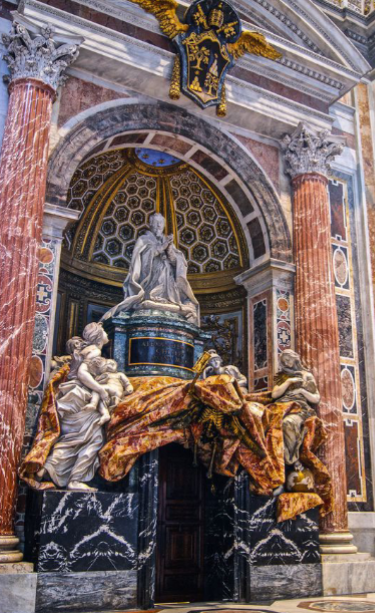
___ of art and architectural elements
, strong flowing ___
intermingling, curves

Bernini, Baroque Architecture
Chair of St. Peter

Bernini, Baroque Architecture
Piazza of St. Peter’s

Bernini, Baroque Architecture
Piazza of St. Peter’s
Baroque architects sometimes used forced ___ to create ___.
perspective, illusions

Bernini, Baroque Architecture
Scala Regia
For the ___ the stair tapers in plan and in section to exaggerate the depth and ___.
Scala Regia, importance

Bernini, Baroque Architecture
Scala Regia
In Baroque sculpture, groups of figures assumed
new importance, and there was a ___
movement and energy of human forms— they
___ around an empty central vortex, or
reached __ into the surrounding space.
dynamic, spiraled, outwards

Baroque Architecture - Italy
Trevi Fountain
___: ovals and arcs more than
complete circles
strong curves

Borromini, Baroque Architecture - Italy
San Carlo alle Quattro Fontane

Guarino Guarini, Baroque Architecture - Italy
Palazzo Carignano
___, also referred to as "Late
Baroque" is an 18th century style which
developed as Baroque artists gave up
symmetry and became increasingly more
ornate, florid, and playful.
Rococo
The following are characteristics that ___ has, and Baroque does not:
1. The partial abandonment of symmetry, everything being composed of graceful
lines and asymmetric curves.
2. The very wide use of nature as inspiration for ornament; flowers, vines, shells, etc.
3. Pastel colors (whitish-yellow, cream-colored, pinks, light blues).
Rococo
The following are characteristics that Rococo has, and Baroque does not:
1. The partial abandonment of ___, everything being composed of graceful
lines and asymmetric curves.
2. The very wide use of ___ as inspiration for ornament; flowers, vines, shells, etc.
3. ___ colors (whitish-yellow, cream-colored, pinks, light blues).
symmetry,nature, Pastel

Balthasar Neumann, Rococo Architecture
Amalienburg
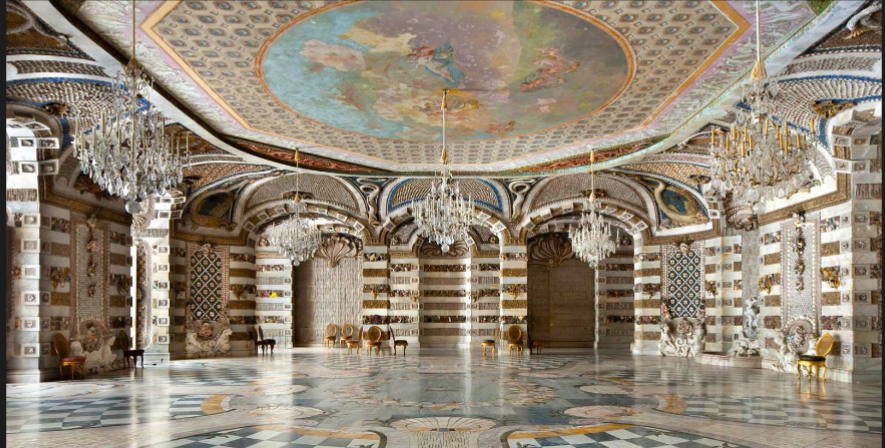
Rococo Architecture
Grotto Hall, at The New Palace
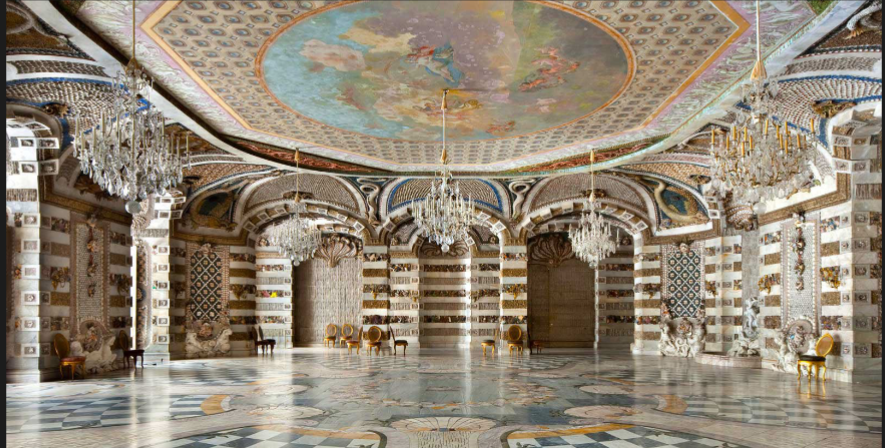
walls encrusted with ___, ___, ___, ___, and semi-precious stones
shells, stones, marble, quartz