10. Assessment of amblyopia
 Call Kai
 Learn
 Practice Test
 Spaced Repetition
 Match
 Flashcards
 Knowt Play
1/39

There's no tags or description
Looks like no tags are added yet.
40 Terms
What symptoms should you expect in a patient with amblyopia?
Most patients have no symptoms because the better eye compensates. Possible complaints include:
Blurred vision
Eye rubbing or squinting
Headaches
Asthenopia
Why is amblyopia clinically significant beyond reduced visual acuity?
Amblyopia can cause:
Nearly double the lifetime risk of bilateral visual impairment
Limitations in occupations with visual requirements
Visual-motor deficits
Slow or impaired reading with increased saccades
Reduced quality of life
Slower completion of visually demanding tasks
What visual-function abnormalities may be associated with amblyopia?
Major associated deficits include:
Reduced visual acuity
Accommodative and oculomotor dysfunction
Reduced contrast sensitivity
Impaired spatial judgment
Unsteady or inaccurate monocular fixation
Increased contour interaction
Positional inaccuracy or distortion
Distortion of retinotopic maps
What is the crowding phenomenon in amblyopia?
Crowding is disproportionately poorer recognition of an optotype when it is surrounded by nearby contours or other optotypes compared with when it is presented alone.
It represents abnormal contour interaction, in which neighboring contours interfere with identification of the target.
What mechanisms are thought to produce abnormal crowding in amblyopia?
Proposed mechanisms include:
Abnormal or excessive lateral inhibition
Abnormally large receptive fields
Abnormal eye movements
These mechanisms cause confusion between the target and its surrounding contours.
In which type of amblyopia is crowding especially prominent?
Crowding is generally greater in strabismic amblyopia.
Approximately 66% to 90% of strabismic amblyopes demonstrate abnormal crowding or contour interaction.
Why can isolated optotype acuity overestimate vision in amblyopia?
An isolated optotype removes the surrounding contours responsible for crowding, allowing the patient to perform better than under real-world or full-chart conditions.
Therefore, amblyopia testing should use:
A full chart, or
Single optotypes with crowding/surround bars
What features should a good visual acuity test for amblyopia have?
It should include:
Enough lines to measure reduced acuity
LogMAR progression
Equal numbers of optotypes per line
Optotypes of similar difficulty
Contour interaction through a full chart or crowding bars
Acuity should not be based on isolated, uncrowded letters or symbols.
Which optotypes should be used to assess amblyopia at different ages?
Children younger than approximately 7 years: LEA or HOTV
Older children and adults: ETDRS or Sloan letters
Standardized pediatric examination: ATS HOTV
Regardless of age, use a full chart or optotypes with crowding bars and LogMAR progression
Which acuity tests should be avoided when evaluating amblyopia?
Avoid tests that use isolated, uncrowded letters, symbols, or lines without contour-interaction bars.
Examples listed in the slides include:
Allen figures
Sjögren hand
Sailboat or lighthouse charts
Tumbling E
Landolt C
Nonstandard Snellen presentations
What must be ruled out before attributing reduced visual acuity to amblyopia?
Rule out an ocular or optical explanation, including:
Uncorrected refractive error
Corneal distortion
Ocular media abnormalities
Ocular pathology
Refraction, ocular health testing, and, when appropriate, multiple-pinhole testing help distinguish these causes.
Why should HOTV and ETDRS acuities not be treated as perfectly interchangeable in amblyopia?
Compared with ETDRS, crowded HOTV may:
Overestimate acuity by approximately 0.68 lines in the amblyopic eye
Overestimate acuity by approximately 0.25 lines in the better eye
Underestimate the interocular acuity difference by approximately 0.4 lines
The discrepancy is most relevant when acuity is worse than approximately 0.3 logMAR.
What is the overall structure of the ATS HOTV visual acuity protocol?
The ATS protocol uses:
Screening
Phase I
Reinforcement if needed
Phase II retesting
Assignment of acuity as the lowest level passed
It uses single HOTV optotypes with surround bars.
How is the screening portion of the ATS acuity protocol performed?
Begin at approximately 20/100 or 20/400, depending on the protocol or patient.
Present progressively smaller optotypes.
Continue until the patient misses an optotype.
How is Phase I of the ATS protocol performed?
Begin 2 LogMAR levels larger than the level missed during screening.
If the patient reaches 20/20 during screening, begin Phase I at 20/30.
Continue toward smaller optotypes.
A level is passed with 3 of 3 or 3 of 4 correct.
What happens if a child misses two letters at an ATS acuity level?
Provide reinforcement by showing three larger letters.
Then proceed to Phase II, in which the last level missed during Phase I is presented again.
If passed, continue to smaller levels.
Stop when the patient fails a level.
Recorded visual acuity is the smallest level passed in Phase I or Phase II.
What practical techniques improve the reliability of pediatric amblyopia acuity testing?
Use a matching or lap card
Watch carefully for peeking
Confirm that the child is looking before presenting the optotype
Use encouragement and reinforcement
Allow the child’s best attempt
To reduce fatigue, show one optotype per line until a miss, then move up two lines or to 20/30 and test threshold formally
How can vision be assessed in an infant who cannot complete optotype acuity testing?
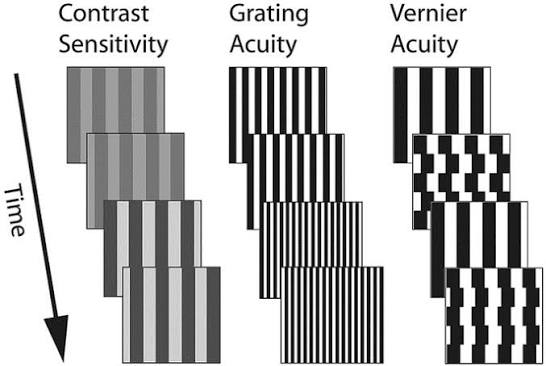
Use preferential-looking testing, such as Teller Acuity Cards, to estimate grating acuity.
An interocular difference of approximately 0.5 to 1 octave may be significant, but an abnormal result should be retested before diagnosing amblyopia.
Why can Teller Acuity Cards miss amblyopia?
Teller cards measure grating acuity, not recognition acuity.
In amblyopic eyes:
Grating acuity is often better than optotype acuity.
The discrepancy becomes greater with more severe amblyopia.
Sensitivity is approximately 80%, so a normal result does not completely exclude amblyopia.
What infant acuity measure may be more sensitive to amblyopia than grating acuity?
Vernier acuity cards may have greater sensitivity to amblyopia than standard preferential-looking grating acuity cards.
What aspects of fixation should be documented in an infant or young child?
Assess whether fixation is:
Central, steady, and maintained, abbreviated C&S&M
Fixes and follows, abbreviated F&F
Preferred equally or unequally between the eyes
Maintained after the preferred eye is uncovered
Fixation preference may provide an estimate of interocular visual asymmetry when optotype acuity cannot be obtained.
How is fixation preference assessed in a patient with manifest strabismus?
Identify the fixing and deviating eyes.
Cover the preferred fixing eye.
Allow the deviating eye to take up fixation.
Uncover the preferred eye.
Observe how long the previously deviating eye maintains fixation.
Rapid return to the preferred eye indicates a stronger fixation preference.
How is fixation preference tested when there is no strabismus or only a small-angle deviation?
Use the induced tropia test:
Place a 10 to 15 prism-diopter vertical prism before one eye while the child fixates a target.
Repeat with the prism before the other eye.
Observe fixation behavior and preference.
The prism creates a vertical separation that permits comparison of fixation by the two eyes.
How is fixation preference graded from Grade 0 to Grade 4?
Grade 0, absolute: Preferred eye immediately resumes fixation after uncovering.
Grade 1, strong: Nonpreferred eye holds fixation only momentarily.
Grade 2, moderate: Nonpreferred eye holds until the next blink.
Grade 3, slight: Nonpreferred eye maintains fixation through the next blink.
Grade 4, none: Equal alternation between the eyes.
How do fixation-preference grades relate to the expected interocular acuity difference?
Lower fixation-preference grades generally correspond to a larger interocular acuity difference:
Grade 4: approximately 0 logMAR
Grade 3: approximately 0.10 logMAR
Grade 2: approximately 0.17 logMAR
Grade 1: approximately 0.30 logMAR
Grade 0: approximately 0.80 logMAR
How reliable is fixation-preference testing for detecting amblyopia?
Fixation preference has limited sensitivity overall:
Any amblyopia: approximately 31%
Anisometropic amblyopia: approximately 20%
Strabismic amblyopia: approximately 80%
It is therefore more useful for strabismic amblyopia than anisometropic amblyopia.
When is fixation-preference testing most clinically useful, and what is its main limitation?
It is most useful when testing shows either:
A very strong or absolute preference, or
No fixation preference with free alternation
Intermediate findings are less definitive. False-positive results are common, possibly because normal ocular dominance can resemble an amblyopic fixation preference.
Do not diagnose or exclude amblyopia from fixation preference alone.
How do contrast-sensitivity losses differ between anisometropic and strabismic amblyopia?
Anisometropic amblyopia: More uniform and extensive loss across the spatial-frequency range
Strabismic amblyopia: More asymmetric and generally less severe loss, concentrated at higher spatial frequencies
In general, greater amblyopia severity is associated with greater contrast-sensitivity loss.
What are the key refraction considerations when evaluating amblyopia?
Perform careful retinoscopy, especially in children younger than approximately 6 years.
Use lens bars or trial lenses as needed.
In strabismus, occlude one eye or use prism when necessary to obtain an accurate reflex.
Perform cycloplegic refraction to identify the full refractive error.
Consider binocular refinement when developmentally appropriate.
What pupil findings may occur in amblyopia, and how clinically useful are they?
Reported findings include:
Longer pupillary-constriction latency
A mild relative afferent pupillary defect
However:
Pupillary abnormalities occur in only a minority of patients.
They do not correlate reliably with visual acuity.
They do not predict response to occlusion therapy.
A substantial RAPD should therefore raise concern for disease other than uncomplicated amblyopia
What binocular vision and ocular-motor testing should be included in an amblyopia assessment?
Versions
Ductions when indicated
Cover testing
Measurement of tropia or phoria
Assessment of comitancy
Evaluation for A/V patterns and syndromes
Stereoacuity testing with both random-dot and contour tests
An A/V pattern may be suggested by a difference of approximately 10 to 15 prism diopters between upgaze and downgaze.
What testing error must be avoided during stereoacuity assessment?
Do not allow the patient to inspect the stereotest before putting on the appropriate glasses.
Seeing the monocular contours without the glasses may provide clues that allow the patient to identify the correct response without true stereopsis.
How can central versus eccentric fixation be evaluated in amblyopia?
Fixation location can be assessed using:
Visuoscopy with a direct ophthalmoscope
MITT box
Maxwell’s spot
These methods determine where the patient places the fixation target relative to the fovea.
How does fixation typically differ between refractive and strabismic amblyopia?
Refractive amblyopia: Usually central but may be unsteady
Strabismic amblyopia: Eccentric fixation is more common
Unilateral high myopia: May be an exception in which refractive amblyopia demonstrates eccentric fixation
Eccentric fixation has been reported in approximately 23% to 82% of patients with strabismic amblyopia.
Why is identifying eccentric fixation clinically useful?
Eccentric fixation can:
Support a diagnosis of strabismic or combined-mechanism amblyopia
Help distinguish pure refractive amblyopia from combined amblyopia
Serve as a prognostic indicator
What forms of suppression should be assessed in a patient with amblyopia?
Evaluate for both:
Central suppression
Peripheral suppression
Suppression testing complements acuity, fixation, strabismus, and stereoacuity assessment when evaluating binocular function.
A child performs much better with an isolated HOTV letter than with a line of HOTV letters. What does this indicate?
This indicates the crowding phenomenon, reflecting abnormal contour interaction.
The isolated optotype reduces interference and may overestimate functional acuity. Use a full chart or single optotypes with standardized surround bars.
A preverbal child freely alternates fixation between the two eyes. How should this be interpreted?
Free alternation corresponds to approximately Grade 4 fixation preference and suggests little or no interocular acuity difference.
However, fixation testing is not perfectly sensitive, so amblyopia cannot be excluded without age-appropriate acuity and a complete examination.
A child with no obvious strabismus shows a strong preference during the induced tropia test. What does this suggest, and what should be done next?
It suggests possible unequal visual acuity between the eyes, but it is not diagnostic by itself because ocular dominance can produce a false-positive result.
Next steps include:
Standardized crowded monocular acuity
Cycloplegic refraction
Ocular health examination
Repeat testing if reliability is questionable
A patient has a reduced pupil response and severe unilateral acuity loss presumed to be amblyopia. What is the key clinical concern?
Although a mild pupillary asymmetry can occur in amblyopia, pupil findings do not reliably correlate with its severity.
A clear or substantial RAPD should prompt investigation for retinal, optic-nerve, or other afferent disease rather than being automatically attributed to amblyopia.