hell simulator
 Call Kai
 Learn
 Practice Test
 Spaced Repetition
 Match
 Flashcards
 Knowt Play
1/247

There's no tags or description
Looks like no tags are added yet.
248 Terms
define social influence
influence that occurs when an individual, group, or institution alters another's thoughts, feelings and/or behaviour through accidental, expressive, or rhetorical communication
accidental communication
unintentional and unplanned
expressive communication
emotionally driven, unconcious
rhetorical communicaiton
purposeful
components of social influence
change in others' thoughts, feelings, or behaviours, and the presence of others
zimbardo's stanford prison year
1973
zimbardo aim
explaining atrocities against humans such as those in the vietnam war, identifying factors leading to someone committing such crimes
zimbardo method
70 young male uni students recruited through newspaper article, 24 healthy average nopsych men chosen, half were prisionors and the others guards, prisionors deidentified stripped and deloused, given uniforms, expriment stopped after 6 days because prisinors showed signs of severe stress, too brutal
zimbardo findings
toxic situations are sufficiant to cause toxic behaviour
identify and define the three levels of obedience (kelman 1958)
compliance, identification, internalisation
compliance definition
occurs when an individual accepts influence hoping to recieve favourable reaction or avoid punishment, only works if individual sees benefit
identification definition
when an individual sees themselves as similar to or connected to the person or group, as a result, adopting their attitudes and values
internalisation
occurs becayse new thoughts, feelings, or behaviours are rewarding and congruent with your own values, fulfilling a need
define obedience
acting in response to an instruction from an authority figure, as opposed to social pressure
stanley milgram year
1963
milgram aim
identifying what conditions people will carry out the commands of an authority figure, when will they refuse to obey, why Nazi officers obeyed orders from their superiors to gas millions in WW2
milgram method
subjects told they were participating in a study on memory, the learner (confederate) was appeared to be shocked with 30 switche by the teacher (given a shock too), the learner says stop at 150 volts, but the teacher is told to continue
milgram findings
65% of participants delivered shocks to the maximan, the agentic state where participants see themselves as an instrument of the experimentor when participants want to do their job well, suggesting obedience is unconditional and automatic
factors impacting obedience milgram
proximity to victim, (teacher visible led to drop in obedience), authority figure (removing experimentor reduced rates), and perception of authority (obedience reduced when experimentors not wearing lab coats)
milgram limitations
participants didn't continue shocking even when given no choice, further research indicates obedience occurs because we identify with the group that the authority figure belongs to
define conformity
the process of changing one's behaviour in response to group pressure
informational influence
taking cues from those around us on how to react and behave in unfamilliar situations
normative influence
conforming to group standards to belong and feel accepted
solomon asch year
1951
asch method
participants in a room with 4 to 6 participants to do a vision test, confederates chose the same answer to see which line was most like the comparison line, the participant gave answer last
asch findings
average subject conformed 1/3 times, 75% at least once, 25% never, normative influence decreased when privately answered
asch factors of conformity
group size (conformity increases), unanimity (undone when one person disagrees), culture (collectivist more likely), deindividualisation (loss of individuality leads to acceptance of group norms)
define antisocial behaviour
involves selfish behaviour that is negatively valued by society and usually causes harm to the common good, or results in reward for the person involved, can also withold prosocial behaviour, varies
diffusion of responsibility
when individuals in a group feels decreasingly responsible as group size increases
audience inhibition
when performance decreases within the presence of others because of fear of evaluation
social norms
individuals are more likely to adopt the group norm
direct teacing
aggressive behaviour in children increases in families with higher punshment and lower affection
modelling
bandura 1977 suggests children pay attention and observe the consequences of influential people
reinforcement
the frquency of a behaviour will increase if its consequence is favourable
cost benefit analysis
social interactions are exchanges where in general, we want the rewards to be greater than the cost (if not, social dissonance)
groupthink
when the desire for group consensus overrides rational consideration of possible alternatives because those with different opinions are pressured to conform
apply bullying as an example of antisocial behaviour
involves physical, communicative, and intimidatory actions that can be indirect or direct, becoming more specialised as we get older
define bystander effect
when the presence of multiple bystanders inhibits each person's tendancy to help, due to social responsibility and conmparison
bystanders act from
notice, interpret, accept responsibility, capability, willingness
factors influencing bystander effect
similarity between people, gender, group size, unaniminty
summarise kitty genovese case
1964, she was walking home and attacked, screaming loudly, but nobody came to her assistance even though 38 people heard her, and she died 30 mins later
group inhibition of room, Latane & Darley (1968)
define prosocial behaviour
occurs when a person selflessly des something to help someone else with little regard for themselves, valued positively by society, and helpful to the person being helped
describe factors influencing prosocial behaviour
reciprocity (recieving something in return), social responsibility (drive to contribute), personal empathy, mood, competence, altruism (helping soeone without expecting something in return)
explanations for altruism
could be genetic or inherited, amygdala responsible, larger reactions from amygdala from altruists
apply helping as an example of prosocial behaviour
Phineas Gage’s injury
struck by a pole in the left frontal lobe in 1848, resulting in more irritability and organisational issues
localisation definition
some areas of the brain have specific functions, first attributed to damage of Phineas Gage’s brain
purpose of Walter Freeman exploring lobotomies
as an intervention for people with schizofrenia and depression
process of an icepick lobotomy
first performed in 1936, a thin rod was swept laterallt through cerebral tissue, taking under 10 minutes
advertised purpose of icepick lobotomy
an improvement from an institute, a tool for controlling the mentally ill
side effects of icepick lobotomy
severe disablement, loss of language functions, institutionalisation, haemorrhage, zombie-likeness, vegetative behaviour
purpose of Roger Sperry Split Brain Experiments
to study specific functions associated with each hemisphere of the brain, as until the 1960s, it was believed that most people were left hemisphere dominant
examples of split brain experiments
spoon one where the nonverbal right hemisphere cannot say what the left hand felt, half a word one where the right hemisphere cannot indicate the correct word being displayed, interpretation by the left hemisphere of a word as it cannot see what the right hemisphere sees
process of an electroencephalograph (EEG)
measures electrical activity via electrodes on the calp to indicate amplitude and frequency of wave forms from neural activity
benefits of an EEG
can help diagnose epilepsy, sleep disorder, arousal, without requiring radiation or magnets
tomography definition
generating a 2D image of a slice of a 3D section
uses for Computed Axial Tomography
studying brain structures
process of Magnetic Resonance Imaging (MRI)
magnetic field sends radiofrequency pulses to align and measure signals from atomic nuclei
uses for an MRI
identify structures and tissue in the brain
function of a Functional MRI (fMRI)
detects specific areas of the brain involved in a task, process, or emotion, as active areas consume more oxynamoglobin containing iron compounds, showing magnetisation
hindbrain functions
unconcious vital processes like breathing, as well as some voluntary processes like muscle coordination
elements of the hindbrain
medulla oblongata, cerebellum
medulla oblongata function
connection point for nerves from the spinal cord, controls heart rate, breathing, digestion, and swallowing, considered ‘brain dead’ if damaged
cerebellum function
recieves sensory information to regulate posture, balance, and fine muscle movement
midbrain structure
small structure joining the hindbrain to the forebrain, containing reticular formation
midbrain function
acts as a ‘sensory switchboard’ to screen relevant sensory information to prevent overload, maintains general arousal, sleep/wake cycle
elements of the forebrain
cerebral cortex, thalamus, hypothalamus, corpus callosum, cerebral hemisphere, Broca’s area
structure of the cerebral cortex
covers 75% of the 2 hemispheres, but only 2mm thin due to folds and crevices that increase the surface area to 25cm²
cerebral cortex function
processing perception, language, learning, memory, problem solving, and movement
thalamus function
regulates arousal with reticular formation, filters and relays sensory information
hypothalamus function
regulates hormone release for temperature, circadian rhythm, sex drive, thirst, and hunger
corpus callosum function
allows messages to be sent between left and right hemispheres
longitudal fissure definition
a deep groove seperating the two cerebral hemispheres
control of each cerebral hemisphere
each side controls the other, with left controlling language, and right controlling recognition of faces, patterns, and visual patterns/attention
Broca’s area function
responsible for producing clear, fluent speech through muscle movements
location of Broca’s area
left frontal lobe near motor cortex
elements of the temporal lobe
Wernicke’s area, primary auditory cortex
temporal lobe function
processes visual memory, mood, emotion, language percetion, and long term memory storage/formation
Wernicke’s area function
comprehension of speech, interpretation, and locating appropriate words and responses
location of Wernicke’s area
in the left hemisphere of the temporal lobe, next to the primary auditory cortex
primary auditory cortex function
responsible for recieving and processing auditory information
role of speciallist pathways in the primary auditory cortex
responding to stimuli including sounds, speech patterns, and relating heard information to words in memory
parietal lobe function
intergrates sensory and spacial information, located in the somatosensory cortex, includes primary sensory cortex
examples of damage symptoms to the parietal lobe
hemineglect - inability to attend to one side of the body, sensory distortions or hallucinations on one side of the body
primary sensory cortex role
recieves and processes ensory information
example of damage to the primary sensory cortex
phantom pain
occipital lobe function
detection and intergration of visual information, includes the primary visual cortex
function of specialist pathways in the occipital lobe
movement in the visual field, object identicfication, perception of lines/edges, detecting flashing stimuli
primary visual cortex function
represents visual information from the retina, responsible for initial object detection and motion/spacial relationships
structure of the nervous system
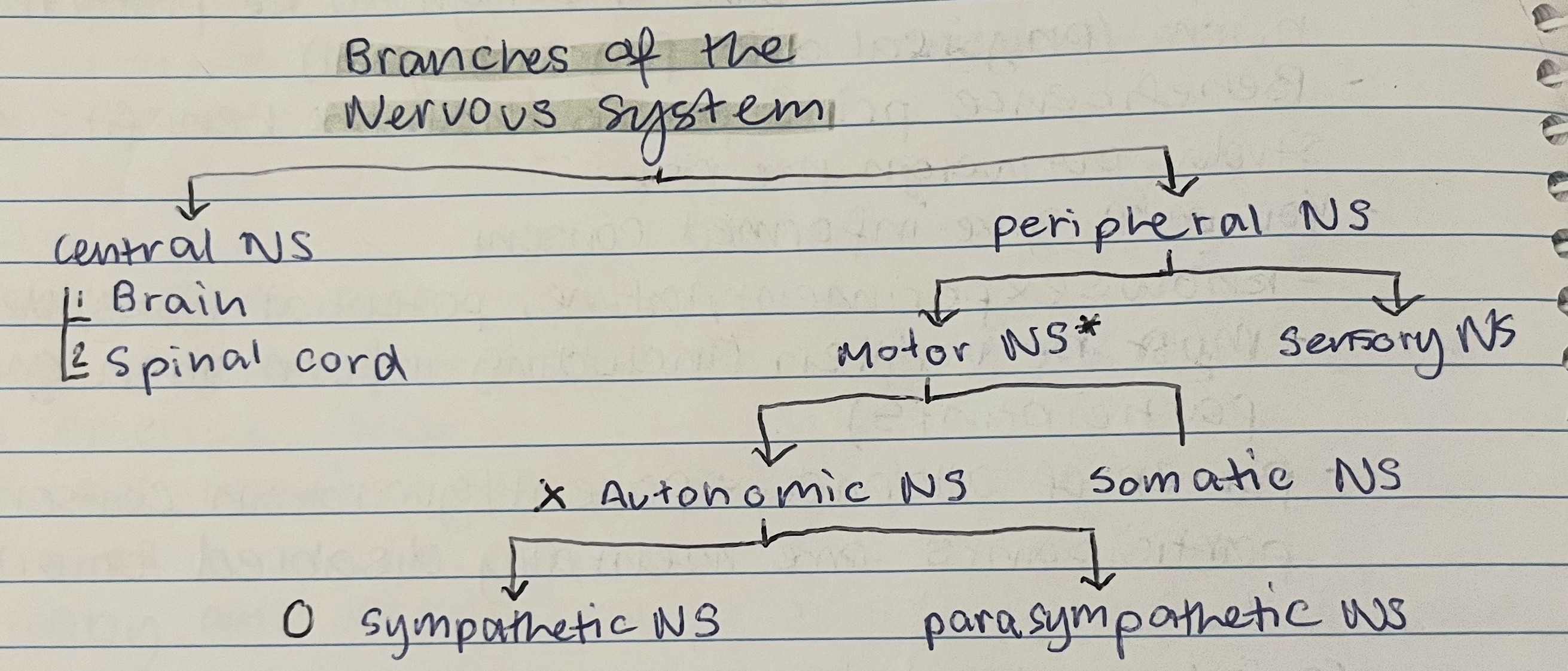
main functions of the nervous system
recieving information via sensory pathways, processing information via CNS, and coordinating a response via motor pathways
role of the sympathetic system
arouse the body to respond to threats
role of the parasympathetic nervous system
rests the body to return to a state of equillibrium
role of the brain
responsible for processing sensory information, coordinating muscles and glands to regulate body systems
role of the spinal cord
carry information between PNS and the brain
role of the somatic nervous system
carries messages away from the CNS to skeletal muscles, transmits information from sense receptor sites towards CNS, voluntary muscle movements
role of the autonomic nervous system
carries nerural messages between the CNS, heart, lungs, and other organs/glands
role of the motor neuron system
brings the body back to homeostasis