Unit IVA - vocab - Sci
 Call Kai
 Learn
 Practice Test
 Spaced Repetition
 Match
 Flashcards
 Knowt Play
1/38

There's no tags or description
Looks like no tags are added yet.
39 Terms
What is Adhesion?
The process by which dissimilar substances stick together at their surfaces.
What is the Carbon Cycle?
The series of biological and geological processes by which carbon is exchanged among the atmosphere, oceans, soil, and living organisms.
What is Cohesion?
The process by which similar substances stick together.
What is a Covalent Bond?
Chemical bonds formed when atoms share electrons.
What is a Hydrogen Bond?
A type of chemical bond that occurs when a hydrogen atom covalently bonded to an electronegative atom is attracted to another electronegative atom.
What is a Ionic bond?
A type of chemical bond that occurs when atoms transfer electrons, resulting in the formation of oppositely charged ions that are attracted to each other.
What is the Nitrogen Cycle?
The nitrogen cycle is the series of processes by which nitrogen and its compounds are inter converted into the environment and in living organisms, including nitrogen fixation, nitrification, and denitrification.
What are Amino Acids? What Organic Compound are they connected to?
Amino acids are the fundamental building blocks (monomers) of proteins (polypeptides).
What are Carbohydrates? And how many Calories per gram do they give you?
Vital macronutrient that your body breaks down into glucose to power your cells, tissues, and organs. They give you 4 Cal/gram
What are Disaccharides? What Organic Compound are they connected to?
Double sugars made of two simple sugar molecules (monosaccharides) joined together by a covalent bond. They are Carbs.
What are Enzymes?
Biological catalysts that speed up chemical reactions in living organisms.
What are Fats? And how many Calories per gram do they give you?
Major macronutrient and a type of lipid made of glycerol and fatty acids that provide 9 calories per gram.
What is a Molecule being Hydrophilic mean? And what is Hydrophilic?
The molecule would be able to resolve in water or other liquids. They are water loving molecules.
What is a Molecule being Hydrophobic mean? And what is Hydrophobic?
The molecule would not be able to be dissolved in water or any type of liquid. They do not like water.
What are Lipids? And how many Calories per gram do they give you?
A group of organic molecules that do not dissolve in water. They provide 4 Cal/gram.
What are Macromolecules?
A very large, complex molecule made up of thousands of smaller atoms and repeating sub-units.
What are Monomers?
A small or simple molecule
What are Nucleic acids?
Large biomolecules that store and express genetic information in all living cells.
What is an Organic Compound?
Chemical molecules that contain carbon atoms covalently bonded to hydrogen atoms and/or other elements.
What is a Peptide Bond?
A strong chemical link that joins amino acids together to build proteins.
What are Polymers?
A fat molecule that forms the primary structural foundation of all living cell membranes.
What are Polymers?
A large molecule made of many smaller, repeating units called monomers linked together in long chains.
What is a Polypeptide? What Organic Compound does it represent?
A continuous, chain of amino acids linked together by covalent peptide bonds. Proteins are connected with them.
What is a Polysaccharide? What Organic Compound is it connected to?
A large, complex carbohydrate made of long chains of simple sugar units called monosaccharides linked together by chemical bonds.
What are Proteins? And are they Organic Compounds?
Large, essential molecules made of long chains of amino acids that build and run every cell in your body. They are Organic Compounds.
What are Saturated Fats? Are they healthy for you? What is chemically different about them?
They are fat molecules with no double bonds between carbon molecules, meaning they are "saturated" with hydrogen atoms. They are not healthy for you.
What are Unsaturated Fats? Are they healthy for you?
Fats with flexible chemical structures, that are healthy for you to eat.
What are Trans Fats? Are they healthy for you?
A type of unsaturated fat that can be artificial or natural, and they are NOT healthy for you.
Translation
the biological process by which a cell uses the genetic information encoded in a messenger RNA molecule to build a specific protein (polypeptide chain).
Transcription
the biological process of copying a segment of DNA into a complementary RNA sequence.
Primary structure
the linear sequence of amino acids linked together by covalent peptide bonds in a polypeptide chain

Secondary structure
The regular, local 3D folding patterns of a biopolymer's backbone (such as a protein's polypeptide chain or a nucleic acid strand), stabilized primarily by hydrogen bonds.
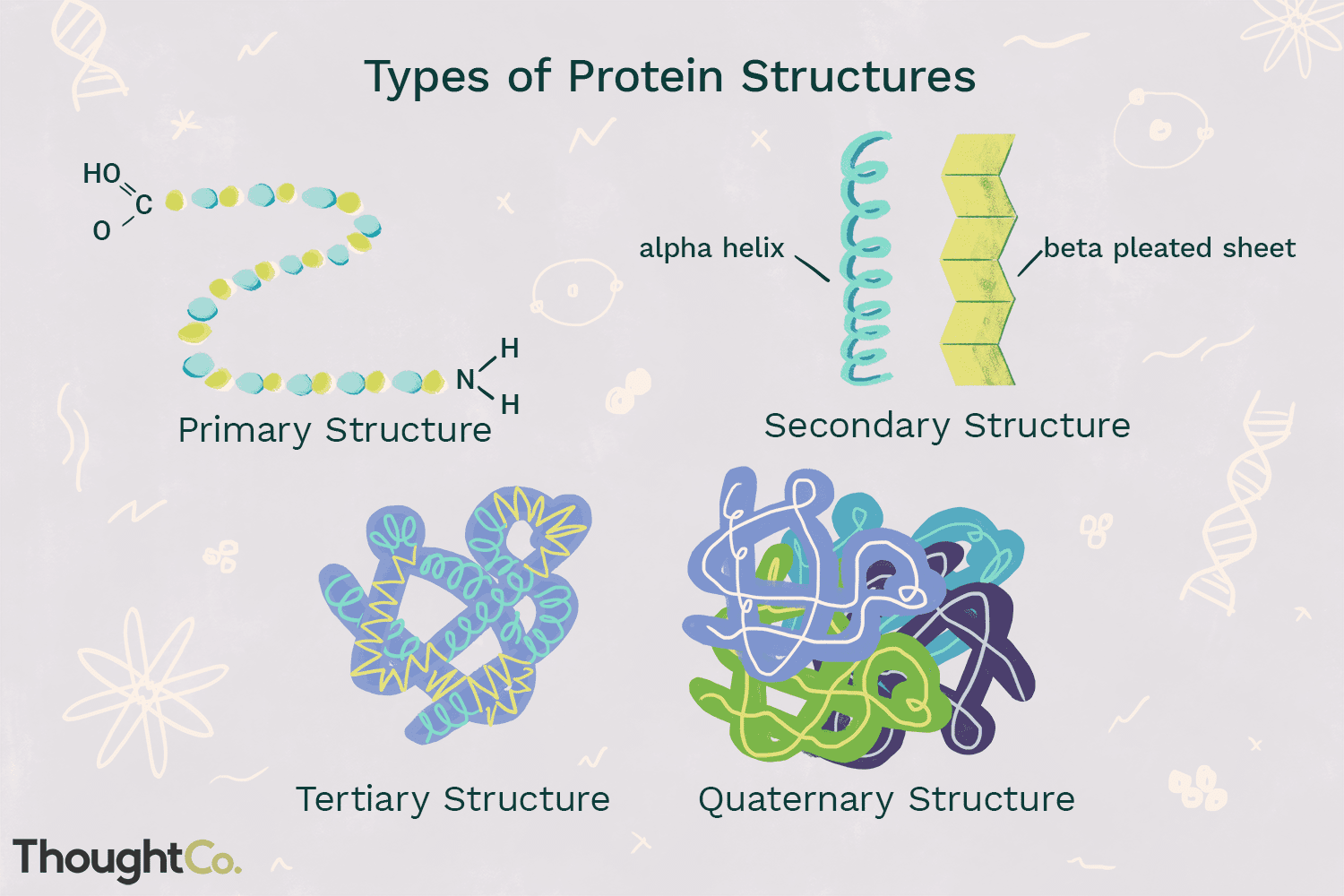
Tertiary Structure
the overall three-dimensional shape of a single polypeptide chain.

Quaternary structure
the highest level of protein organization in biology, formed when two or more distinct polypeptide chains (known as protein subunits) join together to create a single, functional macromolecule.

Alpha helix
A common, rod-like secondary structure in proteins where a polypeptide chain of amino acids twists into a tight, right-handed spiral coil

Beta pleated sheet
A major type of secondary structure in proteins, where individual sections of a polypeptide chain (called beta strands) lie side-by-side and are held together by hydrogen bonds

X-ray crystallography
A laboratory technique used in biology to determine the detailed three-dimensional atomic structure of biological macromolecules.
GFP
Green Fluorescent Protein
Chromophore
the specific region of a molecule that is responsible for its color by absorbing light within the ultraviolet or visible spectrum