Bio Quiz 7
 Call Kai
 Learn
 Practice Test
 Spaced Repetition
 Match
 Flashcards
 Knowt Play
1/103

There's no tags or description
Looks like no tags are added yet.
104 Terms
fermentation
the partial breakdown of sugars or other organic fuels without using oxygen. It releases some energy, but it does not completely break down glucose into carbon dioxide and water (fuel is processed through partial breakdown).
Doesn’t use an electron transport chain to transfer electrons to an external final electron acceptor.
In _, pyruvate is reduced to lactate/ethanol
In _, NADH is oxidized to NAD+
aerobic respiration
This process breaks down organic fuel using oxygen. It is the most efficient of the catabolic processes for harvesting energy from fuel (extensive breakdown of fuel, releasing substantial energy, so cells get much more energy through _). Oxygen is the final electron acceptor during cellular respiration.
Anaerobic respiration
Some prokaryotes harvest energy through a respiration process that uses a substance other than oxygen as the final electron acceptor.
ATP, heat
C6H12O6 + 6O2 → 6CO2 + 6H2O + energy is the balanced chemical equation for cellular respiration
Energy appears in 2 forms: _ and _
redox reaction
A _ is a chemical reaction involving oxidation and reduction (always happen together, because when one substance loses electrons, another must receive them)
oxidation, oxidized
_ refers to the loss of electrons. A substance that loses electrons becomes _.
reduction, reduced
_ refers to the gain of electrons. A substance that gains electrons becomes _.
reducing agent
A _ donates electrons to another substance. By donating electrons, it causes the other substance to be reduced. The donor itself becomes oxidized.
Think: it causes the OTHER substance to be reduced
oxidizing agent
An _ accepts electrons from another substance. By accepting electrons, it causes the other substance to be oxidized. The acceptor itself becomes reduced.
Think: it causes the OTHER substance to be oxidized
electronegativity
an atom's tendency to attract shared electrons toward itself in a chemical bond.
hydrogen
_-rich molecules are good fuels
NAD+, NADH
_ is the oxidized form of nicotinamide adenine dinucleotide, whereas _ is the reduced form. It is a coenzyme derived from the vitamin niacin. _ is especially important because it can accept electrons from fuel molecules and carry them to other parts of the respiration process. Important as a cell needs a way to capture the electrons released during fuel breakdown and deliver them to the machinery that uses them to help make ATP.
_ gains electrons to become _, which can later donate those electrons.
dehydrogenase
an enzyme called a _ removes a pair of hydrogen atoms from a substrate. Each hydrogen atom contains 1 proton and 1 electron, so the pair represents 2 electrons and 2 protons. The enzyme transfers:
2 electrons to NAD+
1 proton along with those electrons to the NAD+ molecule
The other proton is released into the surrounding solution as H+
NAD+ + 2H → NADH + H+
NAD+ has been reduced as it gained electros and NADH now carries energy-rich electrons that can be used later in respiration. This stored energy can be tapped later as its electrons move to a lower-energy state through the electron transport chain.
electron transport chain
The _ is a series of molecules, mostly proteins, that pass electrons from one carrier to another through successive redox reactions.
In a eukaryotic cell, this is built into the inner membrane of the mitochondrion.
In aerobically respiring prokaryotes, the chain is located in the plasma membrane.
NADH → _ → electron carrier 1 → electron carrier 2 → electron carrier 3 → electron carrier 4 → O2 (final electron acceptor in aerobic respiration) + electrons + H+ → H2O
Explains how glucose’s energy is captured in a controlled manner, rather than most of it dissipating as heat.
As electrons move down this energy gradient (each successive carrier having a greater affinity for the electrons than the last), they lose potential energy, and energy is released in stages, making it possible for the cell to capture and use the energy. ΔG = -53kcal/mol
terminal electron acceptor
in an aerobic electron transport chain, oxygen is called the _ because it accepts the electrons at the end of the chain.
glycolysis
Glucose is broken down into two molecules of pyruvate. A small amount of ATP is produced, and NADH is produced, capturing some electrons. This is known as _.
It occurs in the cytosol.
pyruvate
a 3-carbon molecule, with 2 formed from the breakdown of glucose (6-carbon molecule) during glycolysis.
pyruvate oxidation
_ links glycolysis to the citric acid cycle by oxidizing 3-carbon pyruvate molecules into 2-carbon acetyl units (acetyl CoA). This happens through a large enzyme group called the pyruvate dehydrogenase complex.
citric acid cycle (aka Krebs cycle)
During this:
acetyl CoA enters a series of enzyme-controlled reactions
the carbon-containing molecules are progressively broken down
CO2 is released
NAD+ and FAD accept electrons, forming NADH and FADH2
A small amount of ATP is produced
NADH and FADH2 carry electrons harvested during the first 2 stages to the electron transport chain. Those electrons provide the energy source for most ATP production during aerobic respiration.
oxidative phosphorylation
This stage produces most (90%) of the ATP made during cellular respiration. It consists of electron transport chain as well as chemiosmosis.
O2 is reduced to H2O
NADH is oxidized to NAD+
electron transport
Electrons from NADH and FADH₂ move through the electron transport chain. The released energy helps establish a difference in hydrogen-ion concentration across the inner mitochondrial membrane.
chemiosmosis
Hydrogen ions, also called protons, flow down their electrochemical gradient through an enzyme called ATP synthase. The flow powers ATP production from ADP and inorganic phosphate.
explains how ATP is produced along the electron transport chain (cellular respiration)
substrate-level phosphorylation
An enzyme transfers a phosphate group from an organic substrate to ADP. It does not require an electron transport chain, occurs in Glycolysis and citric acid cycle, and produces a small amount of ATP
Anabolism
Builds larger, more complex molecules from smaller molecules. Requires an input of energy
_ pathways are a series of chemical reactions that combine smaller molecules to construct larger, more complex molecules.
Require an input of energy.
Used to build polymers, proteins, and other cellular structures.
Often powered by ATP.
Catabolism
Breaks down larger, complex molecules into smaller, simpler molecules. Releases energy overall.
_ pathways are a series of enzyme-controlled chemical reactions that break down complex organic molecules into simpler products, releasing stored chemical energy.
- Break down organic fuels such as glucose, carbohydrates, fats, and proteins.
- Transfer energy released during breakdown into usable forms, especially ATP.
- Some released energy is captured in ATP, while some is dissipated as heat.
- Cellular respiration is an example of a catabolic pathway.
Activation energy
The initial energy required to get a chemical reaction started.
- Even an exergonic reaction can have an activation energy barrier.
- Enzymes lower the activation energy required for reactions.
- During cellular respiration, enzymes allow glucose to be oxidized gradually through controlled steps rather than burning all at once.
- Enzymes do not change the overall ΔG of a reaction.
NAD+ (nicotinamide adenine dinucleotide)
An electron-carrying coenzyme that functions as an oxidizing agent during cellular respiration.
_ is the oxidized form.
Accepts two electrons and one proton during reduction.
Becomes NADH after accepting these electrons and the proton.
A second proton is released into the surrounding solution as H+
Accepts electrons removed from organic molecules during enzyme-controlled oxidation reactions.
Helps transport high-energy electrons to the electron transport chain.
NADH
The reduced form of NAD+ that carries high-energy electrons harvested from organic molecules during cellular respiration.
Formed when NAD+ accepts two electrons and one proton.
Carries electrons from reactions in glycolysis, pyruvate oxidation, and the citric acid cycle.
Delivers electrons to the electron transport chain.
Donates electrons to the chain and is oxidized back into NAD+.
The electrons it carries provide energy that is ultimately used to produce ATP.
FAD (flavin adenine dinucleotide)
An electron-carrying coenzyme that functions similarly to NAD+.
Accepts electrons and hydrogen during oxidation reactions.
Becomes reduced to FADH2.
Participates in the citric acid cycle.
Helps transfer harvested electrons to the electron transport chain.
FADH2
The reduced form of FAD that carries high-energy electrons to the electron transport chain.
Produced during the citric acid cycle.
Donates electrons to the electron transport chain.
Its electrons contribute to the hydrogen ion gradient used for ATP production.
Generally contributes to less ATP production than NADH because its electrons enter the electron transport chain at a later point.
Acetyl CoA (acetyl coenzyme A)
A molecule that carries a two-carbon acetyl group into the citric acid cycle.
Produced during pyruvate oxidation.
Contains a two-carbon acetyl group attached to coenzyme A.
Delivers the acetyl group to the citric acid cycle.
The acetyl group is eventually broken down, releasing carbon dioxide and transferring electrons to NAD+ and FAD.
ATP synthase
A protein complex embedded in the inner mitochondrial membrane that produces ATP using the energy released as hydrogen ions flow down their electrochemical gradient.
Hydrogen ions pass through ATP synthase.
Their movement provides energy for the enzyme's operation.
ATP synthase combines ADP and inorganic phosphate to form ATP.
Plays an essential role in oxidative phosphorylation.
Oxidative, Substrate-level
_ phosphorylation uses energy from electron transport and chemiosmosis to make ATP through ATP synthase.
_ phosphorylation makes ATP through direct phosphate transfer from an organic substrate to ADP.
Organic fuel
A carbon-containing molecule that can be broken down through metabolic pathways to release usable energy.
Examples include:
Glucose and other carbohydrates.
Fats.
Proteins.
Starch
A storage polysaccharide in plants consisting of many glucose molecules joined together.
Is a major dietary carbohydrate.
Can be broken down by digestive enzymes into glucose subunits.
Glucose can then enter cellular respiration.
Oxaloacetate
A four-carbon molecule in the citric acid cycle that combines with the two-carbon acetyl group from acetyl CoA.
Produces a six-carbon molecule at the beginning of the cycle.
Is regenerated at the end of each turn.
Allows the cycle to continue accepting new acetyl groups.
Glucose
_ is a six-carbon simple sugar with the chemical formula C6H12O6
It is an important organic fuel used by cells.
It contains chemical energy that can be harvested through cellular respiration.
During glycolysis, one glucose molecule is chemically modified and eventually split into two three-carbon molecules.
Its six carbon atoms are all accounted for in the two pyruvate molecules produced.
energy investment, energy payoff
glycolysis consists of 10 steps, distinctly labeled the _ phase and the _ phase.
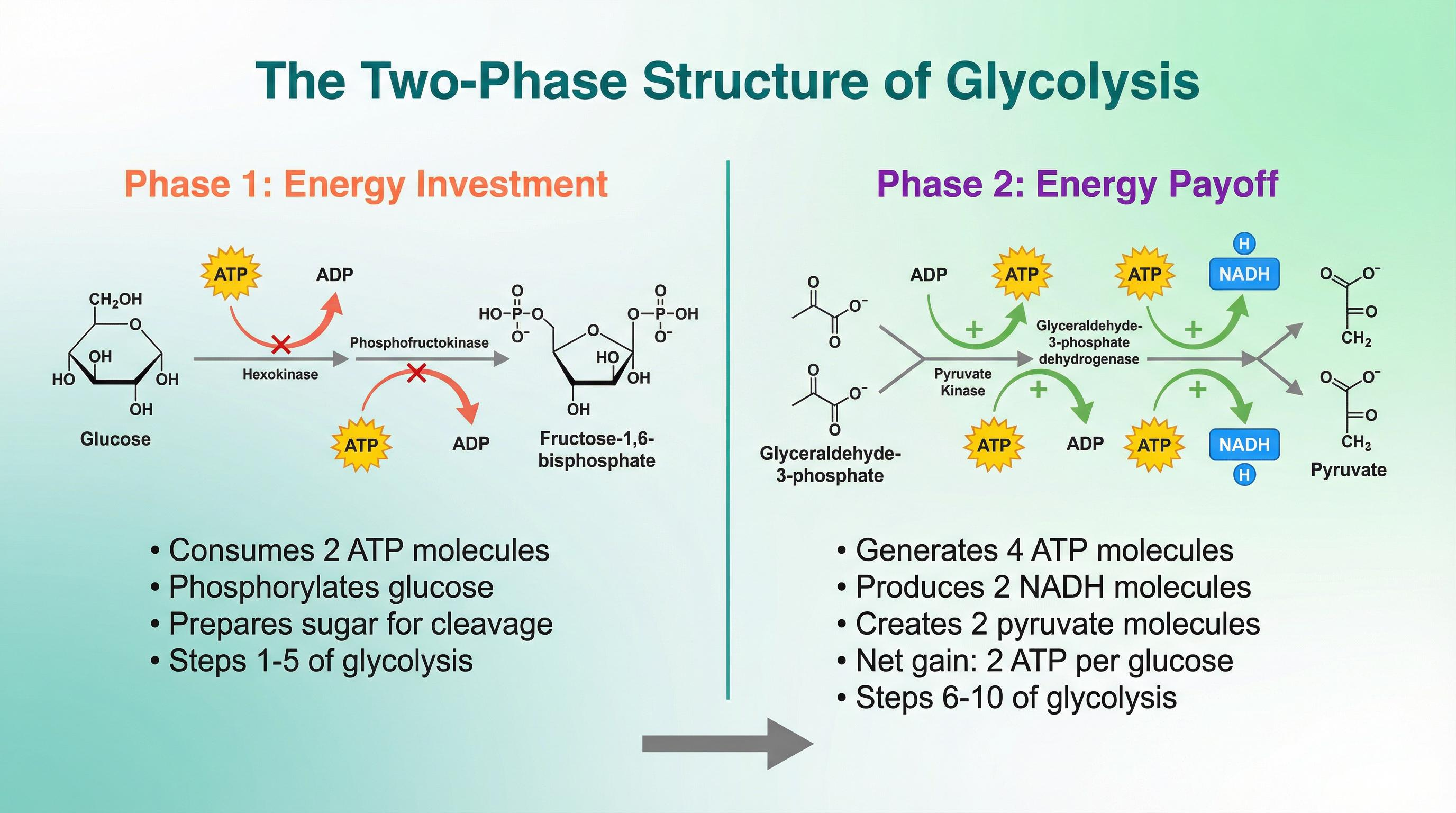
Energy investment phase
The _ phase is the first half of glycolysis, consisting of steps 1–5. The cell uses 2 ATP molecules. A cell can spend energy even if its goal is to harvest energy because the initial ATP investment helps prepare glucose for the reactions that follow. The ATP molecules transfer phosphate groups to the glucose-derived molecules. This changes their chemical structure and makes them more reactive for the rest of the pathway.
During this phase:
2 ATP are consumed.
Glucose is chemically modified.
The six-carbon sugar is eventually split into two three-carbon molecules.
Both three-carbon molecules continue into the payoff phase.
The cell has not yet made a net gain of ATP. It has spent two ATP molecules. The total cost is 2 ATP per glucose molecule.
glucose receives a phosphate group, hexokinase
Step 1 of energy investment phase is when _. An enzyme called _ transfers a phosphate group from ATP to glucose.
Starting molecule: glucose.
ATP is used: 1.
Product: glucose-6-phosphate.
Adding a phosphate group helps trap glucose inside the cell because the charged glucose-6-phosphate does not easily cross the cell membrane. It also prepares glucose for the next reactions.
The molecule is rearranged, phosphoglucose isomerase
step 2 of energy investment phase is when _. An enzyme called _ rearranges glucose-6-phosphate into fructose-6-phosphate.
Notice that the molecule still has six carbons.
What changed? Its atoms were rearranged into a different structural arrangement. No carbon was added or removed.
another phosphate is added
step 3 of energy investment is _. An enzyme called phosphofructokinase-1 (PFK-1) transfers another phosphate group from ATP to fructose-6-phosphate.
ATP used: 1 more.
Product: fructose-1,6-bisphosphate.
The molecule now has two phosphate groups. This helps prepare it for splitting into two smaller molecules. This is another major energy investment step.
The six-carbon molecule splits into two three-carbon molecules, aldolase
step 4 of energy investment is _. An enzyme called _ splits fructose-1,6-bisphosphate into two molecules:
Glyceraldehyde-3-phosphate (G3P).
Dihydroxyacetone phosphate (DHAP).
Each molecule has three carbons. This is the actual splitting part of glycolysis.
Both molecules become G3P, triose phosphate isomerase
step 5 of energy investment is _. An enzyme called _ rearranges DHAP into G3P.
The next reactions of glycolysis use G3P. Therefore, the DHAP molecule must be converted into G3P so both three-carbon molecules can continue through the pathway.
At the end, we have:
one original glucose molecule → 2 G3P molecules
Glyceraldehyde-3-phosphate (G3P)
_ is a three-carbon sugar phosphate that continues through the energy payoff phase.
One _ is produced directly when fructose-1,6-bisphosphate is split.
The other is produced when DHAP is rearranged into G3P.
Therefore, two _ molecules continue through the payoff phase per glucose.
_ is oxidized in step 6, which helps produce NADH.

Energy payoff phase
The second half of glycolysis, in which the cell begins recovering the energy it invested. The two three-carbon molecules from the investment phase are processed through additional reactions.
During this phase, two important things happen:
ATP is produced - the cell spent 2 ATP during the investment phase, during the payoff phase, it produces 4 ATP total through a process called substrate-level phosphorylation. 4 are produced because the glucose was split into two three-carbon molecules, and Each of those molecules goes through the payoff reactions and produces two ATP. (2 ATP per 3-carbon molecule * 2 = 4 ATP)
NAD⁺ is reduced to NADH. During glycolysis, the three-carbon molecules are oxidized. As they lose electrons, those electrons are transferred to NAD⁺. NAD⁺ accepts the electrons and becomes NADH. (NAD+ → NADH). Because glucose originally produced two three-carbon molecules, the pathway produces 2 NADH per glucose. NADH is an electron carrier. It carries high-energy electrons that can be used later during cellular respiration. If oxygen is available, the electrons carried by NADH can eventually enter the electron transport chain during oxidative phosphorylation.
So, glycolysis produces energy in 2 different forms:
ATP: immediately usable cellular energy.
NADH: carries electrons containing energy that can be harvested later.
Because the cell previously spent 2 ATP, the net ATP gain is 2.
G3P is oxidized, and NADH is produced, glyceraldehyde-3-phosphate dehydrogenase
step 6 of glycolysis (energy payoff) is _. An enzyme called _ acts on G3P.
This step is especially important because it is where oxidation and reduction occur.
1. G3P loses electrons, meaning G3P is oxidized.
2. NAD⁺ accepts those electrons, meaning NAD⁺ is reduced.
3. NAD⁺ becomes NADH.
4. An inorganic phosphate is added to the molecule.
5. The product is 1,3-bisphosphoglycerate (1,3-BPG).
Because there are two G3P molecules, this reaction happens twice. Therefore, 2NAD+ → 2 NADH. This is where glycolysis produces 2 NADH.
The first ATP molecules are produced, phosphoglycerate kinase
step 7 of glycolysis (energy payoff) is _. An enzyme called _ ansfers a phosphate group from 1,3-BPG to ADP.
This creates ATP and 3-phosphoglycerate (3PG).
This is an example of substrate-level phosphorylation because a phosphate is transferred directly from a substrate to ADP.
Since there are two molecules going through the pathway, this reaction produces 2 ATP.
The molecule is rearranged again, phosphoglycerate mutase
step 8 of glycolysis (energy payoff) is _. An enzyme called _ rearranges 3-phosphoglycerate into 2-phosphoglycerate.
The molecule still has three carbons. The phosphate group is moved to a different position.
Water is removed, enolase
step 9 of glycolysis is _. An enzyme called _ removes a water molecule from 2-phosphoglycerate.
This produces phosphoenolpyruvate (PEP).
PEP is a high-energy molecule that can donate its phosphate group to ADP in the next step.
The second ATP-producing reaction occurs, pyruvate kinase
step 10 of the glycolysis is called the _. An enzyme called _ transfers a phosphate group from PEP to ADP.
This produces:
ATP.
Pyruvate.
Because there are two PEP molecules per original glucose, this step produces another 2 ATP. And, each pyruvate has 3 carbons.
Net ATP yield
_ is the amount of ATP remaining after subtracting the ATP used from the ATP produced.
For glycolysis:
2 ATP are consumed.
4 ATP are produced.
4 − 2 = 2 ATP net.
Glycolysis has a net ATP yield of 2 ATP per glucose.
Gross ATP production
_ is the total amount of ATP produced before subtracting the ATP consumed.
ex: Glycolysis produces 4 ATP total, it also consumes 2 ATP, so its _ is 4 ATP, but its net yield is only 2 ATP.
Glyceraldehyde-3-phosphate dehydrogenase
the enzyme that catalyzes step 6 of glycolysis.
During this reaction:
G3P is oxidized.
NAD⁺ accepts electrons and is reduced to NADH.
An inorganic phosphate is incorporated.
The product, 1,3-bisphosphoglycerate, is formed.
Because two G3P molecules are processed per glucose, this enzyme helps produce two NADH per glucose.
Fructose-6-phosphate
Fructose-6-phosphate is the six-carbon molecule formed when glucose-6-phosphate is rearranged.
It is produced during step 2.
Phosphoglucose isomerase catalyzes its formation.
It receives another phosphate group from ATP during step 3.
The product is fructose-1,6-bisphosphate.
Fructose-1,6-bisphosphate
Fructose-1,6-bisphosphate is a six-carbon molecule containing two phosphate groups.
It is formed in step 3 when phosphofructokinase-1 transfers a phosphate group from ATP to fructose-6-phosphate.
This uses the second ATP of the energy investment phase.
In step 4, aldolase splits it into two three-carbon molecules: G3P and DHAP.
Dihydroxyacetone phosphate (DHAP)
_ is one of the two three-carbon molecules formed when fructose-1,6-bisphosphate is split.
It is produced during step 4.
It is not used directly in the remaining glycolysis reactions.
Triose phosphate isomerase converts it into G3P during step 5.
This ensures that both three-carbon molecules can continue through glycolysis.
1,3-Bisphosphoglycerate (1,3-BPG)
_ is a three-carbon molecule containing two phosphate groups.
It is produced during step 6 when G3P is oxidized and an inorganic phosphate is added.
Its high-energy phosphate group can be transferred to ADP.
During step 7, phosphoglycerate kinase transfers a phosphate group to ADP, producing ATP and 3-phosphoglycerate.
3-Phosphoglycerate (3PG)
_ is a three-carbon molecule produced during step 7.
It forms when 1,3-BPG transfers a phosphate group to ADP.
This reaction produces ATP.
Phosphoglycerate mutase rearranges it into 2-phosphoglycerate during step 8.
2-Phosphoglycerate (2PG)
_ is a three-carbon molecule formed when 3-phosphoglycerate is rearranged.
Phosphoglycerate mutase catalyzes step 8.
The phosphate group is moved to a different position.
Enolase removes water from it during step 9.
The resulting molecule is PEP.
Phosphoenolpyruvate (PEP)
_ is a three-carbon molecule with a high-energy phosphate group.
It is produced during step 9 when enolase removes water from 2-phosphoglycerate.
It can transfer its phosphate group to ADP.
Pyruvate kinase catalyzes this transfer during step 10.
The reaction produces ATP and pyruvate.
Pyruvate kinase
_ is the enzyme that catalyzes the final step of glycolysis.
During this reaction:
PEP transfers its phosphate group to ADP.
ADP becomes ATP.
PEP is converted into pyruvate.
Because two PEP molecules are processed per glucose, this reaction produces two ATP per glucose.
3 NADH, 1 FADH₂, 1 ATP equivalent (ATP or GTP), 2 CO₂
The products for 1 cycle of the citric acid cycle (one acetyl CoA) are
6 NADH, 2 FADH₂, 2 ATP equivalents, 4 CO₂
Products per one glucose (two turns) for the citric acid cycle
Acetyl CoA (acetyl coenzyme A)
_ is a molecule made of coenzyme A attached to a two-carbon acetyl group.
It is produced during pyruvate oxidation.
Its acetyl group contains two carbon atoms derived from pyruvate.
It carries the acetyl group into the citric acid cycle.
The acetyl group combines with oxaloacetate to form citrate.
It is the molecule that introduces the two-carbon acetyl group into each turn of the cycle.
Coenzyme A (CoA)
_ is a molecule that helps carry and transfer chemical groups, including acetyl groups.
During pyruvate oxidation, it attaches to the two-carbon acetyl fragment.
This forms acetyl CoA.
During the first step of the citric acid cycle, the acetyl group is transferred from acetyl CoA to oxaloacetate.
Coenzyme A is released and can be reused.
Acetyl group
An acetyl group is a two-carbon chemical group carried by acetyl CoA.
It comes from pyruvate during pyruvate oxidation.
It contains two carbon atoms.
It enters the citric acid cycle by combining with oxaloacetate.
Its carbon atoms are eventually oxidized to CO₂ through the cycle and subsequent turns.
Oxaloacetate
a four-carbon molecule that combines with the acetyl group from acetyl CoA to begin the citric acid cycle.
It combines with a two-carbon acetyl group.
Together they form six-carbon citrate.
It is not permanently consumed.
It is regenerated in the final step when malate is oxidized.
Its regeneration allows the citric acid cycle to repeat.
Citrate (citric acid)
a six-carbon molecule formed during the first step of the citric acid cycle.
It forms when the two-carbon acetyl group combines with four-carbon oxaloacetate.
_ is the ionized form of citric acid.
It is rearranged into isocitrate during step 2.
The cycle is named after this molecule.
Isocitrate
a six-carbon molecule formed when citrate is rearranged.
Aconitase catalyzes its formation.
It is produced during step 2.
It is oxidized during step 3.
During that oxidation, NAD⁺ becomes NADH and CO₂ is released.
It becomes five-carbon alpha-ketoglutarate.
Alpha-ketoglutarate (α-ketoglutarate)
a five-carbon molecule formed when isocitrate is oxidized and loses a carbon as CO₂.
It is produced during step 3.
It is oxidized during step 4.
NAD⁺ accepts electrons and becomes NADH.
Another carbon is released as CO₂.
It is converted into four-carbon succinyl CoA.
Succinyl CoA
a four-carbon molecule formed from alpha-ketoglutarate during step 4.
It contains a four-carbon fragment attached to coenzyme A.
Its formation is accompanied by oxidation, NADH production, and CO₂ release.
During step 5, it is converted into succinate.
Energy from this reaction supports substrate-level phosphorylation, producing GTP or ATP.
Succinate
a four-carbon molecule formed from succinyl CoA.
It is produced during step 5.
Its formation is associated with production of one GTP or ATP equivalent.
It is oxidized during step 6.
FAD accepts electrons and becomes FADH₂.
_ is converted into fumarate.
Fumarate
a four-carbon molecule produced when succinate is oxidized.
It is produced during step 6.
The oxidation of succinate transfers electrons to FAD, forming FADH₂.
Water is added to fumarate during step 7.
This produces malate.
Malate
a four-carbon molecule produced when water is added to fumarate.
Fumarase catalyzes its formation during step 7.
Malate is oxidized during step 8.
NAD⁺ accepts electrons and becomes NADH.
The product is oxaloacetate, regenerating the starting molecule of the cycle.
FAD
an electron carrier that accepts electrons during certain oxidation reactions.
It functions similarly to NAD⁺.
It accepts two electrons and two hydrogen ions to become FADH₂.
During the citric acid cycle, FAD accepts electrons during the oxidation of succinate.
It is used in step 6.
FADH₂
the reduced form of FAD and carries high-energy electrons.
It is formed when FAD accepts electrons during the oxidation of succinate.
One _ is produced per turn of the citric acid cycle.
Two _ are produced per glucose because the cycle turns twice.
It delivers electrons to the electron transport chain.
Its electrons enter at a later point than NADH electrons, so they generally contribute less ATP.
GTP (guanosine triphosphate)
a nucleotide that is structurally and functionally similar to ATP.
It contains guanine, a sugar, and three phosphate groups.
It is produced during step 5 of the citric acid cycle in many animal tissue cells.
It can directly power cellular work.
It can also transfer a phosphate group to ADP to produce ATP.
It represents one ATP equivalent per turn of the cycle.
Oxidative phosphorylation
the process by which cells use energy released from electron transport to produce ATP through chemiosmosis.
It includes two connected processes:
NADH and FADH₂ deliver electrons to the electron transport chain.
Electrons move through a series of carriers, releasing energy.
The electron transport chain uses that energy to pump hydrogen ions across a membrane.
This creates a hydrogen ion electrochemical gradient, also called the proton-motive force.
Hydrogen ions flow back across the membrane through ATP synthase.
ATP synthase uses the energy released by hydrogen ion movement to combine ADP and inorganic phosphate, forming ATP.
Electron transport chain (ETC)
The electron transport chain is a collection of protein complexes and electron carriers embedded in a membrane.
During aerobic cellular respiration:
NADH donates electrons to Complex I.
FADH₂ supplies electrons through Complex II.
Electrons are transferred to ubiquinone.
Ubiquinone carries electrons to Complex III.
Complex III transfers electrons to cytochrome c.
Cytochrome c carries electrons to Complex IV.
Complex IV transfers electrons to oxygen, the final electron acceptor.
Oxygen combines with electrons and hydrogen ions to form water.
Chemiosmosis
an energy-coupling process in which energy stored in a hydrogen ion gradient across a membrane is used to perform cellular work.
During cellular respiration:
The electron transport chain pumps hydrogen ions from the mitochondrial matrix into the intermembrane space.
Hydrogen ions accumulate in the intermembrane space.
A difference in hydrogen ion concentration and electrical charge develops across the inner mitochondrial membrane.
Hydrogen ions have a tendency to move back toward the mitochondrial matrix.
They flow through ATP synthase.
Their movement provides energy for ATP production.
Electron transport
the movement of electrons from one electron carrier to another through a series of redox reactions
ATP synthesis
the formation of ATP from ADP and inorganic phosphate.
Cristae
_ are folds of the inner mitochondrial membrane.
They increase the membrane's surface area.
They provide more space for electron transport chain complexes and ATP synthase.
Their structure supports efficient oxidative phosphorylation.
Mitochondrial matrix
the fluid-filled space enclosed by the inner mitochondrial membrane.
Pyruvate oxidation occurs here.
The citric acid cycle occurs here.
NADH and FADH₂ are produced during these pathways.
Hydrogen ions are pumped out of the matrix into the intermembrane space during electron transport.
Complex I (aka NADH dehydrogenase)
a protein complex in the electron transport chain that receives electrons from NADH.
NADH donates electrons and becomes NAD⁺.
The electrons pass through flavin-containing and iron-sulfur components.
The electrons are transferred to ubiquinone.
Energy from electron transfer is used to pump hydrogen ions from the mitochondrial matrix into the intermembrane space.
Complex II
a protein complex that transfers electrons originating from FADH₂ to ubiquinone.
It is associated with succinate dehydrogenase.
It transfers electrons to ubiquinone.
It does not pump hydrogen ions across the inner mitochondrial membrane.
Electrons entering through Complex II therefore contribute less to the proton gradient than electrons entering through Complex I.
Complex III
a protein complex that receives electrons from ubiquinone and transfers them to cytochrome c.
It participates in electron transport.
It uses energy from electron transfer to pump hydrogen ions into the intermembrane space.
Complex IV
the final major protein complex in the electron transport chain.
It receives electrons from cytochrome c.
It transfers electrons to oxygen.
Oxygen accepts the electrons and combines with hydrogen ions to form water.
Complex IV also contributes to hydrogen ion pumping.
Ubiquinone (Coenzyme Q or CoQ)
a small, mobile, hydrophobic electron carrier located within the inner mitochondrial membrane.
It accepts electrons from Complex I and Complex II.
It carries those electrons through the membrane to Complex III.
Unlike most electron transport chain components, it is not a protein.
It is also known as coenzyme Q or CoQ.
Cytochrome c
a small protein that carries electrons from Complex III to Complex IV.
It moves along the surface of the inner mitochondrial membrane.
It contains a heme group.
The iron atom in its heme group accepts and donates electrons.
Cytochromes
electron-carrying proteins that contain heme groups.
Their heme groups contain iron atoms.
The iron atoms can accept and donate electrons.
Cytochromes transfer electrons through the electron transport chain.
They are important for moving electrons toward oxygen
Flavoprotein
a protein containing a flavin molecule that participates in electron transfer.
In Complex I, the flavoprotein receives electrons from NADH.
It contains a prosthetic group called flavin mononucleotide (FMN).
It transfers electrons to an iron-sulfur protein.
Flavin mononucleotide (FMN)
a flavin-containing molecule that functions as an electron carrier.
It is a prosthetic group within the flavoprotein in Complex I.
It accepts electrons from NADH.
It helps transfer electrons to the next component of Complex I.
Iron-sulfur protein (Fe-S protein)
a protein containing iron and sulfur atoms that participate in electron transfer.
It is found in Complex I.
It accepts electrons from the flavoprotein.
It passes electrons toward ubiquinone.
Heme group
a nonprotein component containing an iron atom that can accept and donate electrons.
It is found in cytochromes.
Its iron atom participates in electron transfer.
It helps cytochromes carry electrons through the electron transport chain.
Proton-motive force
the stored potential energy resulting from the electrochemical gradient of hydrogen ions across a membrane.
The electron transport chain establishes the gradient.
Hydrogen ions accumulate on one side of the membrane.
Their concentration and electrical differences create stored energy.
Hydrogen ions flow down this gradient through ATP synthase.
The energy released helps drive ATP production.
It can also power other processes, including nutrient transport and flagellar rotation in prokaryotes.
Rotor
the rotating part of ATP synthase.
Hydrogen ions interact with binding sites on the rotor.
Their movement causes the rotor to spin.
Rotation helps drive the structural changes needed for ATP synthesis.
free energy
is the energy available to perform work.
During electron transport, electrons move through a series of reactions that release free energy.
The electron transport chain uses some of this energy to pump hydrogen ions.
The resulting gradient stores energy.
ATP synthase uses that stored energy to produce ATP.
Uncoupling protein
_ is a membrane protein that allows hydrogen ions to cross the inner mitochondrial membrane without passing through ATP synthase.
It provides an alternative pathway for hydrogen ions to return to the mitochondrial matrix.
It reduces the amount of energy used for ATP synthesis.
The energy is released as heat instead.
Uncoupling proteins in brown fat help generate heat.