Back and Spine
 Call Kai
 Learn
 Practice Test
 Spaced Repetition
 Match
 Flashcards
 Knowt Play
1/61

There's no tags or description
Looks like no tags are added yet.
62 Terms
What are the primary curvatures of the spine?
thoracic and sacral regions
kyphosis/kyphotic - anteriorly curved regions that remain from embryo
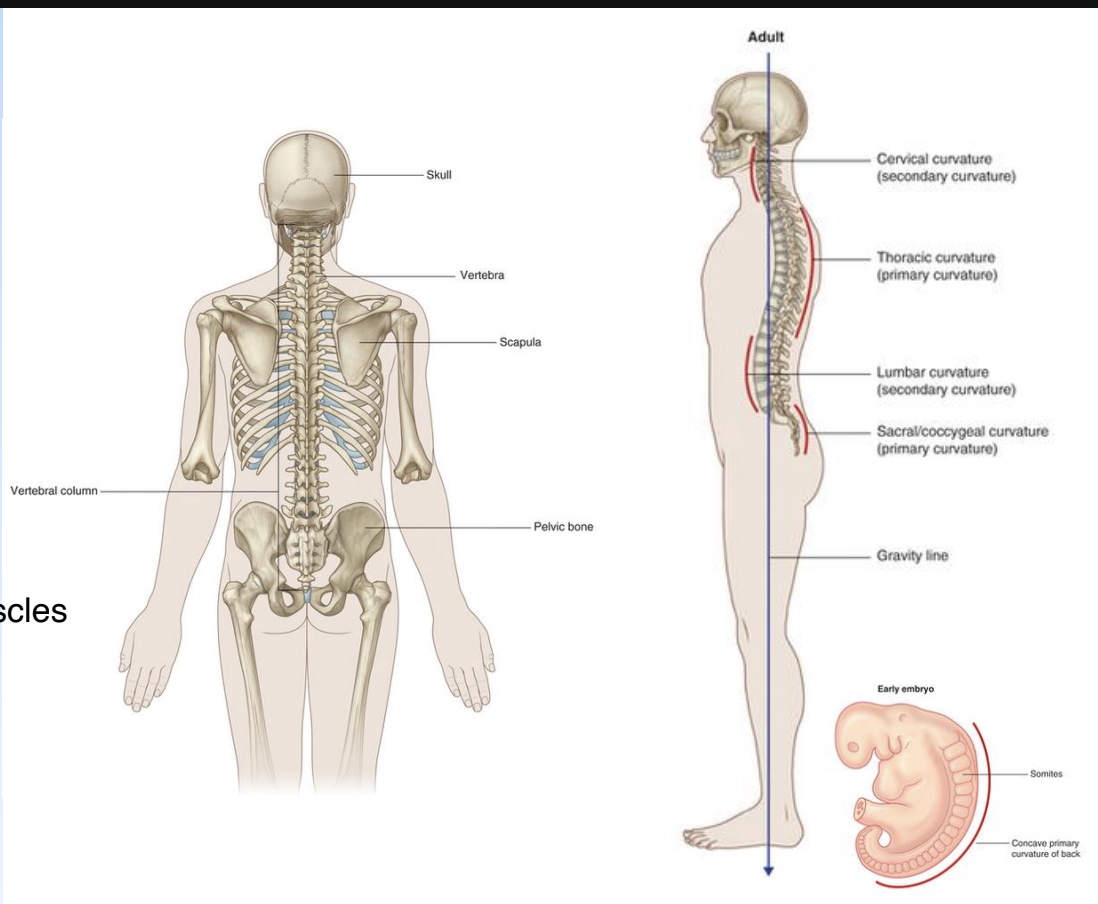
What are the secondary curvatures of the spine?
cervical and lumbar regions
lordosis/lordotic - posteriorly curved regions

What is the main function of the extrinsic back muscles?
moves the limbs and ribs
What is the main function of the intrinsic back muscles?
maintain posture and move vertebral column
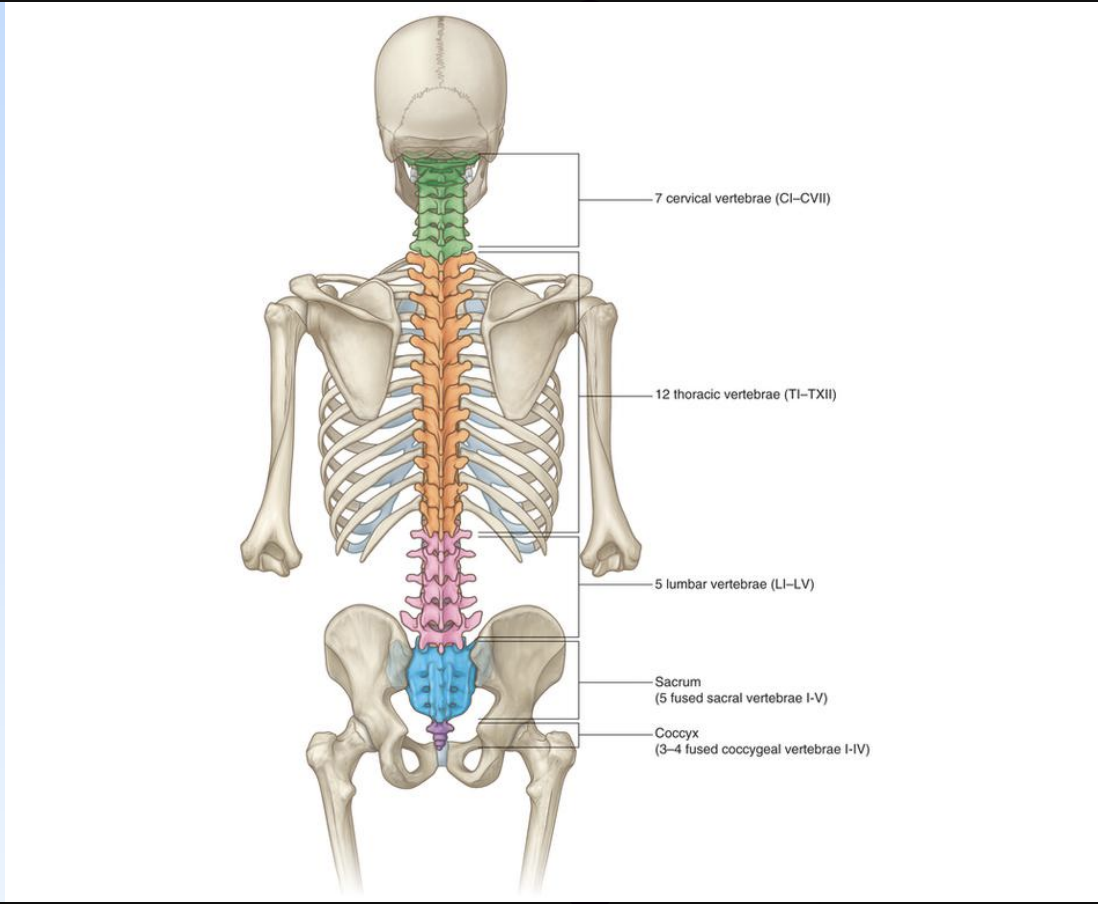
What are the sections of the spine and how many vertebrae are within each group?
cervical (7)
thoracic (12)
lumbar (5)
sacral (5 fused)
coccyx (3-4 fused)
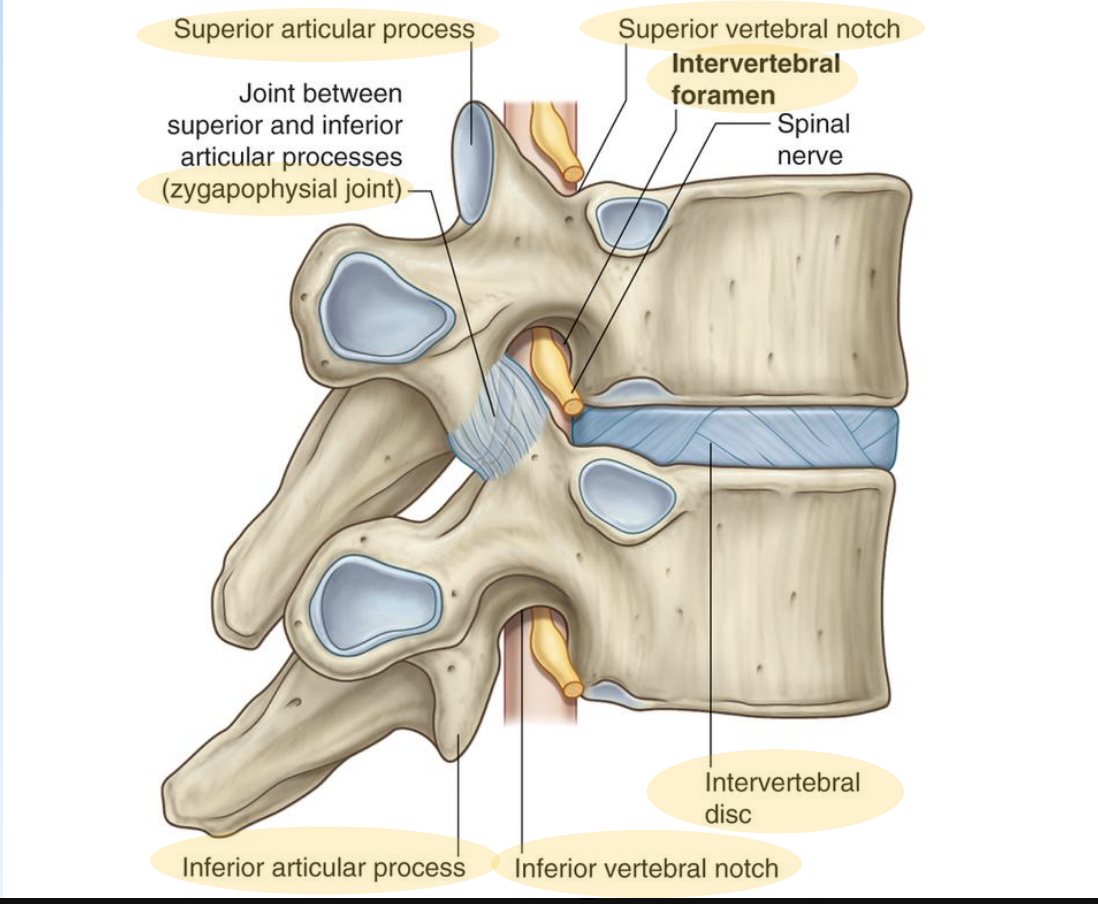
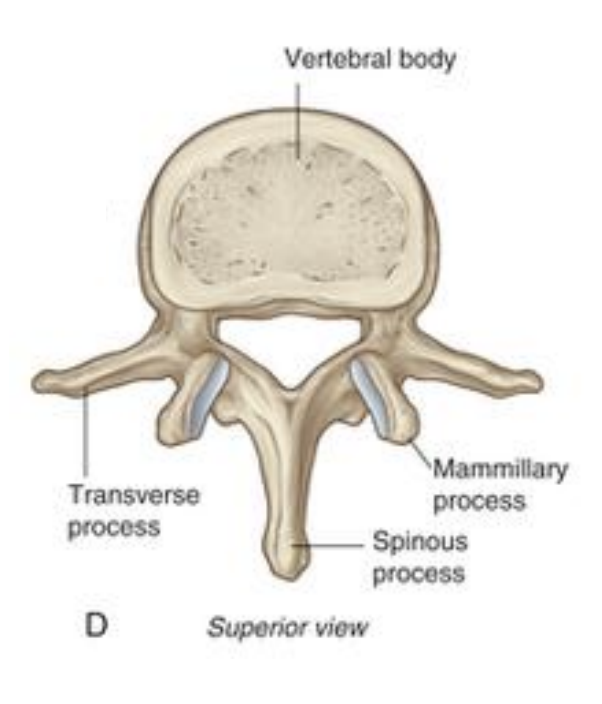
What are the structures of a typical vertebra?
Vertebral Body
Vertebral Arch
pedicle
transverse process
lamina
spinous process
superior and inferior articular processes
superior and inferior vertebral notches

What vertebral structures come together to form the vertebral canal which houses and protects the spinal cord?
vertebral bodies and IV discs (anteriorly)
vertebral arches (posteriorly and laterally)

What vertebral structures come together to form the intervertebral foramen where spinal nerves exit the vertebral canal?
superior and inferior articular processes (posteriorly)
superior and inferior vertebral notches (superiorly and inferiorly)
IV discs and vertebral bodies (anteriorly)
What structure separates the vertebral bodies from each other?
intervertebral discs
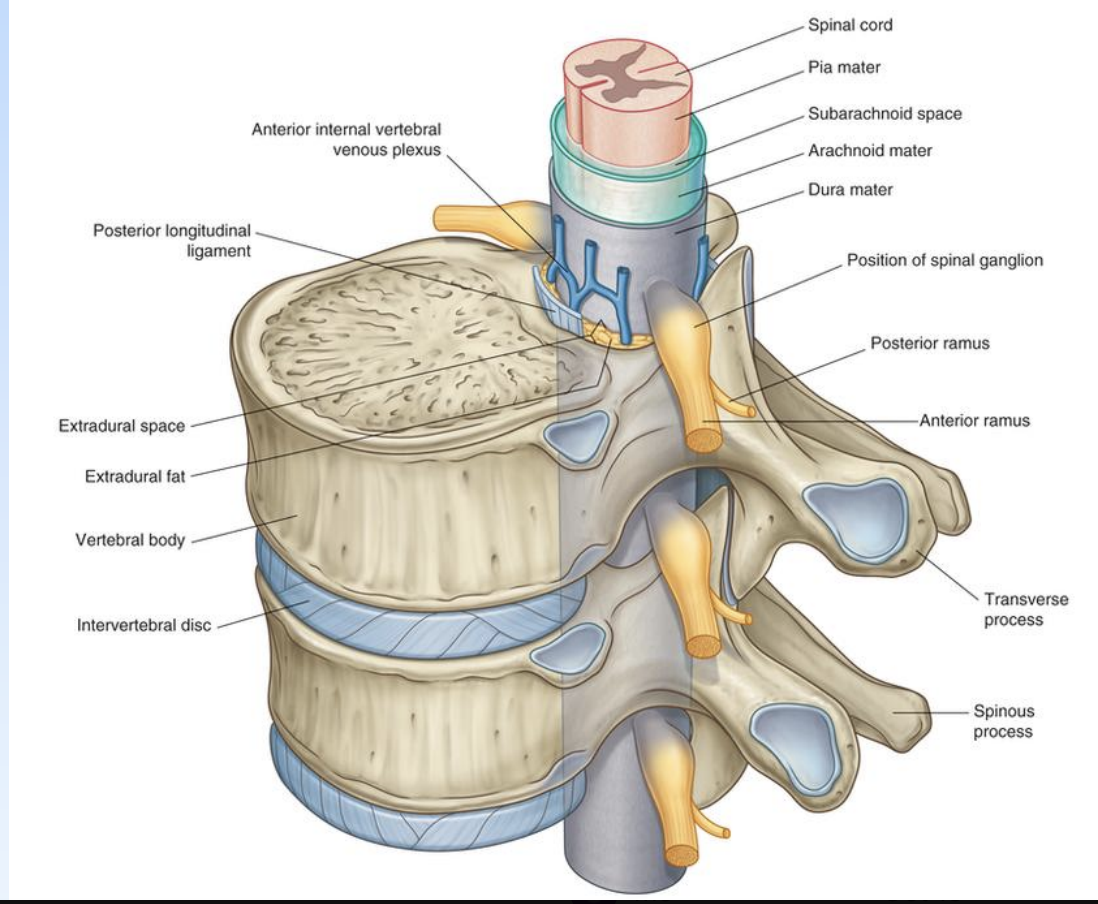
Where does the spinal cord terminate?
~level of L2 (varies)

What is a zygapophysial joint?
articulation between inferior and superior articular processes of adjacent vertebrae

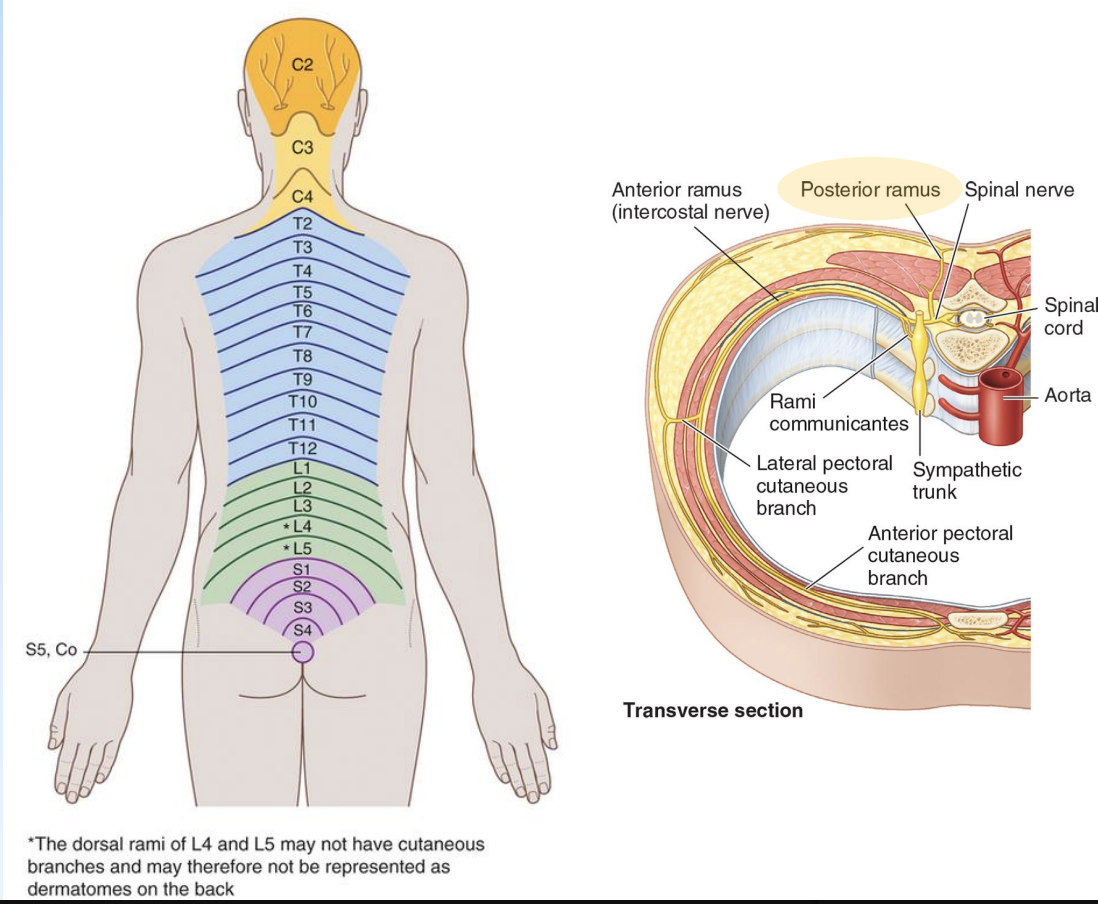
What is the innervation of the back?
posterior rami innervate deep back musculature (intrinsic) and skin
anterior rami innervate superficial/intermediate back muscles (extrinsic)
What are the main arteries that supply the spinal cord?
anterior spinal artery - arises in cranium from junction of vertebral arteries
posterior spinal arteries - arise in cranium from vertebral arteries
segmental arteries- feed spinal cord via IV foramina at every level

What is the venous drainage of the spinal cord?
anterior and posterior spinal veins drain into internal vertebral plexus (extradural)

What are the unique features of cervical vertebrae?
smaller and shorter in height
transverse foramen
concave superior vertebral body surface (uncinate process)
convex inferior vertebral body surface
short, bifid spinous process (sometimes)
triangular vertebral foramina

What is the purpose of the transverse foramen of cervical vertebrae?
allow for passage of vertebral arteries into the foramen magnum before merging (basilar artery) and heading to the brain

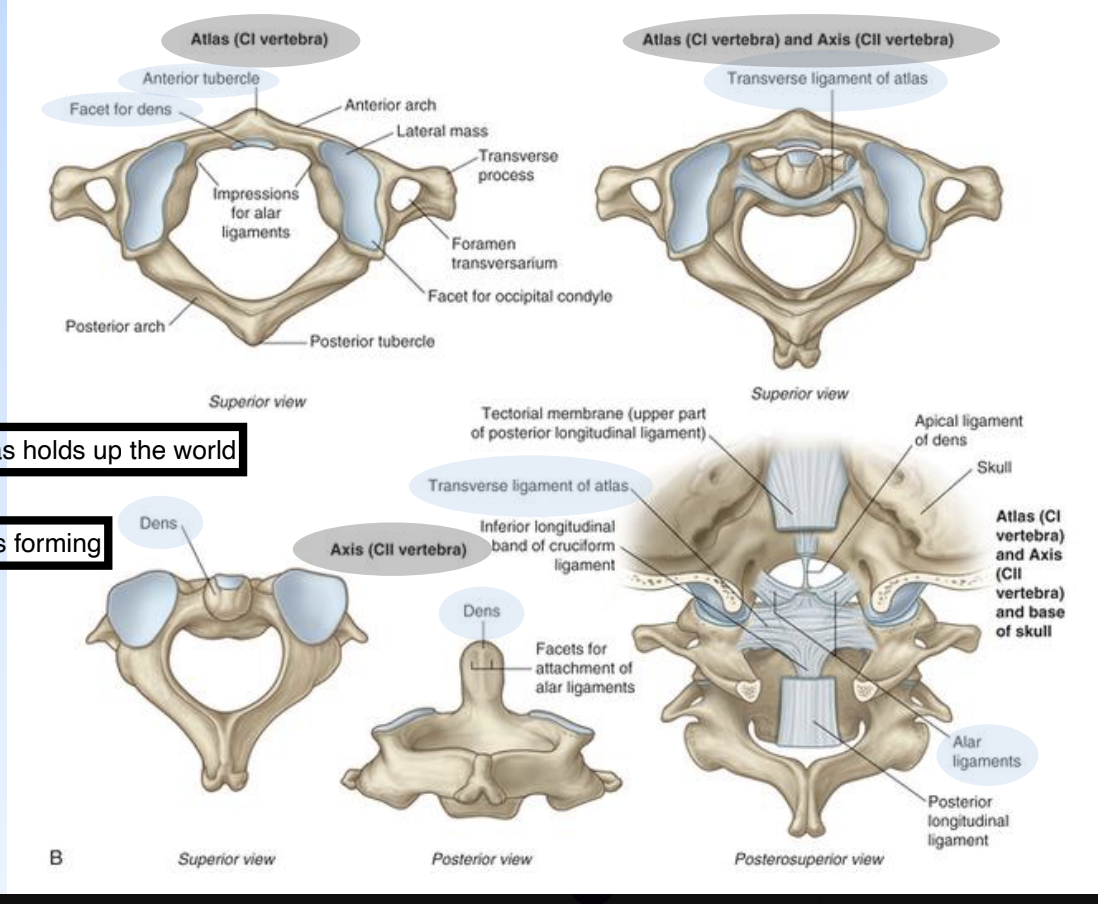
What are the unique features of the atlas (C1)?
no IV disc with axis
no vertebral body
ring-shaped with anterior and posterior arches forming tubercles
facet for dens
strong transverse ligament of atlas (prevents posterior movement of dens0

What does the atlas articulate with?
atlanto-occipital joint (convex occipital condyles → concave superior articular process, nodding yes)
atlanto-axial joint (shaking head no)

What are the unique features of the axis (C2)?
dens (stabilized by transverse ligament of atlas)
alar ligaments (attach dens to occipital condyles (limits rotation)
What are the unique features of the thoracic vertebrae?
articulations for ribs at vertebral bodies and transverse processes
sharper angle of spinous process

What are the unique features of the thoracic vertebrae?
very large vertebral bodies
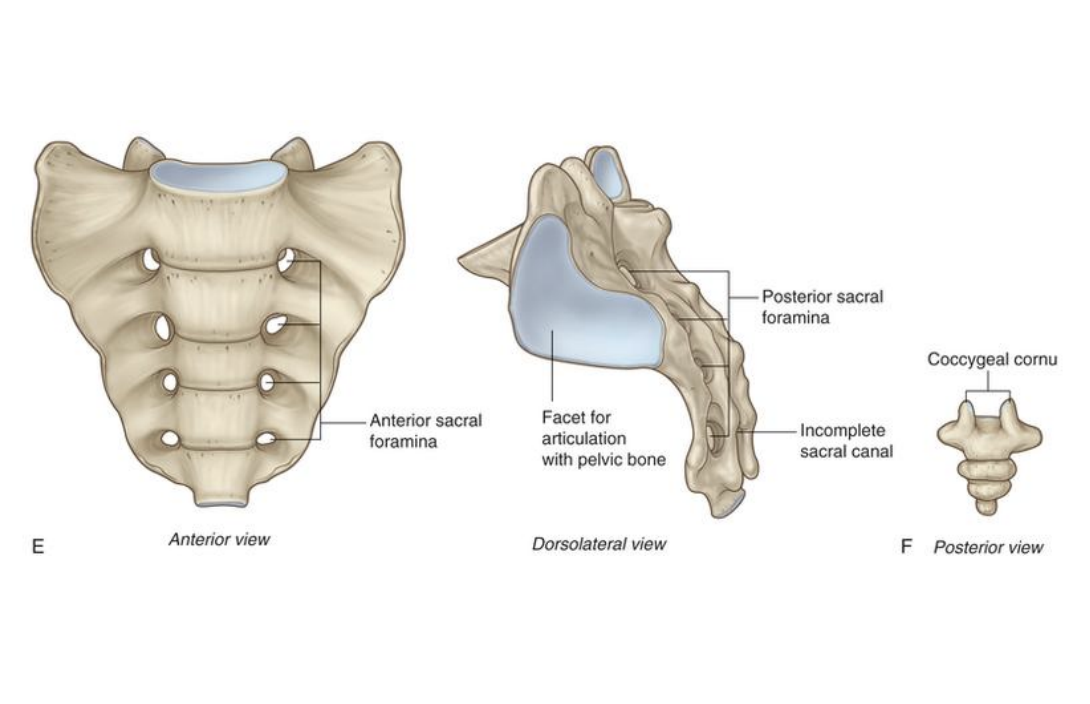
What are the joints associated with the sacrum and coccyx?
lumbosacral joint
sacroiliac joint
What are the major types of spinal joint and where do they occur?
symphyses occur between vertebral bodies (IV discs)
synovial joints occur between articular processes (and between uncinate processes)
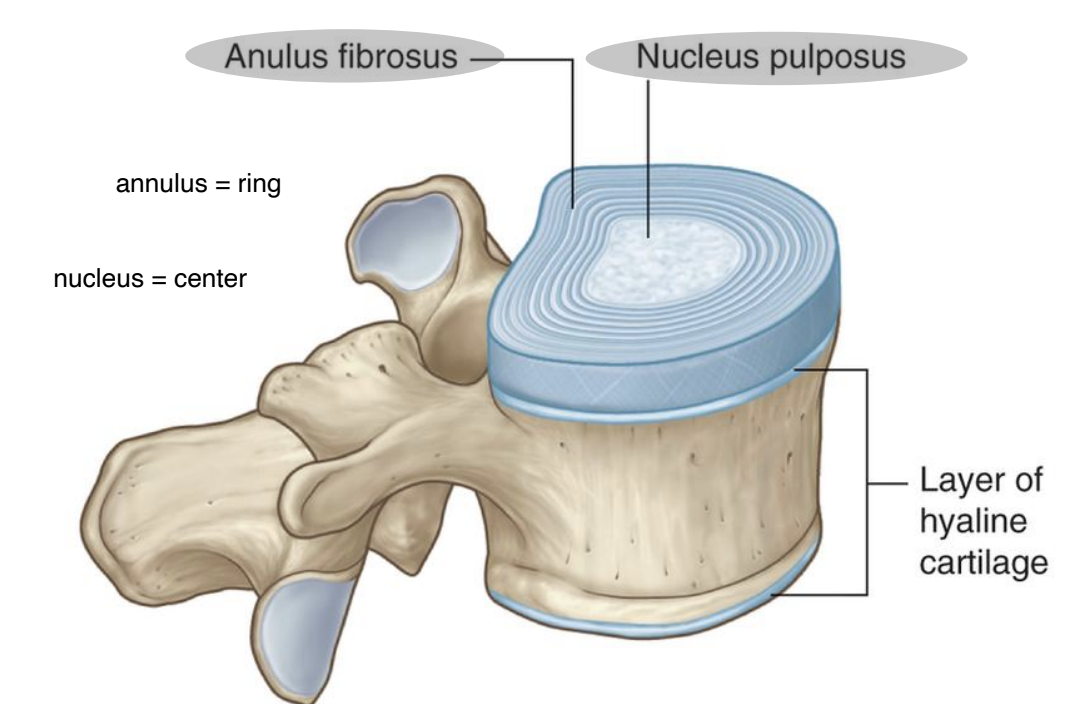
What are the components of intervertebral discs?
annulus fibrosus - fibrocartilage in lamellar formation (resists rotation)
nucleus pulposus - gelatinous center (absorbs compression)
What are the synovial joints present in the spine?
zygapophysial joints
uncovertebral joints
What are the articulating surfaces of an uncovertebral joint?
uncinate processes of superior aspect of cervical vertebral bodies receive convex surface of cervical vertebral body above

What are the major ligaments of the spine?
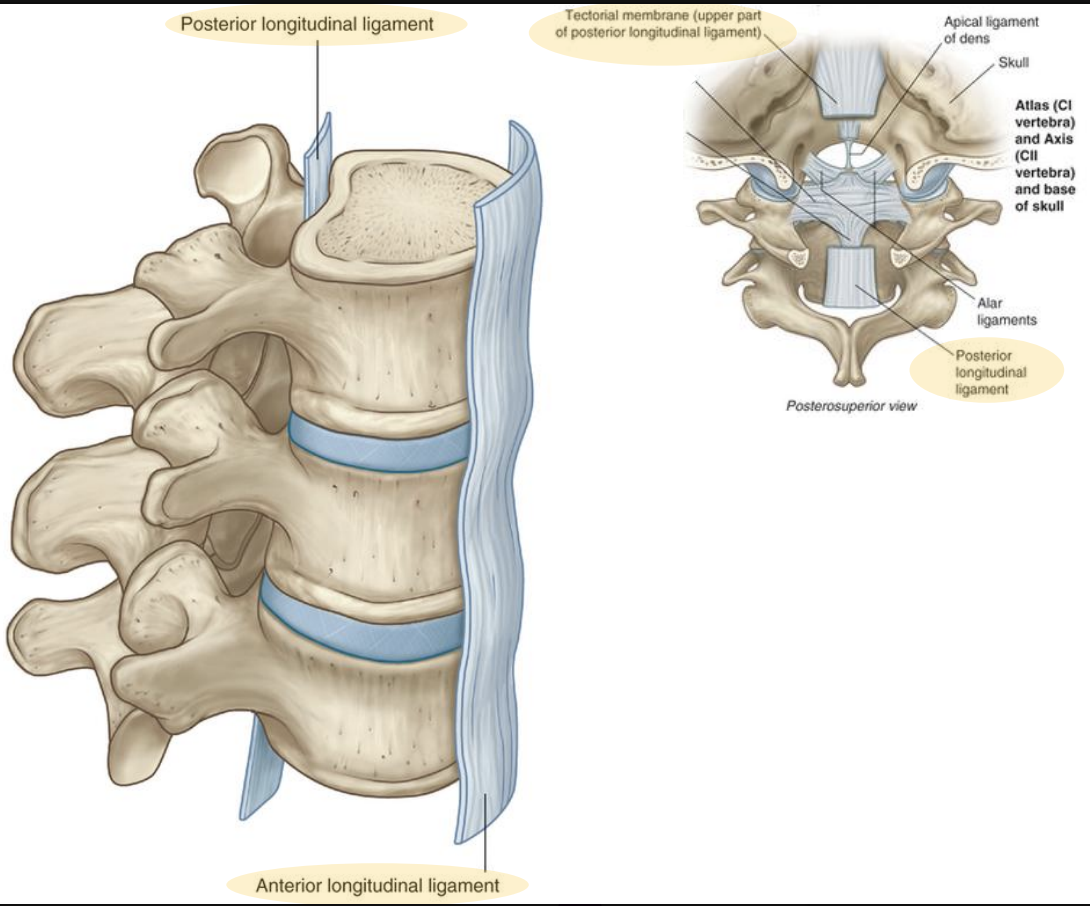
anterior longitudinal ligament
posterior longitudinal ligament
ligamentum flava
ligamentum nuchae
supraspinous ligament
interspinous ligament
Where does the anterior longitudinal ligament run and where does it attach?
from base of skull to anterior sacrum
attached to anterior vertebral bodies and IV discs

Where does the posterior longitudinal ligament run and where does it attach?
runs the length of the vertebral column
attached to posterior surface of vertebral bodies and IV discs
lines the anterior portion of the vertebral canal

What is the length of the posterior longitudinal ligament that is attached to C2 and connects to the skull called?
tectorial membrane
Where does the ligamentum flava attach?
between laminae of each vertebrae
form part of posterior surface of vertebral canal

Where does the supraspinous ligament run and where does it attach?
runs along tips of spinous processes from C7 to sacrum
becomes ligamentum nuchae past C7
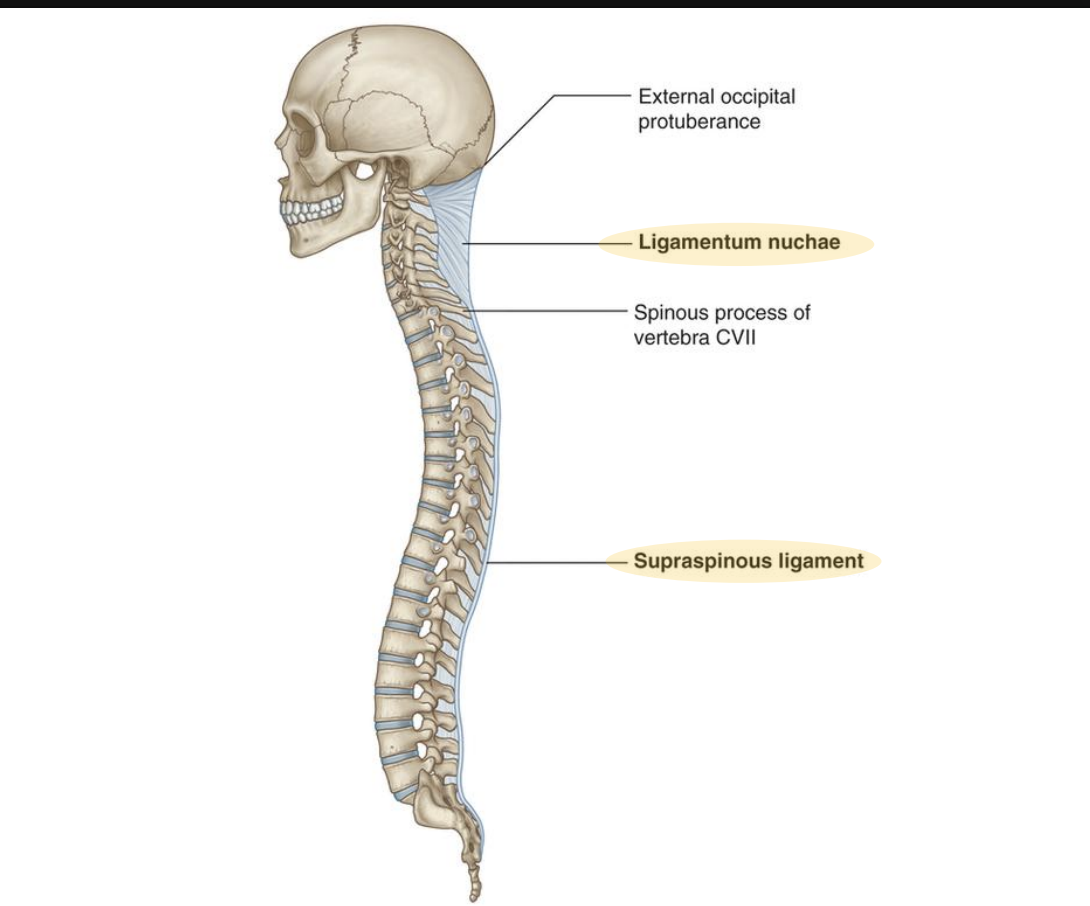
Where does the ligamentum nuchae run and where does it attach?
runs from C7 to skull
connects to external occipital protuberance, tip of C7, spinous processes of above cervical vertebrae

Where do the interspinous ligaments attach?
run between spinous processes
blend with ligamentum flava (anteriorly) and supraspinous ligament (posteriorly)

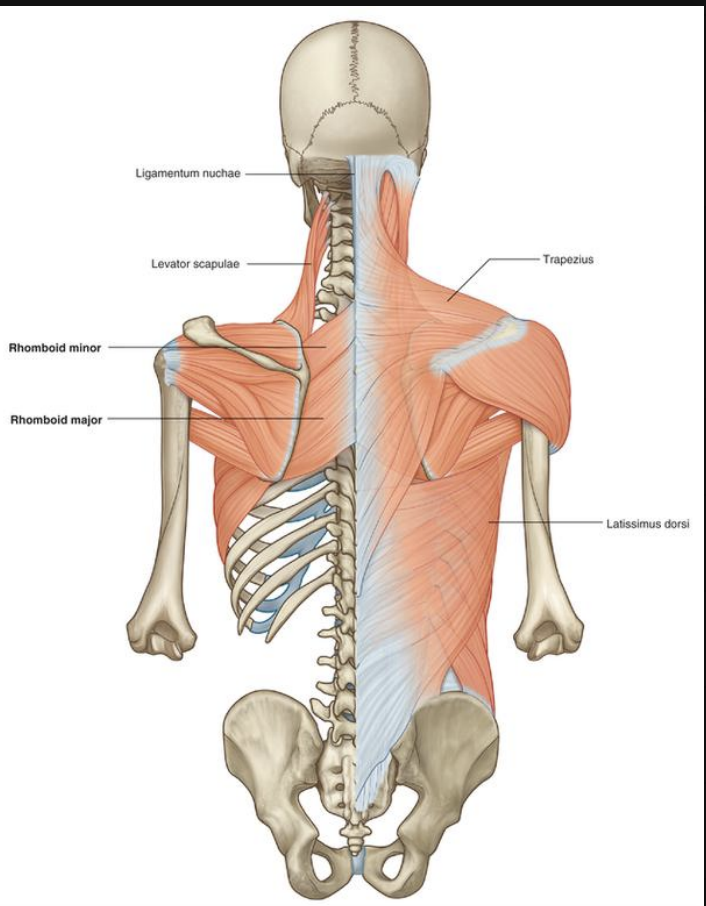
What are the superficial back muscles?
latissimus dorsi
trapezius
levator scapulae
rhomboid major
rhomboid minor

What are the features of the superficial back muscles?
immediately deep to skin and superficial fascia
attach appendicular skeleton to axial skeleton (movers of appendicular skeleton)
innervated by anterior rami
What is the OIIA of trapezius?
O: skull (superior nuchal line, external occipital protuberance), spine (spinous processes C7-T12), ligamentum nuchae
I: clavicle (lateral 1/3), scapular (acromion and spine)
I: accessory nerve (CN XI, motor), C3-C4 (sensory, proprioception)
A: moves the scapula (rotating scapular with abduction of humerus past horizontal, upper fibers elevate, middle fibers adduct, lower fibers depress)

What is the OIIA of latissimus dorsi?
O: spine (spinous processes of T7-L5, sacrum), iliac crest, ribs 10-12
I: humerus (intertubercular sulcus)
I: thoracodorsal nerve (C6-C8)
A: moves the humerus (extension, adduction, internal rotation)

What is the OIIA of levator scapulae?
O: spine (transverse processes C1-C4)
I: scapula (medial border, upper aspect)
I: C3-C4, dorsal scapular nerve (C4-C5)
A: elevates scapula
What is the OIIA of rhomboid minor?
O: spine (spinous processes C7-T1), ligamentum nuchae (lower portion)
I: scapula (medial border, at spine
I: dorsal scapular nerve (C4-C5)
A: moves the scapula (retraction, adduction, elevation

What is the OIIA of rhomboid major?
O: spine (spinous processes T2-T5)
I: scapular (medial border, between spine and inferior angle)
I: thoracodorsal nerve (C4-C5)
A: moves the scapula (retraction, adduction, elevation)

What is the blood supply of the superficial back musculature?
Transverse Cervical Artery (levator scapulae)
superficial branch (trapezius)
deep branch (rhomboid major and minor)
Thoracodorsal Artery (latissimus dorsi)

What are the intermediate back muscles?
serratus posterior superior
serratus posterior inferior
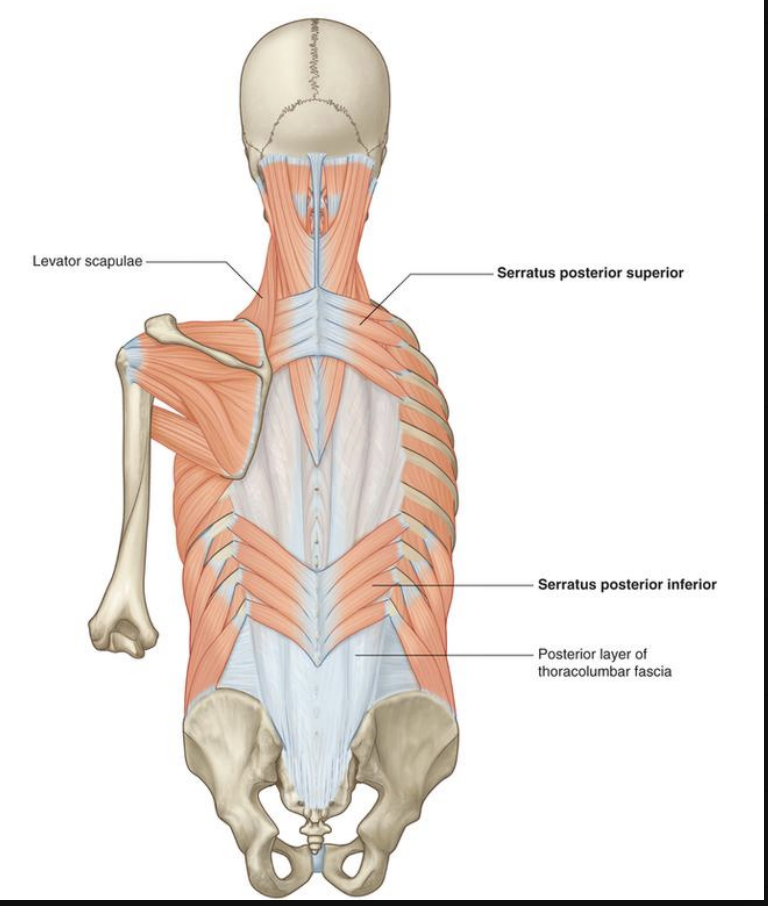
What are the features of the intermediate back muscles?
respiratory group of back muscles
attach to spinal column medially and posteriorly
innervated by anterior rami of segmental branches of thoracic spinal nerves (intercostal nerves)
What is the OIIA of serratus posterior superior?
O: spine (spinous processes C7-T3), ligamentum nuchae (lower portion), supraspinous ligament
I: ribs 2-5 (upper border, lateral to angles)
I: upper thoracic nerves (T2-T5, anterior rami)
A: elevates ribs 2-5 (proprioception)

What is the OIIA of serratus posterior inferior?
O: spine (spinous processes T11-L3), supraspinous ligament
I: ribs 9-12 (lower border, lateral to angles)
I: lower thoracic nerves (T9-T12, anterior rami)
A: depresses ribs 9-12 (proprioception)
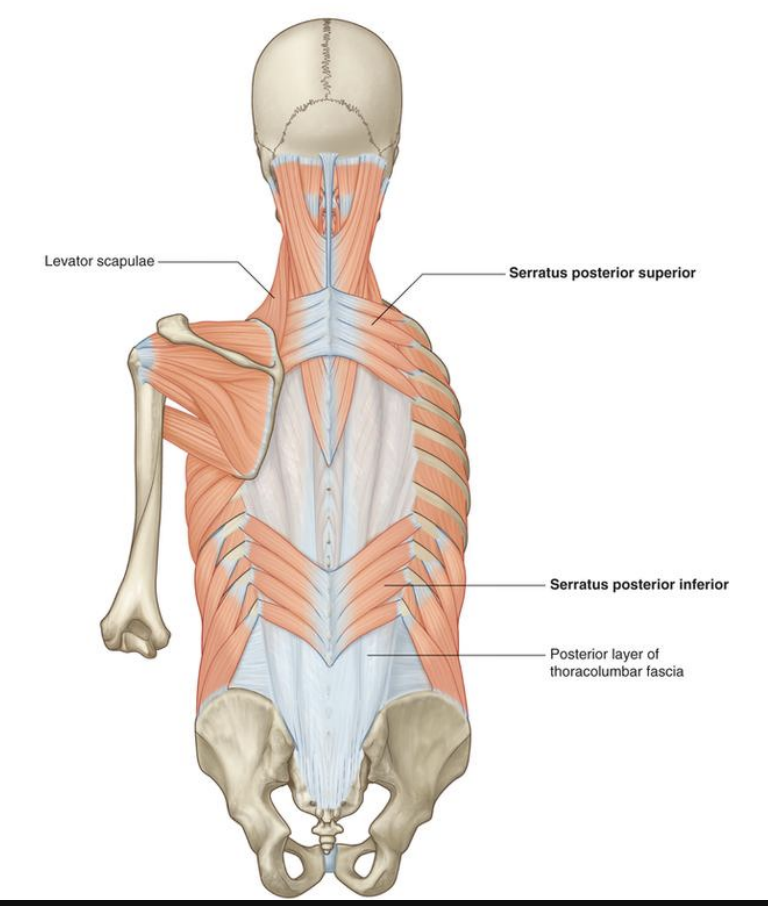
What is thoracolumbar fascia?
deep fascia that separates deep back muscles from intermediate and superficial layers
attaches to spinous processes of thoracic vertebrae and ribs (at angles)

What are the layers of thoracolumbar fascia?
anterior
middle
posterior

What are the features of the deep back muscles?
extend from skull to pelvis
innervated by posterior rami of segmental branches of spinal nerves
What are the deep back muscles?
Extensors and Rotators of Head/Neck
spinotransversales group
Extensors and Rotators of Vertebral Column
erector spinae group
transversospinales group
Short, Segmental Muscles
levatores costarum group
interspinales group
intertransversarii group

What muscles are in the spinotransversales group?
splenius capitis
splenius cervicis

What is the OIIA of splenius capitis?
O: spine (spinous processes C7-T4), ligamentum nuchae (lower portion)
I: temporal bone (mastoid process), occipital bone (below lateral portion of superior nuchal line)
I: middle cervical nerves (posterior rami)
A:
Bilaterally = draw head backward (retract), extend neck
Unilaterally = draw and rotate head to same side
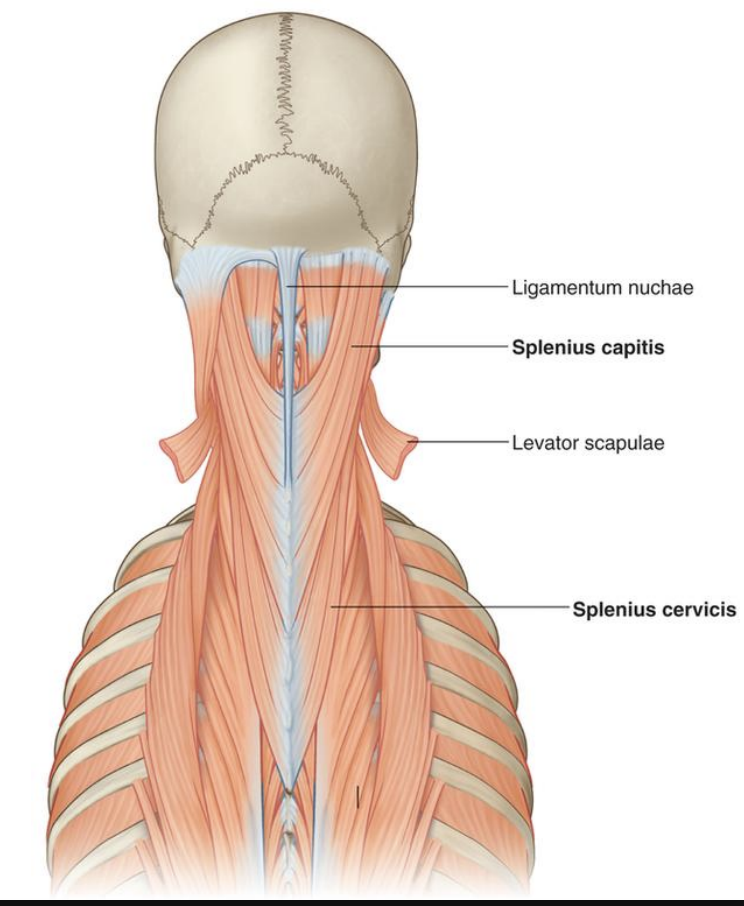
What is the OIIA of splenius cervicis?
O: spine (spinous processes T3-T6)
I: spine (transverse processes C1-C3)
I: lower cervical nerves (posterior rami)
A:
Bilaterally = draw head backward (retract), extend neck
Unilaterally = draw and rotate head to same side

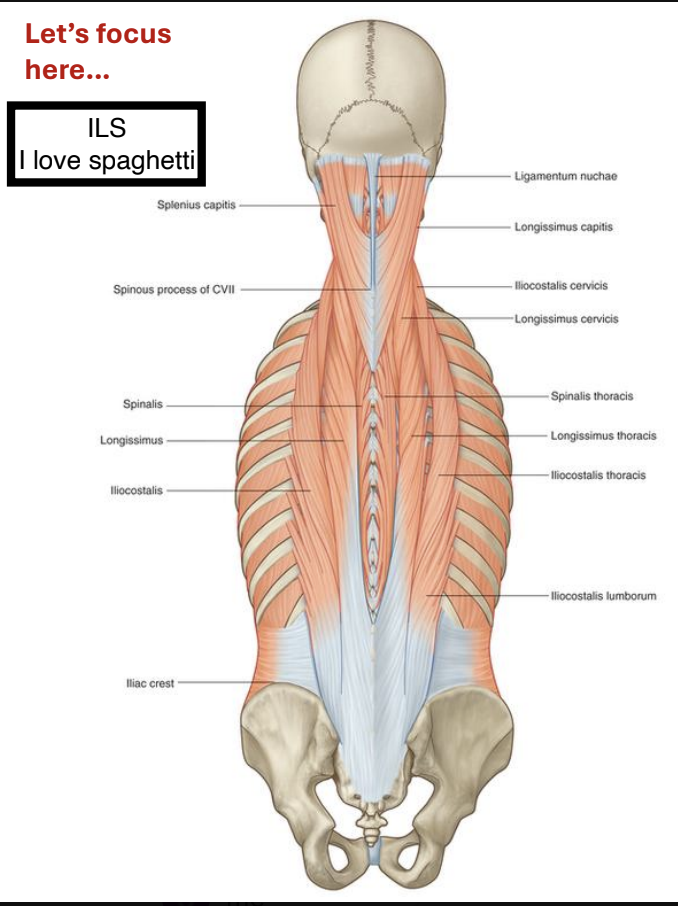
What are the muscles of the erector spinae group?
iliocostalis
longissimus
spinalis

What is the OIIA of iliocostalis?
O: iliac crests
I: upper ribs (angles)
I: segmental branches of spinal nerves (posterior rami)
A: spinal extension, spinal flexion control, postural maintenance; lateral/side flexion (unilaterally)

What is the OIIA of longissimus?
O: transverse processes (lumbar and thoracic), articular processes (cervical)
I: transverse processes (thoracic and cervical), mastoid process
I: segmental branches of spinal nerves (posterior rami)
A: spinal extension, spinal flexion control, postural maintenance; lateral/side flexion (unilaterally)

What is the OIIA of spinalis?
O: spinous processes of C7-L2
I: spinous processes of thoracic vertebrae and C2 (axis)
I: segmental branches of spinal nerves (posterior rami)
A: spinal extension, spinal flexion control, postural maintenance; lateral/side flexion (unilaterally)
What are the muscles of the transversospinales group?
semispinalis
multifidus
rotatores

What is the OIIA of semispinalis?
O: spine (thoracic transverse processes, cervical articular processes)
I: spine (spinous processes of 4-6 vertebrae above [cervicis]), head (occipital bone [capitis])
I: segmental branches of spinal nerves (posterior rami)
A:
Bilaterally = spinal extension; head retraction (semispinalis capitis only)
Unilaterally = contralateral spinal rotation, ipsilateral head rotation [semispinalis capitis only])

What is the OIIA of multifidus?
O: spine (ilium and sacrum, thoracic transverse processes, lumbar and cervical articular processes)
I: spine (spinous processes 3-4 vertebrae above
I: