rx test 1 study guide pt1

0.0(0)
Studied by 0 people
call kaiCall Kai
learnLearn
examPractice Test
spaced repetitionSpaced Repetition
heart puzzleMatch
flashcardsFlashcards
GameKnowt Play
Card Sorting

1/55

encourage image

There's no tags or description

Looks like no tags are added yet.

Last updated 7:12 PM on 9/28/26
Name
Mastery
Learn
Test
Matching
Spaced
Call with Kai
Chat

No analytics yet

Send a link to your students to track their progress

56 Terms

1
New cards

Physical activity

Any bodily movement produced by skeletal muscles that results in energy expenditure; this is not necessarily exercise.

2
New cards

Physical fitness

An attained set of attributes, such as muscular strength and flexibility.

3
New cards

Sedentary behavior

Behavior in a sitting, reclining, or lying posture while engaging in minimal energy expenditure (≤1.5 METs).

4
New cards

What is 1 MET?

3.5 mL·kg⁻¹·min⁻¹.

5
New cards

What are the basic physical activity recommendations for healthy adults ages 18–65?

Moderate-intensity aerobic physical activity for at least 30 min on 5 days each week OR vigorous-intensity aerobic physical activity for at least 20 min on 3 days each week.

6
New cards

engaging in sufficient physical activity has been identified as the

____ leading risk factor

fourth

7
New cards

The higher the intensity of physical activity, the greater the

reduction in risk of stroke and related outcomes (vigorous better than moderate)

8
New cards

inverse/ reduction relation with what cancers

inverse for lung, colon, and pancreatic relative for breast cancer

9
New cards

Stand goal met? No evidence this is meaningful

standing doesnt show to help anything

10
New cards

what percent increased risk of childhood obesity with every hour per day spent

watching television


13%

11
New cards

sedentary time such that individuals with 13 hours per day of sitting had more

than _____ the risk of developing cancer as those with 8 hours per day

twice
12
New cards
Informed consent
The first step before collecting personal/confidential information, fitness testing, or exercise prescription; explains risks and allows the participant to ask questions or withdraw at any time.
13
New cards
Who gives informed consent for a minor?
The parent/guardian gives consent; the minor gives assent.
14
New cards
What is the goal of preexercise screening?
Identify people at risk for an adverse event during exercise and determine who needs medical clearance.
15
New cards
What does the ACSM preparticipation screening algorithm consider?
Current exercise participation, known cardiovascular/metabolic/renal disease, signs or symptoms, and desired exercise intensity.
16
New cards
No exercise + no disease + asymptomatic
No medical clearance needed for light-to-moderate exercise.
17
New cards
No exercise + known cardiovascular, metabolic, or renal disease + asymptomatic
Medical clearance before light-to-moderate exercise.
18
New cards
No exercise + symptomatic
Medical clearance before exercise.
19
New cards
Regular exercise + no disease + asymptomatic
No medical clearance needed for moderate-to-vigorous exercise.
20
New cards
Regular exercise + known cardiovascular, metabolic, or renal disease + asymptomatic
No clearance needed for moderate exercise; clearance needed before vigorous exercise.
21
New cards
Regular exercise + symptoms suggestive of cardiovascular, metabolic, or renal disease
Discontinue exercise and seek medical clearance.
22
New cards
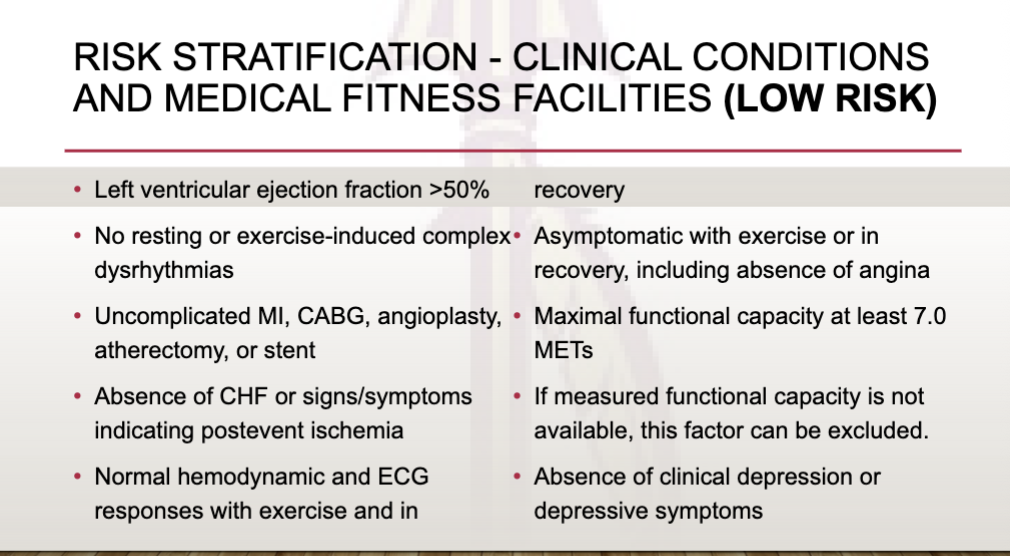
Low-risk classification
LVEF >50%; asymptomatic with exercise/recovery; normal hemodynamic and ECG responses; no complex dysrhythmias; functional capacity ≥7 METs.
23
New cards
Moderate-risk classification
LVEF 40–50%; angina/signs or symptoms at moderate exercise (60–75% maximal functional capacity); mild-to-moderate silent ischemia.
24
New cards
High-risk classification
LVEF <40%; symptoms at low exercise (<5 METs); functional capacity <5 METs; abnormal exercise hemodynamics, significant ischemia, or complex ventricular dysrhythmias.
25
New cards
Normal blood pressure
SBP <120 AND DBP <80 mm Hg.
26
New cards
Elevated blood pressure
SBP 120–129 AND DBP <80 mm Hg.
27
New cards
Stage 1 hypertension
SBP 130–139 OR DBP 80–89 mm Hg.
28
New cards
Stage 2 hypertension
SBP ≥140 OR DBP ≥90 mm Hg.
29
New cards
What does SBP represent?
Systolic blood pressure; the pressure during contraction of the heart.
30
New cards
What does DBP represent?
Diastolic blood pressure; the pressure during relaxation of the heart.
31
New cards
What are Korotkoff sounds used for?
To determine systolic and diastolic blood pressure when manually measuring BP.
32
New cards
When taking blood pressure, what does the first Korotkoff sound indicate?
Systolic blood pressure.
33
New cards
When taking blood pressure, what does disappearance of Korotkoff sounds indicate?
Diastolic blood pressure.
34
New cards
CVD risk factors
Age, family history, cigarette smoking, physical inactivity, obesity, hypertension, dyslipidemia, and elevated blood glucose
35
New cards
Negative CVD risk factor
High HDL cholesterol (protective)
36
New cards


37
New cards


38
New cards
VO₂max
The maximal amount of oxygen the body can take in and use during exercise; a measure of cardiorespiratory fitness.
39
New cards
Absolute VO₂max
VO₂max expressed without adjusting for body weight.
40
New cards
Relative VO₂max
VO₂max expressed relative to body weight in mL/kg/min.
41
New cards
What is the purpose of a maximal exercise test (GXT)?
Diagnosis, prognosis, and evaluation of the exercise response to guide exercise prescription.
42
New cards
What is needed for an accurate submaximal VO₂max estimate?
Steady-state HR at each workload, a linear HR-work rate relationship, accurate predicted HRmax, and similar mechanical efficiency.
43
New cards
What can interfere with an accurate submaximal VO₂max estimate?
Medications that alter HR, high caffeine intake, illness, and high environmental temperature.
44
New cards
What should be reviewed before an exercise test?
Completed consent and screening forms.
45
New cards
What equipment preparation is needed before exercise testing?
Equipment should be properly calibrated and data collection forms should be ready.
46
New cards
What should the testing environment be like?
Quiet, private, well ventilated, 68–72°F, and <60% humidity.
47
New cards
What should a person avoid within 3 hours before cardiorespiratory testing?
Food, caffeine, alcohol, and tobacco.
48
New cards
What should a person avoid for at least 24 hours before cardiorespiratory testing?
Strenuous exercise.
49
New cards
Absolute contraindication
A condition in which an exercise test should NOT be performed.
50
New cards
Relative contraindication
A condition in which the risks of testing must be weighed against the benefits before performing the test.
51
New cards
What should be monitored during a symptom-limited maximal exercise test?
Heart rate, blood pressure, ECG when appropriate, symptoms, and the person's response to increasing exercise intensity.
52
New cards
Abnormal systolic BP response during exercise
A failure of SBP to rise appropriately or a drop in SBP as exercise intensity increases.
53
New cards
Why is a drop in SBP during increasing exercise concerning?
It can indicate an abnormal cardiovascular response and may be a reason to stop the test.
54
New cards
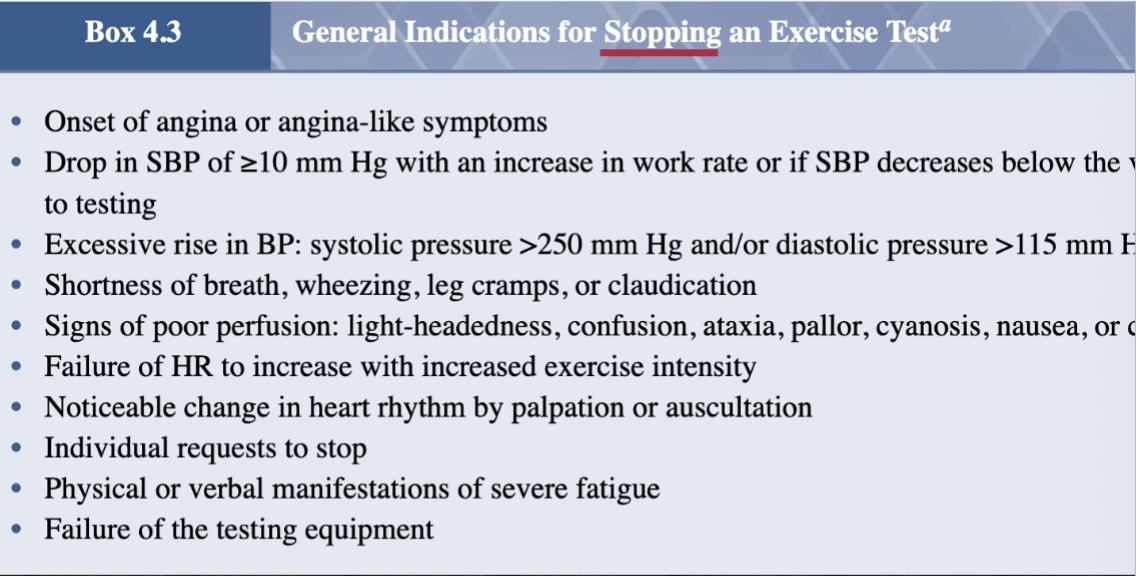
General reasons to stop an exercise test
Abnormal BP response, significant symptoms, abnormal ECG/arrhythmias, signs of poor perfusion, equipment problems, or the participant requests to stop.
55
New cards
Symptom-limited maximal exercise test
The test continues as intensity increases until symptoms or another clinical indication requires the test to stop.
56
New cards