Compass Study Plan A: Maternity Quiz 2
 Call Kai
 Learn
 Practice Test
 Spaced Repetition
 Match
 Flashcards
 Knowt Play
1/13

There's no tags or description
Looks like no tags are added yet.
14 Terms
A client had a cesarean birth 3 days ago. Where would the nurse, while palpating the client’s fundus, expect to locate the fundus if each line represents 1 cm?
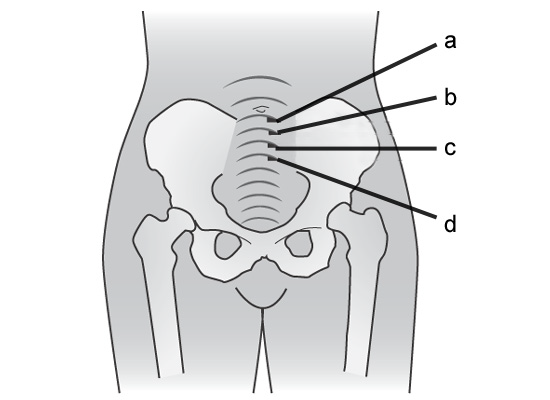
a
b
c
d
c
Three days after birth, the fundus should be located 3 cm below the umbilicus; 12 hours after birth it should be located about 1 cm above the umbilicus; each following day it drops 1 to 2 cm. Location a is too high; the fundal height is 1 cm below the umbilicus on day 1. Location b is too high; the fundal height is 2 cm below the umbilicus on day 2. Location d is too low; the fundal height is 4 cm below the umbilicus on day 4.
The nurse explains to the pregnant client that the serum alpha-fetoprotein test screens for which condition?
Trisomy 21
Turner syndrome
Open neural tube defects
Chromosomal aberrations
Open neural tube defects
An increased level of alpha-fetoprotein (AFP), a fetal serum protein, has been found to reflect open neural tube defects such as spina bifida and anencephaly. Genetic testing of fetal cells reveals trisomy 21. Genetic studies will reveal the presence of just one X chromosome in a female child (Turner syndrome). Genetic testing, not AFP testing, will reveal chromosomal aberrations.
During the initial assessment of a newborn the nurse suspects a congenital heart defect. Which clinical manifestations support this suspicion? Select all that apply. One, some, or all responses may be correct.
Nasal flaring
Sternal retractions
Grunting respirations
Short periods of apnea
Cyanotic hands and feet
Heart rate of 160 beats/min
Nasal flaring
Sternal retractions
Grunting respirations
Nasal flaring occurs because of the stress of breathing; the flaring allows more air to enter the respiratory passages. Sternal retractions occur when accessory muscles of respiration contract during the stress of breathing. Grunting respirations occur as the glottis closes and reopens at the height of inhalation; this momentary closure of the glottis increases the time during which oxygen and carbon dioxide are exchanged in the alveoli. Newborns have irregular respirations with periods of apnea. Cyanosis of the hands and feet (acrocyanosis) is typical of all newborns at the time of birth. A heart rate of 160 beats/min is within the expected range of heart rates of healthy infants.
A client at her first visit to the prenatal clinic states that she has missed three menstrual periods and thinks that she is carrying twins because her abdomen is so large. She now has a brownish vaginal discharge. Her blood pressure is increased, indicating that she may have gestational hypertension. Which condition is suggested by this client profile?
Renal failure
Placenta previa
Hydatidiform mole
Abruptio placentae
Hydatidiform mole
Hydatidiform mole develops in 15% of women with gestational hypertension during the first trimester. Signs of hydatidiform mole include slight painless vaginal bleeding and a larger-than-expected uterus. Renal failure is an unlikely complication unless the hypertension becomes severe or there was preexisting hypertension. The client’s adaptations are not associated with placenta previa, a hemorrhagic condition that results in problems in the third trimester. Premature separation of the placenta is associated with uterine bleeding, uterine hypertonicity, abdominal pain, and a boardlike abdomen; usually it occurs in the last trimester.
Which is the position of the fetus whose buttocks are in the fundus, whose fetal back is on the maternal right side between the midline and lateral surface of the abdomen, and whose attitude is general flexion?
Right sacrum anterior (RSA)
Right occiput anterior (ROA)
Right mentoanterior (RMA)
Left occiput anterior (LOA)
Right occiput anterior (ROA)
The fetus is in the ROA position, with the occiput facing the front on the right side of the mother. It is a vertex delivery. In the RSA position, the buttocks point anteriorly on the mother’s right side. RMA is a brow presentation. In LOA, another vertex position, the fetus’s back is on the mother’s left side.
Which nursing intervention would be recommended for a client after a radiation implant is inserted as part of internal radiation therapy for cervical cancer?
Ensuring that the client’s diet is low residue
Placing the client in the high-Fowler position
Checking the client’s voiding and catheterizing if necessary
Staying with the client for half an hour and assessing her for signs of radiation sickness
Ensuring that the client’s diet is low residue
Clients with internal radiation for cervical cancer are given a low-residue diet and often medications to suppress peristalsis and prevent pressure from bowel movements. The necessity for this altered diet should be explained to the client. If the head of the bed is elevated, the implant may be dislodged by gravity. A catheter is inserted routinely before loading to prevent bladder distention and possible radiation damage or alteration of implant position. Because the client is the source of radiation, the nurse must limit the time spent with the client to prevent excessive exposure.
Which suggestion for coping with morning sickness would the nurse give to a pregnant client?
"Eat protein before bedtime."
"Take an antacid before breakfast."
"Drink water until the nausea subsides."
"Take an over-the-counter herbal remedy."
"Eat protein before bedtime."
Nausea and vomiting in early pregnancy can be relieved with a small snack of protein before bedtime to slow digestion. An antacid may affect electrolyte balance, and it will not ease morning sickness. Drinking water until the nausea subsides is contraindicated because both fetus and mother need nourishment. Many medications and herbal remedies in the first trimester are contraindicated because this is the period of organogenesis, and such preparations could have teratogenic effects.
A female client asks the nurse whether she should be tested for osteoporosis. Which statements reflect current advice regarding the prevention of osteoporosis? Select all that apply. One, some, or all responses may be correct.
"A bone mineral density test is the only way to diagnose osteoporosis."
"Everyone with osteoporosis should be treated with bisphosphonates."
"All adults need 1000 mg calcium and 400 to 800 IU of vitamin D each day."
"Women should be evaluated clinically for risk of osteoporosis annually after age 70."
"Postmenopausal women and all adults over the age of 65 should be tested for osteoporosis."
"A bone mineral density test is the only way to diagnose osteoporosis."
"Postmenopausal women and all adults over the age of 65 should be tested for osteoporosis."
A bone mineral density test is the only way to diagnose osteoporosis and determine the risk for future fractures. The U.S. Preventive Services Task Force and the National Osteoporosis Foundation recommend testing for all postmenopausal women and all adults over the age of 65. Everyone with osteoporosis will not necessarily be treated with bisphosphonates; many other treatments are available, including calcitonin, estrogens, estrogen agonist-antagonists, and parathyroid. Adults under the age of 50 require 1200 mg of calcium and 800 to 1000 IU of vitamin D. All postmenopausal women, regardless of age, should be evaluated clinically for risk of osteoporosis and need for bone mineral density testing.
Which information would tell the nurse if a woman at 40 weeks’ gestation having contractions is in true labor?
The cervix dilates and becomes effaced in true labor.
Bloody show is the first sign of true labor.
The membranes rupture at the beginning of true labor.
Fetal movements lessen and become weaker in true labor.
The cervix dilates and becomes effaced in true labor.
The major difference between true and false labor is that true labor can be confirmed by the presence of dilation and effacement of the cervix. Bloody show may occur before or after true labor begins. The membranes may rupture before or after labor begins. Fetal movements continue unchanged throughout labor.
A client with preeclampsia has delivered and is receiving magnesium sulfate postpartum. Which nursing action is the priority during the immediate 4 hours after delivery?
Monitoring blood pressure
Monitoring urinary output
Observing amount of lochia
Assessing breast-feeding technique
Observing amount of lochia
Observing the amount of lochia is a priority during the 4 hours after delivery because of the risk of hemorrhage, which is highest in the immediate postpartum period. This client is at an increased risk of hemorrhage due to both preeclampsia and the use of magnesium sulfate. Monitoring blood pressure is important both to help assess for hemorrhage and to monitor for worsening preeclampsia. Monitoring urinary output is important and is expected to be above 30 mL/hr. Ideally breast-feeding will be instituted in the first hour postpartum, and it is an important nursing role to assess and assist with breast-feeding.
The postpartum nurse is providing care to four maternal/infant couplets who have all delivered within the past 24 hours. After receiving the handoff report from the off-going nurse, which client is a priority for the nurse to see first?
The term infant with a heart rate of 158 beats/min 1 hour after birth
The mother who has saturated one peripad over the 4 hours since delivery
The term infant with a transcutaneous bilirubin reading of 8.6 mg/dL
The mother with a white blood cell count of 12,500/mm3; (12.5 × 10⁹/L) 24 hours after delivery
The term infant with a transcutaneous bilirubin reading of 8.6 mg/dL
The appearance of jaundice during the first 24 hours of life or persistence beyond the ages delineated usually indicates a potential pathologic process that requires further investigation. The acceptable range for the newborn heart rate is 110 to 160 beats/min. Saturating more than one pad per hour with lochia rubra is a matter of concern because it is more than the acceptable limit. The white blood cell count increase is normal after birth, possibly a result of stress and tissue trauma during the birthing process.
Which descriptor would the nurse use when explaining to a client how to time the frequency of contractions?
From the end of 1 contraction to the end of the next contraction
From the end of 1 contraction to the beginning of the next contraction
From the beginning of 1 contraction to the end of the next contraction
From the beginning of 1 contraction to the beginning of the next contraction
From the beginning of 1 contraction to the beginning of the next contraction
The frequency of contractions is timed from the beginning of 1 contraction to the beginning of the next; this is the definition of 1 contraction cycle. The beginning, not the end, of a contraction is the starting point for timing the frequency of contractions. The time between the end of 1 contraction and the beginning of the next contraction is the interval between contractions. Timing from the beginning of 1 contraction to the end of the next contraction is too long a time frame and will produce inaccurate information.
A newborn of 30 weeks’ gestation has a heart rate of 86 beats/min and slow, irregular respirations. The infant grimaces in response to suctioning, is cyanotic, and has flaccid muscle tone. Which Apgar score would the nurse assign to this neonate? Record your answer using a whole number.
3
A heart rate of less than 100 beats/min receives 1 point; slow and irregular respirations receive 1 point; grimacing in response to suctioning receives 1 point; flaccid muscle tone receives 0 points; and cyanosis receives 0 points. This infant’s Apgar score is 3.
Which information in a postpartum client’s health history would alert the nurse to monitor the client for signs of infection?
Three spontaneous abortions
B-negative maternal blood type
Blood loss of 850 mL after a vaginal birth
Temperature of 99.9°F (37.7°C) during the first postpartum day
Blood loss of 850 mL after a vaginal birth
Excessive blood loss predisposes the client to infection because of decreased maternal resistance; the expected blood loss is 350 to 500 mL. Neither a history of spontaneous abortions nor B-negative blood predisposes the client to postpartum infection. A 99.9°F (37.7°C) temperature is acceptable, because a maternal temperature of up to 100.4°F (38.0°C) may occur in response to the exertion and dehydration associated with labor.