Aging Midterm II
 Call Kai
 Learn
 Practice Test
 Spaced Repetition
 Match
 Flashcards
 Knowt Play
1/25

There's no tags or description
Looks like no tags are added yet.
26 Terms
What is the Anxiety About Aging Scale and its subscales?
THE ANXIETY ABOUT AGING SCALE is a scale by Lasher and Faulkender, containing 4 sub-scales with 5 response options (1 strongly agree to 5 strongly disagree)
Fear of Old people subscale → thought to be related to UNCONSCIOUS DENIAL as a defensive mechanism in those who strongly fear old people
Psychological Concerns subscale → reverse-coded: I fear it will be hard for me to find contentment in old age
Physical Appearance subscale
Fear of Losses subscale → all reverse-coded
Scale ranges from scores of 20 to 100 for anxiety about aging
What are the 5 benefits of a UNITED NATIONS CONVENTION to protect older adults, according to HelpAge International? What’s the improtance of a LEGALLY BINDING FRAMEWORK?
HelpAge international hopes that a UNITED NATIONS CONVENTION ON THE RIGHTS OF OLDER PEOPLE will:
create comprehensive, legally binding framework to promote and safeguard the rights of older people
serve as a powerful tool to combat ageism, discrimination, and abuse → fostering inclusive and age-friendly societies
establishing guidelines and mechanisms for preventing, detecting, and addressing instances of abuse
promote dignity and autonomy + independence for older people, ensuring they have justice and support systems
contribute to a paradigm shift in societal attitudes and practices by raising awareness + setting standards for treatment of older people, fostering respect for older adults and intergenerational solidarity
LEGALLY BINDING FRAMEWORK: previous frameworks were not legally binding, now member states would need to estabish laws, submit progress reports, etc. to a convention body that evaluates member states’ upholding of the convention
In Canada, what 3 protections against older adults exist? Where are 9 areas of improvement?
In Canada, the Canadian Charter of Rights and Freedoms, the Canadian Human Rights Act, and provincial human rights codes protect against age-based discrimination.
9 AREAS OF IMPROVEMENT
older adults should be able to age in the place of their choice
some older adults live in isolation o inappropriate homes due to a lack of transportation and housing
income-security measures for Canada’s poorest older adults are not meeting basic needs
supports for caregivers are insufficient
challenges in health and social human resources, as doctors, nurses, and social workers are aging
unequal rates of aging populations in provinces across the country challenge the necessary range of services
the government must provide the right services and the right time
older adults must be recognized as active, engaged citizens
Canadians need to place importance on adding years to life AND life to years
What are pathological, usual, and optimal aging? FROM READING + LECTURE
In recent years, research on Adulthood and Aging has shifted from “pathological” and “usual” aging to optimal aging
PATHOLOGICAL AGING is secondary aging (including Alzheimer’s or cancer) - aging with disability and disease, that then affects physical and cognitive function
USUAL AGING is primary aging (wrinkles and puberty)
OPTIMAL AGING is how we thrive as we age!!!!!! There is a lack of consensus on the terminology, the definition, and measurements of optimal aging!!!!!!!!!
TERMINOLOGY: active aging, healthy aging, OPTIMAL AGING, productive aging, resilient aging → TERMINOLOGY determines our models, and therefore how we determine our constructs
DEFINITION: “successful aging” ROWE AND KAHN
What is ROWE AND KAHN’S DEFINITION OF “SUCCESSFUL AGING”? FROM READING + LECTURE
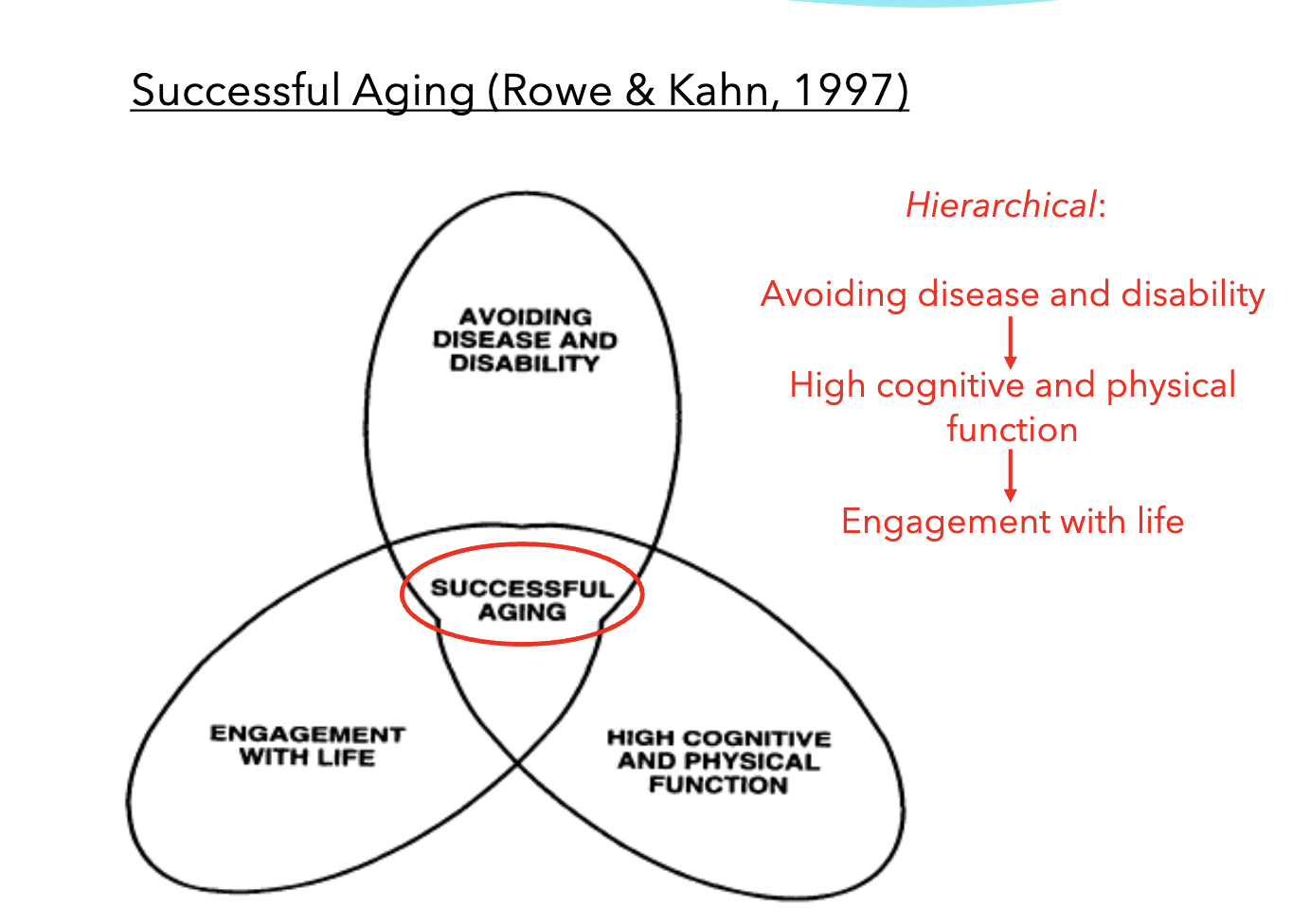
In ROWE AND KAHN’S model of SUCCESSFUL AGING, there is a hierarchal component, whereby avoiding disease and disability allows → maintenance of high cognitive and physical function → to allow for engagement with life (biomedical focus, where some are winners and others are losers)
AVOIDING DISEASE AND DISABILITY low probability of disease + disease-related disability, but also low RISK! heritable factors and ENVIRONMENT, as well as indirect influence of diseases as direct impacts on longevity
HIGH COGNITIVE AND PHYSICAL FUNCTION cognitive functions include language, nonverbal memory, conceptualization, visual spatial ability
physical functions including maintenance of hands, trunk, lower extremity movements, balance, and gait
ENGAGEMENT WITH LIFE interpersonal relations that facilitate emotional and instrumental (chores, assistance with transportation, etc.) support, and engaging in productive paid or unpaid activities that create social value
IN READING, Rowe and Kahn identify 2 forms of “engagement with life",” what are these two forms?
Rowe and Kahn’s 2 forms of “engagement with life” include
INTERPERSONAL relations that facilitate emotional and instrumental (chores, assistance with transportation, etc.) support
ENGAGING IN PRODUCTIVE ACTIVITIES WITH SOCIAL VALUE - paid or unpaid
IN READING, Rowe and Kahn remark that all three components of successful aging are “relative and the relationship among them is hierarchical",” what does this mean?
Rowe and Kahn’s Model of Successful Aging is HIERARCHICAL, prioritizing a BIOMEDICAL MODEL that prioritizes physical lack of disease and disability, to then inform cognitive and physical function, and thereby engagement with life!!!
Despite influence of Rowe and Kahn’s successful aging, what are 4 criticisms to this definition?
Criticisms of Rowe and Khan’s SUCCESSFUL AGING DEFINITION, include:
the focus on “success” suggesting an absolute standard
the focus on only 3 components excludes components that may engage people to age well - heterogenous experiences and numerous routes to ageing well are ignored
reduces successful aging to only physical function - ignoring that majority of older adults develop illness and limitations + that everyone begins with a different vulnerability
treats successful aging, as NOT aging - maintenance of middle-aged function
What is ALDWIN AND IGARASHI’s OPTIMAL AGING Model? What are variables contributing to this model?
OPTIMAL AGING, according to Aldwin and Igarashi, is the maintenance of optimal functioning given current limitations, development of a comfortable life structure, and development of a sense of purpose in life
this is a psychosocial lens to optimal aging where life satisfaction is subjective
Adaptability to Change (extent to which we adapt through physical changes), Perceived Control (meds or not → physical outcomes), Anxiety about Aging (scale), Positive Attitudes about Aging (prolonged life by 7.6 years), Mental Health, Life Narrative (sense of clear identity in old age built on a cohesive coherent narrative), Sense of Purpose (those without died within 3 years of the study). Life satisfaction, Active/Proactive coping (direct action to resolve a stressor vs. anticipatory steps for prevention), etc. are examples of PSYCHOSOCIAL VARIABLES of OPTIMAL AGING
How are disagreements about the MEASUREMENT of Successful Aging found within different models?
Adopting the terminology and definition of ROWE AND KAHN’S SUCCESSFUL AGING we use an objective, categorical measure
you have disease or you do not
you engage in interpersonal relationships facilitating emotional and instrumental support or you don’t
you meet the thresholds of cognitive and physical function or you don’t
Adopting the terminology and definition of ALDWIN AND IRAGASHI’S OPTIMAL AGING we use a subjective, and continuous measure
drawing on individual reports and reflections
What 2 MODELS have been developed to further support OLDER ADULTS with OPTIMAL AGING? What’s an important feature of both of these models
FACILITATING ADAPTATION TO LOSSES THROUGH INTERVENTIONS
THE ECOLOGICAL MODEL OF AGING focuses on environmental adaptation to support optimal aging, “matching” competence levels in physical, cognitive, and social capacities
negative adaptation is when environmental demands “Press” > competence
positive adaptation is when environmental demands “Press” = competence levels
Containing all basic needs to a singular floor of a home, walkers to assist movement across long distances, etc.
THE SELECTIVE OPTIMIZATION WITH COMPENSATION (SOC) MODEL selection: directs attention to domains in which functioning remains high, optimization: invests resources into knowledge and skills that are relevant for the selected domains, and compensation: find strategies to counteract losses
maximizing gains, and minimizing losses
Athlete with worsened endurance but enjoys marathons - half-marathons, braces for his injuries, etc.
BOTH THE ECOLOGICAL MODEL AND THE SElECTIVE OPTIMIZATION COMPENSATION MODEL ARE COMPLIMENTARY - CAN BE WORKING IN COMBINATION
What is the INFORMATION PROCESSING MODEL?
The INFORMATION PROCESSING MODEL holds that cognitive processing is like computer processing, whereby information enters the system and is transformed, coded, and stored for later retrieval and use!!
Information enters our senses, creating SENSORY MEMORY, and we may DIRECT our ATTENTION to information → allowing it to be processed further into SHORT TERM MEMORY, and even LONG TERM MEMORY

What are 3 ATTENTIONAL PROCESSES as a function with AGE (SSD)?
ATTENTIONAL PROCESSES INCLUDE:
SUSTAINED ATTENTION - the ability to maintain attention on a task over an extended period “vigilance”
MEASURED by the MACKWORTH CLOCK TASK: having to identify/press “space” when there are irregular “double jumps” in red dial pointer
sustained attention has a reduced/preserved/improved performance with age
SELECTIVE ATTENTION - the ability to attend to some stimuli while disregarding other, irrelevant stimuli
MEASURED by the STROOP TEST: inhibiting automatic response of word colour vs. the semantic meaning of a word
selective attention had a reduced performance with age
DIVIDED ATTENTION - the ability to allocate attention to coordinate performance of more than one task at a time
MEASURED by the DUAL-TASK PARADIGM: stating if a target letter appears, while detecting the presence of a red dot in a box from peripheral vision
divided attention has a reduced performance with age
What are the 2 SHORT TERM MEMORY PROCESSES as a function of age (PW)?
After directing ATTENTION to sensory memory, it transfers to our SHORT TERM MEMORY
PRIMARY MEMORY - the passive store that holds information in the form in which it was received
Ie. Repeating a string of digits in the order in which they were presented
Primary memory has a preserved performance as we age.
WORKING MEMORY - the active store that allows for processing and manipulation of information
Ie. Repeating a string of digits in reverse order, subtracting 2 from each digit
Working memory has a reduced performance as we age.
What are 4 LONG TERM MEMORY PROCESSES as a function of age (PSEP)?
With REHEARSAL, information in the SHORT TERM MEMORY encodes into LONG TERM MEMORY, which can be retrieved and re-considered in SHORT TERM MEMORY
PROCEDURAL MEMORY - the implicit store that allows for acquisition and performance of skills and action Ie. driving a car
procedural memory has a preserved performance with age
SEMANTIC MEMORY - explicit store that contains general knowledge Ie. recalling the capital of Canada
semantic memory is preserved/improved with age.
EPISODIC MEMORY - the explicit store that contains experiences and events that are linked to a specific time and place Ie. first day at UBC
episodic memory is reduced with age.
PROSPECTIVE MEMORY - the explicit store that contains intentions for the future Ie. Recalling your doctor’s appointment tomorrow at 1pm
prospective memory is reduced, preserved, improved with age.
What are 2 INTELLIGENCE PROCEDURES as a function of age (FC)?
THE DUAL-COMPONENT MODEL OF INTELLIGENCE IS AS FOLLOWS:
FLUID INTELLIGENCE (Gf) - mental operations related to deliberate and controlled problem solving in novel problems: inferences, concept formation, extrapolation, “mechanics” of intelligence “hardware” IE. What comes next in series d f i m r x e
fluid intelligence is reduced with age.
CRYSTALLIZED INTELLIGENCE (Gc) - breadth, depth, and application of language, information, concepts, and conventions acquired through experience, education, and acculturation: Pragmatics of intelligence “software” IE. Why do people put money in banks?
crystallized intelligence is preserved/improved with age
FLUID/MECHANICS - BASIC INFORMATION PROCESSING
content-poor, universals, strong genetic determination
CRYSTALLIZED/PRAGMATICS - FACTUAL AND PROCEDURAL KNOWLEDGE
content-rich, culture-dependent, expreience-based

What is the CATTELL-HORN-CARROLL MODEL OF INTELLIGENCE?
THE CATTELL-HORN-CARROLL MODEL OF INTELLIGENCE contains vulnerable, expertise, and sensory-perceptual abilities
VULNERABILITIES: skills that are linked to biological and neurological efficiency/horsepower that declines as we naturally age → Fluid reasoning (Gf) - which is fluid intelligence, Short-term memory (Gsm), Cognitive processing speed (Gs)
EXPERTISE: skills that are maintained, or even improved, with age → Comprehension-knowledge (Gc) - which is crystallized intelligence, Long-term storage and retrieval (Glr), Quantitative knowledge (Gq)
SENSORY-PERCEPTUAL ABILITIES: skills that are anchored directly with specific sensory modalities → Visual processing (Gv), Auditory processing (Ga)

What is the difference between VULNERABLE, EXPERTISE, and SENSORY-PERCEPTUAL ABILITIES?
IN READING, Parl and Reuter-Lorenz propose scafoolding theory of aging and cognition (STAC), what is it’s purpose and what does it attempt to explain?
IN READING, Parke and Reuter-Lorenz refer to “compensatory scaffolding,” within the context of thier theory, what does this mean (section The Scaffolding Theory of Cognitive Aging)?
IN READING, section “Scaffolding is Promoted by Training and Cognitive Activity",” Parke and Reuter-Lorenz identify number of methods that older adults use to facilitate “scaffolding enhancement” in old age, what are 3 of these methods?
IN READING, Robert, Walton, and Viechtbauer report results of a meta-analysis of longitudinal studies of personality across life course, what is a meta analysis?
IN READING, Robert, Walton, and Viechtbauer discuss concept of mean-level change and rank-order consistency, what are they and how do they relate to one another?
IN READING, section “Is There a Pattern to Mean-Level Changes in Personality Traits", what did Robert, Walton, and Viechtbauer conclude in their meta-analysis, does personality stop changing during life course?
IN READING, Roberts, Walton, and Viechtbauer identify a “critical period” in life course with most personality change, what is the age range?
IN READING, what are the mean-level changes in personality traits across the life course, as reported by Roberts, Walton, and VIechtbauer?