General Psychology Exam 2 Study Guide - Brynildsen
 Call Kai
 Learn
 Practice Test
 Spaced Repetition
 Match
 Flashcards
 Knowt Play
1/108

There's no tags or description
Looks like no tags are added yet.
109 Terms
Amygdala
Brain structure processing emotions, aggression, and fear.
Hypothalamus
Brain region regulating endocrine activity, hormone release, and reward/pleasure.
Hippocampus
Gateway to memory enabling the formation of new conscious memories.
Cerebral cortex
Outer layer responsible for higher forms of thinking, split into two hemispheres.
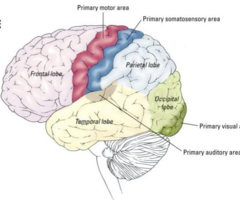
Frontal lobes
Front region involved in planning, creative thinking, personality, and motor control.
Motor cortex
Strip in the frontal region controlling voluntary movement.
Homunculus
Map representing motor or sensory functions across different body parts.
Broca's area
Left frontal region responsible for speech production.
Broca's aphasia
Disorder characterized by difficulty producing spoken words or sentences.
Mirror neurons
Cells that fire both when performing an action and when observing another perform it.
Parietal lobes
Top region containing the somatosensory cortex.
Somatosensory cortex
Brain area receiving and processing information about touch sensations.
Occipital lobes
Back region of the brain containing the visual processing center.
Visual cortex
Brain area that processes incoming light visual signals.
Temporal lobes
Sides of the head containing auditory processing areas and Wernickes area
Auditory cortex
Brain area responsible for processing sound.
Wernicke's area
Left-side region responsible for language comprehension.
Wernicke's aphasia
Disorder impairing the ability to understand spoken and written communication.
Plasticity
Flexibility of brain structures to adapt, reorganize, or shift functions after damage.
Neurogenesis
Growth and development of brand-new neurons.
Selective attention
Focusing on specific information while ignoring surrounding distractions.
Inattentional blindness
Failing to detect visible objects because focus is directed elsewhere.
Change blindness
Failing to notice alterations in environment due to focused focus elsewhere.
Suprachiasmatic nucleus (SCN)
Hypothalamic structure sensitive to light that regulates daily circadian rhythms.
Pineal gland function in rest
Secretes melatonin in response to signals from light-sensitive brain regions.
Artificial lighting impact
Stalls melatonin production and disrupts natural daily biological cycles.
N1 stage
Light initial resting state marked by involuntary muscle twitches and vivid perceptions.
Hypnagogic jerk
Involuntary muscle twitch occurring during light resting transitions.
Hypnagogic hallucination
Vivid sensory perception experienced while falling into rest.
N2 stage
True resting period with slowed brain activity, lower heart rate, and reduced tension.
N3 stage
Deepest resting period involving pituitary hormone release and disorientation upon waking.
REM stage
Phase featuring wake-like brain waves, rapid eye movement, and irregular breathing.
Paradoxical state
Condition where the brain is highly active while physical body muscles are paralyzed.
Sleep paralysis
dreams, 90% of dreams in REM
Evolutionary theory of sleep
Proposal that resting at night evolved to protect organisms from darkness and predators.
Restorative theory of sleep
Proposal that resting repairs body tissue and supports growth through hormone release.
Information processing theory of sleep
sleep supports cognitive processes
restores and rebuilds memories
supports creative thinking
Manifest content
The actual remembered images and events within a dream.
Latent content
The hidden unconscious thoughts, feelings, and wishes behind dream images.
Freudian Theory of Dreaming
dreams stem from unconscious thoughts
Activation-synthesis theory
Brain internally generated signals form dreams
Information Processing Theory of Dreaming
memories of events form dreams
Preserving neural pathways theory of dreaming
purpose of dreaming is to provide brain stimulation
Twin studies
compare pairs of monozygotic and same-sex dizygotic twins
Monozygotic twins
Identical pairs originating from one fertilized egg, sharing 100% of genetic material.
Dizygotic twins
Fraternal pairs originating from two separate eggs, sharing 50% of genetic material.
Adoption Studies
adopted children compare to adoptive families and biological parents
Adoption twin studies
compare MZ twins separated in infancy and MZ twins reared together
Assimilation
Fitting new information into an existing mental framework.
Accommodation
Modifying existing mental frameworks in response to new information.
Primitive Reflexes
sucking, rooting, moro, grasping, babinski
Piagets approach to cognitive development
children understand the world with schemes/schema, children make constant mental adaptations to new observations and experiences
Piagets stages of cognitive development
sensorimotor, preoperational, concrete operational, formal operational
Sensorimotor stage
Period from birth to 2 years - looking sucking, touching, development of object permanence
preoperational stage
2-7 years old - egocentrism, animistic thinking, conservation
concrete operational stage
7-11 years - understand conversation and reversibility
Object permanence
Understanding that physical items continue to exist even when hidden from view.
Egocentrism
Inability to view situations from any perspective other than one's own.
Animistic thinking
Believing inanimate objects possess feelings, intentions, or lifelike qualities.
Conservation
Understanding that physical properties remain unchanged despite alterations in outward appearance.
Reversibility
Concept that an altered object can be returned to its original state.
Transitivity
Ability to logically arrange and recognize relationships among items in a series.
formal operational stage
11-adulthood - abstract thinking, thinking about future, conjuring hypothesis
Zone of proximal development
Range of tasks a learner can accomplish only with guidance from others.
Scaffolding
The teacher adjusts the amount of support to how much support the child needs
Theory of mind
Understanding how other people think - people vary
Band aid box study -
Kids are shown a box of this, and was asked inside, kids were surprised to find pencil in the box
- 3 years old haven't developed theory of mind, assumed anyone else asked would know that there are pencil in there
- 4-5 year olds who have developed theory of mind, knows that other people don't know what's actually in the box
Trust vs. Mistrust
Eriksons theory of social development - Infancy (to 1 yr) - the ability to trust other people develops based on the caregivers ability to provide for them
Autonomy vs. Shame and Doubt
Eriksons theory of social development - Toddlerhood (1-3yrs) - autonomy - independence and self control - piaget, letting a kid struggle and do things on their own
Initiative vs. Guilt
Eriksons theory of social development - Preschool (3-5yrs) - kids will make choices and discover "am i good or bad?"
Industry vs. Inferiority
Eriksons theory of social development - Elementary (6rs-puberty) - kids will see their capabilities and will compare themselves to others "am i good enough?"
Harlow's monkey experiment
Study demonstrating that infants prioritize soft physical contact comfort over food source access.
Ainsworth study
Strange situation experiment -mom leaves stranger and child in room, then child left alone
Ainsworth resultuing attchment styles
Secure, Insecure-anxious/ambivalent, Insecure-avoidant
Secure attachment
Pattern where infants rely on caregivers as a safe anchor to explore. trusting relationships
correlations of attachment styles
Children with secure attachment style have larger size of vocabulary, better interpersonal interactions, more stable emotions
langlois al.'s study
Studied mothers and their babies, had college students rate cuteness of a group of babies, found babies got more affection and attention from their mothers if they were cute. Mothers with not so cute babies said that their kids interfere with their lives
what contributes to attachment styles
Stressful home life, inconsistencies in parental response
Insecure-anxious attachment
Pattern resulting from inconsistent care, causing infant distress and distress upon separation.
Insecure-avoidant attachment
Pattern resulting from emotionally unresponsive care, leading to child detachment.
Authoritative parenting
High warmth, high control - not overly demanding, child centered, get higher grades, cooperative, assertive
- most optimal, higher grades, assertive and cooperative
Authoritarian parenting
Low warmth, high control - controlling, demanding, emphasizing obedience, restrictive with lots of rules
- lower grades, low self esteem, dependence on others
Permissive parenting
High warmth, low control - very few rules and restrictions
- lower grades, low self control, quick temper
Uninvolved parenting
Low warmth, low control - least effective, most determine
- low self esteem, emotional detachment
Preconventional morality
(4-10) - avoid punishment or gain reward
Ex: dont steal the drug bc youll be punished
Conventional morality
(after 10) - good boy morality, law and order
Ex: dont steal bc it against the law, makes you a bad person
Postconventional morality
(Early adolescence/young adulthood) - individual principles and conscience
Ex: dont steal bc stealing is immoral
Delay of gratification
Ability to forgo immediate small rewards to receive larger benefits later.
Marshmallow test
one marshmallow now or two in a few minutes
Identity vs. confusion
Adolescent (12-19) - Stable sense of who one is and what one's values are or identity confusion Identity - who am I? Where do I belong? Which social roles fit me?
Intimacy vs. isolation
Young adult (20s) - Establish enduring, committed relationships, Who do I trust with intimacy and love?
Generativity vs. stagnation
Middle adult (30s-50s) - Generativity - generate things that contribute to the future of society, Stagnation - see life as meaningless, How do I grow as a person?
Integrity vs. despair
Elders (60s+) , Ego integrity - feeling that one's life has coherence and purpose, Despair - disappointment, regret, Can I face death calmly?
Socioemotional selectivity theory
old age- smaller social network, very close relationships maintained, superficial relationships filtered out
Sensation
process by which sensory organs obtain information about the environment and transmit it to the brain
Perception
the organization of sensations into interpretations
Transduction
translation of physical energy into electrical signals
Bottom up processing
start with raw sensory data that gets communicated to the brain
Top down processing
start with observers expectations and knowledge
Absolute thresholds
Minimal amount of stimulation that can be detected half of the time