Calcium Disorders
 Call Kai
 Learn
 Practice Test
 Spaced Repetition
 Match
 Flashcards
 Knowt Play
1/18

There's no tags or description
Looks like no tags are added yet.
19 Terms
Hypercalcemia acute/chronic
Acute: arrhythmia
Chronic: soft tissue calcification
TX: dialysis, diuretics, hydration, bisphosphonates, glucocorticoids
Hypocalcemia
Vitamin D and Calcium supplementation are good
HYPOMAGNESEMIA must be corrected for calcium repletion to be effective
Calcium Levels:
Serum Calcium
Total (bound + free)
8.5 - 10.5 mg/dL
Measures calcium found in ECF
Affected by hypoalbuminemia
Ionized (free)
4.5 - 5.4 mg/dL
ACTIVE FORM
Maintained in tight range
Corrected Calcium Equation:
Use only when serum albumin < 4
Corrected Ca = measured Ca + (0.8)(4-serum albumin)
Serum calcium in mg/dL
Serum albumin in g/dL
HYPERCALCEMIA define
Total serum calcium > 10.5 mg/dL
Three mechanisms
Increased bone resportion
Increased GI absorption
Increased tubular reabsorption in the kidneys
Causes of Hypercalcemia
Cancers
Hyperparathyroidisms
Medications
Granulamtous/Endocrine Diseases
Drug Induced Hypercalcemia
Thiazides
Lithium
Vitamin D
Calcium
acute calcium onset
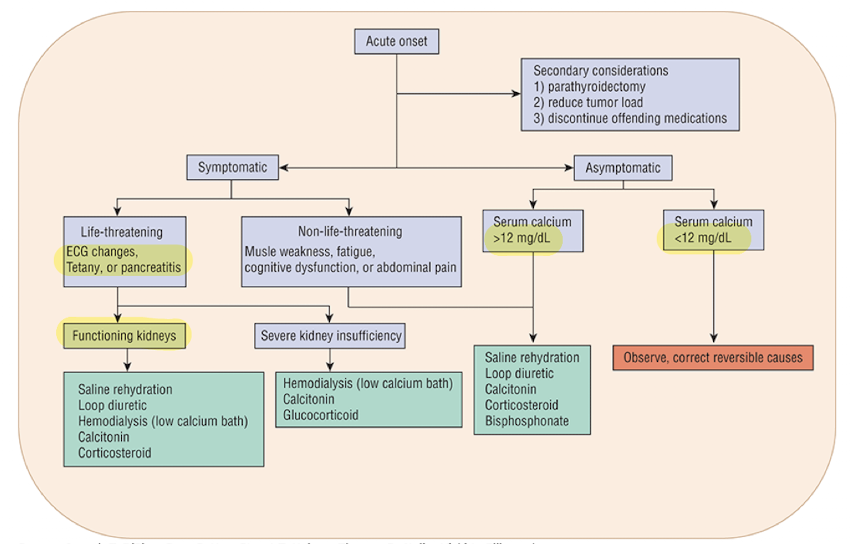
Acute Hypercalcemia TX:
→ acute hypercalcemia causing EKG changes/neurological/pancreatits
Volume expansion with NS
Loop diuretic
Hemodialysis
Loop + hydration: drop 2-3 mg/dL over 1-2 days
Volume expansion with NS:
→ increases natriuresis and urinary calcium excretion
Patient will ALSO LOSE K+ and Mg+ so need to replenish
Loop Diuretics:
Furosemide
Toresemide
Bumetanide
Ethacrynic Acid
Blocks Ca and Na reabsorption in thick ascending limb to increase urinary Ca excretion
→ do not dehydrate patient, monitor K and Mg levels
Calcitonin:
alternative to saline for hypercalcemia
Short term/rapid onset
Inhibits bone resportion, tubular reabsorption
Increases urinary calcium excretion
Bisphosphonates
→ hypercalcemia; commonuly used when hypercalcemia is caused by cancer
Blocks bone resportion
Pamidronate
Etidronate
Zoledrontae
Ibandronate
2-7 day onset, may be given with calcitonin
Hypocalcemia causes…
Vitamin D deficiency
Hypomagnesema
Hungry bone syndrome
Hypoparathyroidism
Medications
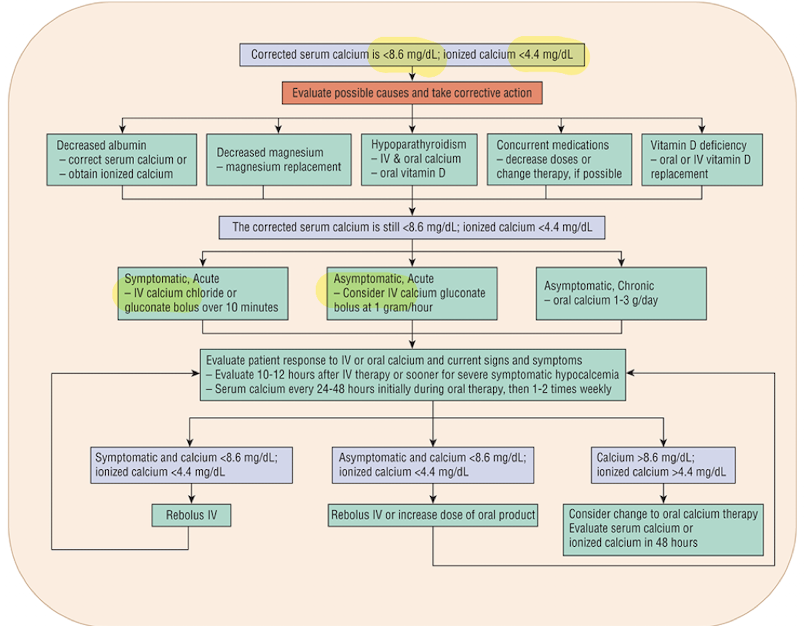
HYPOCALCEMIA define
Hypocalcemia = total calcium < 8.5 mg/dL
Ionized calcium < 4.4 mg/dL
PTH is elevated
Hypomagnesemia;
Low magnesium
Impairs PTH secretion
Leads to PTH resistance in target organs
Can lead to severe, symptomatic hypocalcemia
→ if present, patient will be UNRESPONSIVE to calcium replacement
Need to correct magnesium first
Hungry Bone Syndrome
= transient bone response after parathyroidectomy or thyroidectomy
Calcium drops rapidly as bone sucks up calcium correclty
TX: calcium replacment
Drug induced hypocalcemia
Furosemide
Cinacalet
Phosphorous (PO route)
Denosumab
Hypocalcemia Presentation:
Neuromuscular
Paresthesia
CNS
Depression, anxiety, seizures
Derm
alopeica/nail changes
Cardiac
Prolonged QT
PHYSICAL FINDINGS:
Chvostek’s Sign = facial twitching while tapping on facial nerve
Trousseau’s Sign = carpal spasm when BP inflated
HYPOCALCEMIA ALGO