Chapter 3: Stoichiometry of Formulas and Equations
 Call Kai
 Learn
 Practice Test
 Spaced Repetition
 Match
 Flashcards
 Knowt Play
1/30

31 Terms
Stoichiometry
The study of the mass-mole-number relationships of chemical formulas and reactions from a given substance

Mole (mol)
The SI unit for an amount of substance, defined as having the same number of entities as there are atoms in 12 grams of carbon-12 (Avogadro’s number)
6.022 × 10²³ of anything
Helps relate submicroscopic amounts to macroscopic quantities
Convert the mass of a substance to moles, and then multiply by Avogadro’s number.
How do I find the number of atoms of a substance from its mass?
Atomic mass units (amu)
The mass of a single atom or collection of atoms in a substance
Same numerically to grams per mole

Molar mass (M)
The mass of a mole of a substance’s entities in grams per mole
Can be found through summing the atomic masses involved, proportionally

Conversions
Performed by using ratios to eliminate factors through division and multiplication
Generally begins by converting to the amount in moles first
Mass percent
The percentage of weight each element holds as part of a compound
Multiply the amount of substance by the mass percent of the desired.
How would I find the mass of an element in a compound?

Empirical formula
Chemical formula that shows the lowest relative number of atoms
Several different compounds can have the same one of this

Molecular formula
Chemical formula that shows the actual numbers of each element
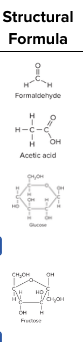
Structural formula
Chemical formula that shows the relative placement of atoms
Isomers
Compounds with the same molecular formula but different atomic arrangements and properties
Determine the mass of each element
Convert each mass to amounts, writing a preliminary formula
Convert the amounts to whole-number subscripts, by:
Dividing each subscript by the smallest subscript
Multiplying by the smallest integer that turns all subscripts into integers
How would I find the empirical formula of an unknown compound, given the masses of each element?
Divide the molar mass by the current mass of the empirical formula, then multiply by that whole-number multiple.
How would I find the molecular formula of an unknown compound, given the molar mass and empirical formula?
Assume 100.0 grams of compound, then proceed to find the empirical and molecular formula.
How would I find formulae when only given mass percents and molecular mass?

Combustion analysis
Determining a chemical formula from combustion product measurements, typically of organic compounds

Burn a substance in excess O2, producing CO2 and H2O from the carbon and hydrogen in the substance.
Measure the amounts of CO2 and H2O collected.
From the amounts of CO2 and H2O, calculate the masses of C and H.
If including a third element, subtract the masses of C and H to find the third element’s mass.
Calculate the empirical, then molecular, formula.
How would I determine the formulae of a substance through combustion analysis?
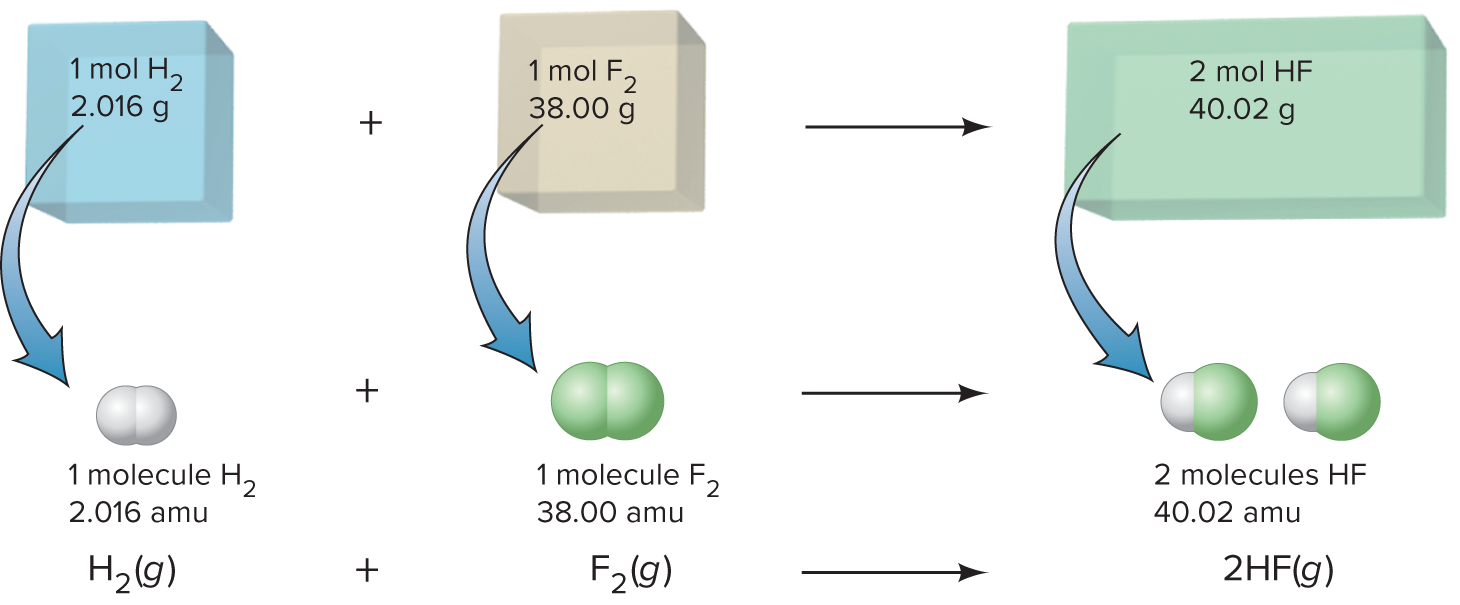
Chemical equation
A statement using formulas to express the identities and quantities of substances involved in a change
Allows for greater insight into molecular interactions beyond mass conservation
Divided into the substances before and after the change, called reactants and products

Place reactants and products in a preliminary equation.
Place balancing coefficients behind each group of atoms, ensuring the sides match each other in number.
Work from substances of high to low complexity first.
Adjust coefficients to be the smallest whole number ratios, and check balances.
Add state notes after each group of atoms.
How do I balance a chemical equation?

State notes
These are written after each group in a chemical formula, and include:
(g) for gas
(l) for liquid
(s) for solid
(aq) for aqueous solution

Balancing coefficient
Numbers placed before a group of atoms in a chemical equation, multiplying the number of all atoms in a group
Only these can be changed in the balancing process
Convert masses to moles if necessary, then use the numbers of moles in the equation’s atom groups as numbers in a conversion factor.
How would I find the amount of a substance needed to react or form, given the amount or mass of another substance in the reaction?

Limiting reactant
The reactant that is all used up before all the excess reactant can form more products
Can be found by determining which reactant forms less product

Excess reactant
The reactant that has amounts left over due to a limiting reactant stopping the reaction prematurely
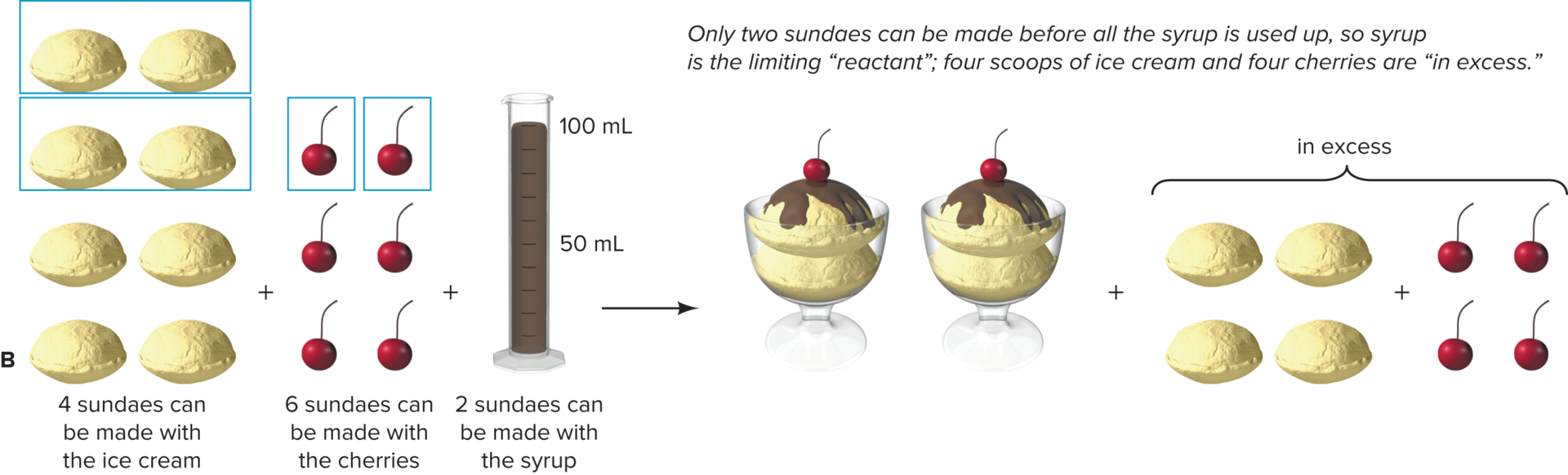
Convert masses to moles if necessary, and then determine how much product each reactant would be able to produce.
The reactant that forms less product is the limiting reactant.
How would I find the limiting reactant in a chemical equation?
Subtract the reacted amount of excess reactant (after reacting with the limiting reactant) from the given amount of excess reactant.
How would I find out the leftover amount of excess reactant in a chemical equation?
Theoretical yield
The amount of product calculated from the molar ratio in the balanced equation, reduced in reality by side reactions, premature stoppages, and physical losses

Side reactions
Reactions that form a different product than the intended main product
Actual yield
The amount of product that is actually obtained after losses during a reaction
Percent yield
The actual yield over the theoretical yield, expressed as a percentage
Atom economy
The mass of atoms in the product over the mass of atoms in all reactants; this is used to optimize synthesis pathways for efficiency