Sci 10 Chem Quiz
 Call Kai
 Learn
Learn Practice Test
 Spaced Repetition
 Match
Match Flashcards
 Knowt Play
1/32

Earn XP
Description and Tags
Quiz Date: Monday, October 5 2026
Name | Mastery | Learn | Test | Matching | Spaced | Call with Kai | Chat |
|---|
No analytics yet
Send a link to your students to track their progress
33 Terms
Atomic Theory: Atom
Smallest particle of an element
Atomic Theory: 3 subatomic particles (smaller particles atoms are made of)
Protons, neutrons, & electrons
Atomic Theory: Charges of 3 subatomic particles
Protons: postitive
Neutrons: no electric charge/ neutral
Electrons: negative
Atomic Theory: Subatomic particles all have __
Subatomic particles have mass, but protons & electrons have electric charge
Atomic Theory: Location of 3 subatomic particles
Nucleus (central part of atom where most mass is found) = Protons + Neutrons
→ nuclear charge is always positive
→ particles are tightly packed in the centre of atom — mass of proton & neutron = 1 atomic mass unit (amu)
Outside the Nucleus = Electrons — circle nucleus very quickly
→ electrons are light & have mass of 1/1800 amu/almost no mass
Atomic Theory: # of protons are equal to (periodic table)
Number of protons = atomic number (for neutral atoms also = number of electrons)
Atomic Theory: Difference between mass number & atomic mass
Mass number = whole number/rounded of amu
Atomic mass = mass of average atom (on periodic table)
Atomic Theory: Difference between ion & atom
Ion = electric charge that forms when atom gain/loses electrons — unequal # of protons & electrons
Atom = neutrally charged, same # of protons & electron
Atomic Theory: How to find # of neutrons
Neutrons = mass number - protons
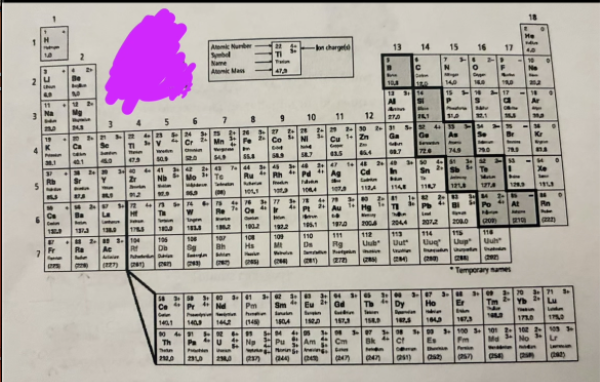
Atomic Theory: Location of metals, non-metals. & metalloids
Metals = left side & middle of table (more conductive)
Non-metals = upper right corner (yellow)
Metalloids = form staircase toward the right side (pink)

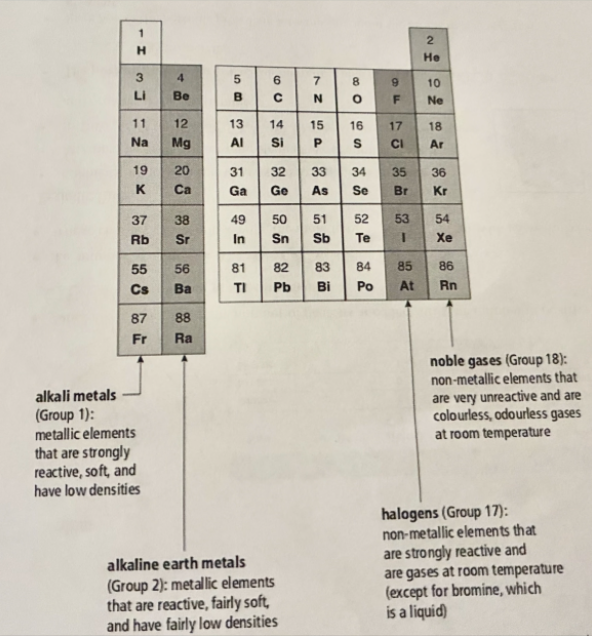
Atomic Theory: Names for Group 1, 2, 17, 18, 3-12
Group 1 - Alkali metals
Group 2 - Alkaline earth metals
Group 17 - Halogens
Group 18 - Noble gases
Group 3-12 - Transition metals
Atomic Theory: Difference between group & period
Group = column in periodic table
Period = row in periodic table
Atomic Theory: Another term for group
Group is also known as “Family”
Atomic Theory: Difference between cation & anion
Cation = + positivity charged ions (metals lose e-)
Anion = - negatively charged ions (non-metals gain e-)
Atomic Theory: Difference between an ion w/ 2+ & ion w/ 2-
Ion w/ 2+ - metal element that loses 2 electrons
Ion w/ 2- - non-metal element that gains 2 electrons
Atomic Theory: How many electrons does an ion w/ 3+ have & ion w/ 3-
Ion w/ 3+ - Protons > electrons (e.g. e = p - 3)
Ion w/ 3- - Electrons > protons (e.g. e = p + 3)
Atomic Theory: What does periodic table show?
Elements w/ similar properties have similar electron arrangement
Bohr Model: What does Bohr model show?
Electron arrangement in shells
Bohr Model: Name of the outermost shell
Valence shell (electrons = valence electrons)
Bohr Model: Other terms for electron shells
Orbits, energy levels
Bohr Model: Maximum # of electrons each electron shell hold
First shell - 2 electrons
Second shell - 8 electrons
Third shell - 8 electrons
**Fourth shell - 18 electrons
Bohr Model: Chemical name for NH3, CH4, and H2O
NH3 = ammonia
CH4 = methane
H2O = water
Bonding: 2 differences between ionic & covalent bonding
Ionic bonding:
→ ionic compound has positive (metal) & negative (non-metal) ion
→ 1 or more electrons transfer from metal to non-metal
Covalent bonding:
→ formed between two or more non-metals
→ electrons shared between atoms
Covalent Bonding: Difference between bonding pair & lone pair
Bonding pair = shared pair of electrons
Lone pair = pair of electrons in the valence shell not used in bonding
Bonding/Diagram: What type of bond & diagram can we use a line to represent a pair of electrons?
Type of bond: covalent bonds
Diagram: Lewis diagram
Diagrams: Differences between Bohr model & Lewis diagram
Bohr Model:
→ diagram shows # of electrons in each of the energy levels/electron shells around an atom
Lewis Diagram:
→ diagram the shows chemical bonding drawing ONLY atom’s valence electrons & chemical symbol
→ drawn w/ dots (electrons) placed around the element symbol (N,E,S,W)
Lewis Diagram: What rule do we need to follow when we draw Lewis Diagram?
Octet Rule = Most atoms want 8 valence electrons to be stable
Elements/Ions: What of the following have the same energy levels: Mg2+, F, & Ar
Mg2+ & F
→ Mg has 3 electron shells, but loses 2 electrons making it have 2 electron shells/energy levels
→ F has 2 energy levels/electron shells
Ar has 3 energy levels/electron shells
Elements: 7 Diatomic Particles
Hydrogen (H2), Nitrogen (N2), Oxygen (O2), Fluorine (F2), Chlorine (Cl2), Bromine (Br2), Iodine (I2)
Ways to Remember:
HOFBrINCl
Number 7 on periodic table
Naming Compounds: When do we use Roman numerals?
Use Roman numerals for multivalent compounds
Naming Compounds: When can we use prefixes?
Use prefixes for covalent compounds
Naming Compounds: When do we have to add brackets when we write chemical formulae?
Polyatomic ions when you criss-cross, # of ion is greater than 1 — add brackets
Naming Compounds: What situation(s) that we cannot reduce the subscripts?
Covalent compounds or if you cannot divide an ionic/polyatomic compound subscripts of both ions with the same #