IB Biology 1.2 Nucleic Acid
 Call Kai
 Learn
Learn Practice Test
 Spaced Repetition
 Match
Match Flashcards
 Knowt Play
1/38

There's no tags or description
Looks like no tags are added yet.
Name | Mastery | Learn | Test | Matching | Spaced | Call with Kai | Chat |
|---|
No analytics yet
Send a link to your students to track their progress
39 Terms
What is the most accurate description of a nucleotide?
A monomer unit of nucleic acids.
What is the backbone of DNA?
Covalent bonds between deoxyribose and phosphate molecules
Outline how complimentary base pairing is important in the replication of DNA as the genetic material
DNA Replication is the production of new DNA molecules. The new replicated DNA molecule must have the same base sequence as the parentDNA
When the two strands of a DNA molecule are separated each one is used as a template to build a new strand. Complimentary base pairing ensures that A pairs with T, and C with G, so new strands ofDNA have the same sequence as the original molecule.
differences between dna and rna and similarities
differences:
DNA has thymine, RNA has uracil
RNA has ribose, DNA has deoxyribose
DNA has double chain, RNA has single chain
RNA has variety of shapes depending on type of RNA while DNA is shaped into double helix
RNA does not contain a permanent genetic code except in viruses, DNA is the permanent genetic code for all organisms.
similarities:
they are both polymers
they are both a type of nucleic acid and they are composed of nucleotides
they are joined by phosphodiester bonds.
describe the structure of nucleosome
DNA molecule wrapped around histone proteins.
There are 8 histone proteins (in the core of the nucleosome)
Additional/one histone molecule and linker DNA join nucleosomes together
-IMPORTANT FOR GENE EXPRESSION AND STORAGE

Outline how it is possible for these universal DNA molecules to store varied genetic information both within species and between species
The DNA base sequence is the store of genetic information There are a huge number of different base sequences possible in a DNA molecule which provides variety in the genetic information.
Different lengths of DNA, or different sequences of the bases causes variation in the genetic information stored in a genome.
Base sequence is a code that determine protein structure/amino acid sequence and the characteristics of an organism.
Within species organism has many genes with a lot of similarity in the DNA sequence and this gives the species it's recognisable characteristics.
There is some variation in the sequence of DNA in some genes even within species giving elements of variation in characteristics.
Between species there are more differences in the DNA sequence, which gives more variation in characteristics. Differences in the DNA sequence between two species can prevent reproduction between members of two different species
an example of a molecul that is soluble in the cytoplasm of a cell and their function
Soluble:
Glucose (or any other monosaccharide or
disaccharide) - used for energy / cell respiration.
Amino acids - used for synthesizing proteins / energy.
Proteins - used for a variety of purposes including enzymes.
Ions or salts - maintaining osmotic pressure in blood or other body fluids / more specific purpose if one specific ion is given.
Possible insoluble molecules and their functions: Fats or lipids or triglycerides - energy storage.
Steroids / hormones - chemical messengers.
Cholesterol - component of membrane structure.
In hershey and chase experiment, why was the presence of radioactive phosphorus correlated with dna and not protein?
Because phosphorus is the central element in each phosphate group and there are many phosphate groups in DNA. Proteins are composed of amino acids and there are no amino acids that contain phosphorus.
DON'T FORGET!!: 35 SULPHUR PRESENT IN THE SUPERNATENT AND 32 PHOSPHORUS PRESENT IN THE PELLET
What parts of nucleotides are joined together in both dna and rna to make these polymers?
pentose sugar with phosphates
How many codons and amino acids are there?
20 amino acids, 64 codons
How the two strands of DNA are held together?
complementary base pairing, hydrogen bonds between A and T, G and C
Explain the factors that contribute to the stability of DNA
Base sequence does not impact the 3-dimensional structure BECAUSE of complementary base pairs. There is equal bond length for purine and pyrimidine base pairs. These factors contribute to the stability of DNA.
outline hershey-chase experiment
Bacteriophages grown in radioactive sulfur (35S) and bacteriophages grown in radioactive phosphorus (32P) was used for the experiment.
Bacteriophages were allowed to infect bacterium, then the
cultures were blended AND centrifuged. In the final data,
radioactively labelled sulfur (35S) present in the supernatant
while radioactively labelled phosphorus (32P) present in the pellet which concluded that DNA is the genetic material in cells.
OR:
Radioactive labelling allows specific molecules to be observed.
Phosphorus is found in DNA but not protein.
Bacteriophage DNA was labelled with radioactive phosphorus.•
The radioactive label showed that the DNA part of the virus entered the (bacterial) cell.
The radioactive labelled DNA was used to make new virus particles showing that DNA was the genetic material passed from one generation to the next (and not protein).

Describe the structure of DNA molecule
double helix
hydrogen bonding between complementary base pairs
adenine - thymine AND guanine to cytosine OR purines - pyrimidines
antiparallel
sugar phosphate backbone
covalent bonding between sugar and phosphate
Describe how genomes can be used to analyse evolutionary relationships
genome as the sum of all genetic information in a cell,
the genetic code is highly conserved amongst living organisms
genome can be sequenced to deduce evolutionary relationships and similar sequences would mean that organisms are closely related
DNA OR RNA OR amino acid sequences can be used to construct cladograms(a branching diagram showing the cladistic relationship between a number of species)
molecular clocks can be used to estimate when different organisms diverged from each other
What happens to water during an anabolic reaction?
Water is released
The importance of complementary base pairing
necessary for replication/expression
mRNA
rRNA
tRNA
mRNA:leaves the nucleus and represents the genetic info, important for transcription(transcribing DNA into message)
rRNA: making ribosome, only assembles when there is a mRNA molecule
tRNA: translating codons by using anticodons
Building blocks of proteins?
amino acids
Nucleotides are joined together by what reaction?
condensation reaction between the pentose sugar of one nucleotide and the phosphate group of the next nucleotide.
this reaction releases a water molecule which is why this is called a condensation reaction. if an RNA molecule contains 322 nucleotides, 321 molecules of water would jave been produced during its synthesis, as it would have required 321 condensation reactions to form.
how many nucleotide tyoes exist within the structure of dna and rna?
8
soluble/nonsoluble in blood?
sodium chloride
glucose
amino acids
oxygen
fats and cholesterol
sodium chloride-soluble
glucose-soluble
amino acids-soluble
oxygen-low solubility
fats and cholesterol-insoluble
anabolic or catabolic?
light-independent reactions of photosynthesis
glycolysis
light-independent reactions of photosynthesis: anabolic
glycolysis: catabolic
Each of the bases has a nitrogen atom bonded to a hydrogen atom in a similar position. Deduce how this nitrogen is used when a nucleotide is being assembled from its units?
it is used for the linkage between the base and the deoxyribose;
base is linked to C1 of the deoxyribose;
What are purines?
A and G, they have two rings

What are pyrimidines?
C and T,they have one ring
Although bases have some shared features, each one has a distinctive chemical structure and shape. Explain why this is important
distinctive shape needed for complementary base pairing;
each base only pairs with one other;
A to T and G to C;
hydrogen bonds formed between complementary bases;
allows accurate replication of DNA;
essential for producing genetically identical cells/organisms/needed for inheritance;
allows gene regulators to recognize specific sequences of bases;
canine circovirus has single stranded dna.
suggest one advantage and one disadvantage
advantage: narrower than double-stranded DNA so takes up less space inside the protein coat of the virus / only 1 nm wide whereas double-stranded DNA is 2 nm wide;
disadvantage: bases more vulnerable to chemical attack when unpaired so more mutations;

distinguish between supernatant and pellet
a pellet is a solid that is spun to the bottom of the tube during centrifugation;
supernatant is the fluid that remains above the pellet at the end of centrifugation;

Evaluate the claim that in dna of eukaryotes and prokaryotes, the amount of adenine and thymine are equal and the amounts of guanine and cytosine are equal
within experimental error the data supports the hypothesis;
differences in amounts of G/C and A/T are too small to be significant;
Explain the ratios between the amounts of bases in eukaryotes and prokaryotes in terms of the structrue of dna
complementary base pairing between A and T would mean they would need to be present in equal quantities.
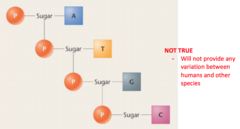
Explain how complementary base pairs falsify the tetranucleotide hypothesis
proportions of bases are not equal;
there cannot be a repeating sequence of the four bases;
A short sequence of nucleotides reads GGACAGAGCGCAGACGA. Determine in which type(s) of molecule this sequence could be found.
This short sequence of nucleotides could be found in both DNA and RNA as it does not include thymine or uracil.
Identify the process in which the genetic code is translated into a protein.
Gene expression
Differences between the chromosomes of eukaryotic cells and prokaryotic cells
it is in cytoplasm in prokaryotes, but in nucleus in eukaryotes
it is linear in eukaryotes but circular in prokaryotes
it is associated with histone proteins in eukaryotes but not in prokaryotes
structure of dna
a new strand will always begin with the 5' end nucleotide first.
two strands are upside down, so they are antiparallel (5'-3')

All organisms use the same genetic code. Then, why are we different?
Because DNA base sequences are different even though the code they read is the same (unchanged because of evolution)
-In summary, while the genetic code itself is conserved across all life forms, the specific sequences of DNA bases vary, leading to the vast diversity of life. This variation in DNA sequences is what makes each organism unique, despite using the same underlying genetic code.
DNA and RNA are important for protein synthesis. Outline the transcription and translation steps of protein synthesis.
1. transcription: transcribing the DNA into a message. One of the two strands of DNA opens and mRNA is synthesized (representing genetic information) using complementary base pairing
2. translation: synthesizing amino acid from mRNA. tRNA (bonded to a specific amino acid) pairs to triplets of mRNA.

What is Chargaff's rule?
-paper chromatography!!
-shows the proportions of nitrogenous base types found in various sources of DNA
-A mixture of substances is embedded to chromatography paper, and the bottom of the paper (below the embedded substances) is placed into solvent. The solvent wicks up (absorbs) the paper, carrying components of mixture with it. Each component travels a different distances based on its molecular size and charge.
RESULT: Same number of Adenine and Thymine, same number of Guanin and Cytosine. This result falsifies the TETRANUCLEOTIDE THEORY, which states that there were same quantities of A,T,C,G
