Quest 2 - Chemistry Discoverys through time
 Call Kai
 Learn
Learn Practice Test
 Spaced Repetition
 Match
Match Flashcards
 Knowt Play
1/45

Earn XP
Description and Tags
goes over the different experiemnts and people in history that made a contribution to the field of chemistry. This flashcard set is for CHM 125 at Grand Valley State University and the material comes from quest 2.
Name | Mastery | Learn | Test | Matching | Spaced | Call with Kai | Chat |
|---|
No analytics yet
Send a link to your students to track their progress
46 Terms
Dalton first published his theory about atoms in 1808. Which of his postulates do we currently hold to be untrue?
More than one of these are untrue.
Chemists in the 19th century constructed an evacuated glass tube with wires inserted in both ends. When an electrical current was generated at the anode, a ‘cathode ray’ would pass to the cathode creating a fluorescent glow. These experiments helped chemists better understand the nature of the electron.
The ray traveled from the cathode to the positively charged anode. What does this tell you about the nature of the charge of a cathodr ray?
Negatively Charged
Chemists in the 19th century constructed an evacuated glass tube with wires inserted in both ends. When an electrical current was generated at the anode, a ‘cathode ray’ would pass to the cathode creating a fluorescent glow. These experiments helped chemists better understand the nature of the electron.
Researches noticed that the cathode “ray” would travel directly through the tube and hit it's back wall. The nature of the ray was a mystery. However, objects placed in the tube in front of the cathode could cast a shadow on the glass. This led scientist ti believe that the ray was made up of ________________.
Particles
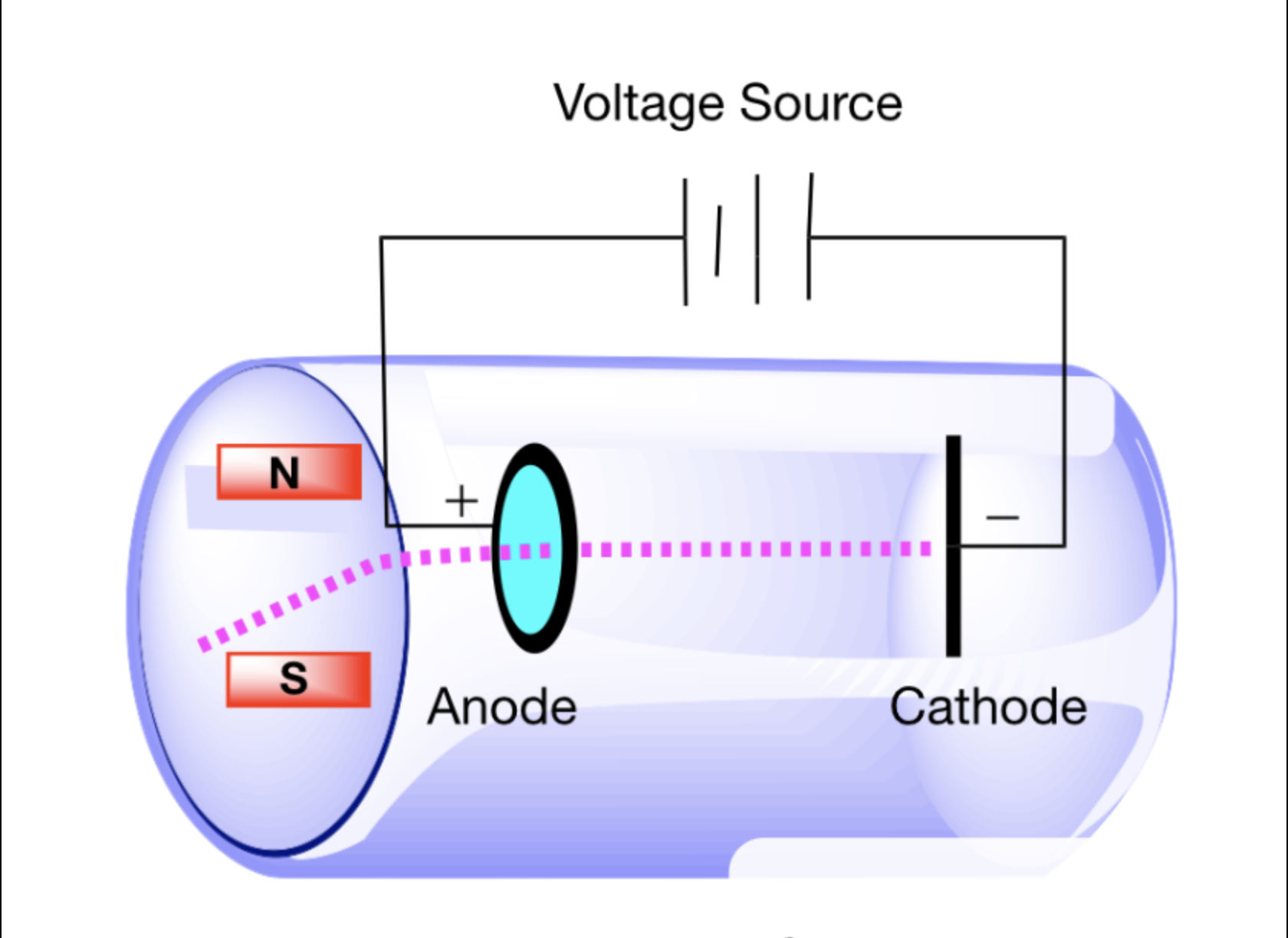
Chemists in the 19th century constructed an evacuated glass tube with wires inserted in both ends. When an electrical current was generated at the anode, a ‘cathode ray’ would pass to the cathode creating a fluorescent glow. These experiments helped chemists better understand the nature of the electron.
J.J Thompson added a magnetic field to a cathode ray tube to show that the ray would bend. His experiments demonstrated that the rays were negatively charged particles. He then calculated the mass-to-charge ratio of the electron ion (electron).
According to his calculations, how massive was the electron relative to the hydrogen ion?
The electron is ~1000 times smaller

Chemists in the 19th century constructed an evacuated glass tube with wires inserted in both ends. When an electrical current was generated at the anode, a ‘cathode ray’ would pass to the cathode creating a fluorescent glow. These experiments helped chemists better understand the nature of the electron.
Experiments using a variety of materials for the cathode and anode provided the same results. This indicates that ______________.
the electrons were present in all atoms

Rutherford and Thomson performed some groundbreaking experiments that revealed the nature of the atom.
Thomas proposed the “plum pudding” model of atoms, which described a positively charged mass with an equal amount of negative charge in the form of electrons embedded in it.
Rutherford performed an experiment in which he bombarded a thin film of gold atoms with a beam of alpha particles.
If the “plum pudding” model (shown in the image) was an accurate portrayal of an atom, what would happen to the alpha particles?
The alpha particles would pass through the atom

Rutherford and Thomson performed some groundbreaking experiments that revealed the nature of the atom.
When Rutherford performed his gold foil experiment, he found that most alpha particles passed through the atoms. However, some of the particles were deflected at large angles, even back towards the source.
This result indicated that…
the atom is mostly empty space with the protons and neutrons in a dense nucleus
Cathode rays are composed of what fundamental particle?
Electrons
Rutherfords gold experiment determined that…
Most of the space in an atom is empty except for a concentrated area called the nucleus
What scientist developed the nuclear model of the atom?
Ernest Ruthford
What did the the Millikan oil drop experiment directly determine?
The charge of an electron
Which of the following is true about subatomic particles…
1- Protons and electrons have charges of opposite signs but the same magnitude
2- Protons have twice the mass of neutrons
3- Electrons are lighter then neutrons
1 and 3
In the photoelectric effect, if the intensity of light shone on a metal increases, what will happen?
There will be more more electrons ejected
What scientist proposed that the electron in a hydrogen atom can only have certain energies (i.e the electron is quantized)
Bohr
Who developed the equation that allowed the energy of an electron to be described quantum mechanically?
Schrodinger (o is supposed to have um-louts over it)
Which scientist surmised the scientific principle that the position and momentum of an electron cannot be known simultaneously with a high degree of accuracy?
Heisenburg
When an electron moves from a location close to a location farther from the nucleus, energy is __________ because there force between the electron and the nucleus is __________.
Required, Attractive
Because electron energy levels are quantized, which of the following is true?
1- Atomic emissions spectra are a series of discrete lines
2- Atomic emissions spectra are constant
3- Electrons may only occupy a discrete set of energy levels
4- Electrons may occupy a continuous range of energy levels
1and 3
Which atomic model adequately addresses the wave characteristics of electrons?
Quantum Mechanical Model
Which two people argued that all matter was composed of small fine particles called atoms?
Lecuippus and Democritus
Democritus believed that…
everything was made up of particles that vary in shape and size depending on the substance that they compose

What image best showcases what democritus model look like?
1 ( model to your left) - 6 (model to your right)
1
Who believed that the atoms consisted of “four elements” (fire, water, earth and air) and that they could be divided.
Aristotle
Who developed the atomic theory?
John Dalton
Who is James Dalton?
He was a man that found out that common substances could be broken down into the same elements, that are in the same proportions. This thought process led him to the conclusion that substances were made up of a different set of atoms and elements. He was also able to propose the law of multiple porportions.
What is the law of porportions?
When two different elements react to form more then compounds, a fired mass of one element will react with the the masses of another element in a ratio of small whole numbers
Who is Joseph Proust?
Was a man that discovered that all samples of a pure compound contain the same elements in the same proportions by mass. (Law of definite proportions/Law of constant composition)
Which chemist used data from Jospeh proust to make further discoveries?
John Dalton
Which chemist used a cathode ray tube to calculate the charge-to-mass ratio of cathode ray particles indicating that particles were much lighter then atoms and led to the discovery of the electron?
J.J Thompson
Who named the electron?
George Stoney
Which individual found the charge of a single electron?
Robert A. Millikan
What did Robert A. Millikan do?
He studied electrons to determine mass to charge ratio and that atoms are divisible.
Who is Hantaro Nagoaka?
He had a competing model with Thompson about how an atom looked. he believed that a there was a saturn like atom where the postive particles were located in the sphere. Then the negative particles created a halo around the sphere.
Who is Fredrick Soddy?
He discovered the isotopes (atoms of the same element that differ in mass), and he was awarded a noble prize for this discovery.
Who is James Chadwick?
He was a man that found evidence of neutrons, and it also explained isotopes in more depth and why they differ in mass.
Who is Glen Seaborg?
He was a nobel prize peace winner, and was active in the discovery of many heavy elements leading to element 106 to be named after him
Who is Lise Meitner?
Discovered nuclear fisson and made major contributions to the discovery of some isotopes.
Who is Mildred Cohen?
Pionnered the usage of isotopes to act as tracers and he made the first discovery that phosphoylation of glucose that takes place in the mitochondria.
Who was Johann Balmer?
They were someone who looked at the starts and burned elements in labs. Through this they saw lines in the line spectra. Through this he ID four lines in the hydrogen spectrum and was able to determine a mathmatical relationship.
Who is Rydenberg?
He formalizes Balmers equation and uses the energy levels of the perodic table
Who was Max Plank?
He was a scientist that models a blackbody (an object on the solar spectrum at 5250 degrees celicus) however his model restricts how atoms vibrate and that leds to the findings that frequencies are not continous.
What were the limitations of Bohr’s model?
His model only predicts energy levels for species with only one electron.
Who is De Broglie?
He is a scientist that models electrons as waves and describes electrons as circular standing waves with interger numbers as waves per orbit. He came up with the equation that Wavelength= h/Mass(velocity)
Who is Erwin Schrodinger?
He models the position of energy of an electron. He also found that the hamilitoian operator (wavelength function) = (energy of the whole atom)(wavelength function)
What does the wavelength function describe?
It mathmatically models the wave and particle properties of electrons. This equation creates orbitals.
Who is Werner Heisenberg?
He figured out the position or momentum of a particle however the better you know one the less you know of the other.