BK2 10 Gravitation
 Call Kai
 Learn
 Practice Test
 Spaced Repetition
 Match
 Flashcards
 Knowt Play
1/19

There's no tags or description
Looks like no tags are added yet.
20 Terms
Newton's Law of Universal Gravitation
States that every particle in the universe attracts every other particle with a force directly proportional to the product of their masses and inversely proportional to the square of the distance between their centres of gravity.
Formula: F = G * M * m / r^2 where G = 6.67 * 10^-11 N m^2 kg^-2.
Conditions: Applies strictly to point masses or spherically symmetric uniform bodies.
Distance r MUST be measured from centre of gravity to centre of gravity (NOT from surfaces).
[IN DSE FORMULA SHEET]
Gravitational Force Action-Reaction Pair & Mass Trap
The gravitational forces exerted between two bodies (F_AB and F_BA) form a Newton's Third Law action-and-reaction pair.
They are strictly EQUAL in magnitude (F_AB = F_BA = G * m_A * m_B / r^2), opposite in direction, and act on different objects along the line joining their centres.
HKEAA Trap: Candidates wrongly assume a massive planet exerts a larger force on a small satellite than the satellite exerts on the planet.
The forces are identical in magnitude, but the smaller mass experiences a much larger acceleration (a = F / m).
Inverse-Square Law of Universal Gravitation
Gravitational force F and field strength g are inversely proportional to the square of the distance r from the centre of the central mass (F proportional to 1 / r^2).
Quantitative Effects: Doubling distance r drops force to 1/4 F_0; tripling r drops force to 1/9 F_0.
HKEAA Trap: When an object is at height h = R_E above Earth's surface, its distance from Earth's centre is r = 2 R_E, so its weight drops to 1/4 W_0 (NOT 1/2 W_0).

Gravitational Field Strength Definition & Formula
Gravitational field strength (g) at a point is defined as the gravitational force per unit mass acting on a small test mass placed at that point.
Formula: g = F / m_0 = G * M / r^2. Units: N kg^-1 (equivalent to m s^-2).
Vector Nature: Directs radially inwards towards the centre of gravity of mass M.
Dependency: g depends ONLY on mass M establishing the field and distance r from its centre; it is independent of the test mass m_0.
[IN DSE FORMULA SHEET]
Variation of Gravitational Field Strength with Altitude
Formula relating field strength g at distance r from Earth's centre to surface field strength g_0: g / g_0 = R_E^2 / r^2 = R_E^2 / (R_E + h)^2, where R_E is Earth's radius and h is height above Earth's surface.
Marking Scheme Application: Used to quickly calculate g or weight at high altitudes without needing G or M_E explicitly.
HKEAA Trap: Always convert height above surface h to distance from centre r = R_E + h before applying the inverse-square ratio.
[NOT IN DSE FORMULA SHEET - MUST MEMORIZE/DERIVE]
Dual Meaning of Symbol 'g'
The symbol 'g' denotes two physically distinct concepts that share the exact same numerical value at any given point in space:
1. Acceleration of free fall (unit: m s^-2) — the acceleration of an object falling under gravity alone.
2. Gravitational field strength (unit: N kg^-1) — the gravitational force exerted per unit mass. Both equal 9.81 m s^-2 (or 9.81 N kg^-1) near Earth's surface and decrease as 1 / r^2 away from Earth.
Graph of Gravitational Field Strength vs Distance
Outside a spherical planet (r >= R_E), g decreases with r following g = G * M / r^2.
Graph Features: Peak value g_0 occurs at surface (r = R_E) and curves asymptotically towards zero as r increases.
A plot of g against 1 / r^2 yields a straight line passing through the origin with slope = G * M.

Gravitational Force as Centripetal Force
For an object of mass m in uniform circular orbit of radius r around central mass M, gravitational force provides the entire required centripetal force.
Core Marking Scheme Equation: F_grav = F_centripetal => G * M * m / r^2 = m * v^2 / r = m * r * w^2 = m * r * (2 * pi / T)^2.
Exact Keyword Phrase: "Gravitational force provides the required centripetal force for uniform circular motion."
[NOT IN DSE FORMULA SHEET - MUST MEMORIZE/DERIVE]
Orbital Linear Speed Formula & Key Properties. given Formula: v = sqrt(G * M / r).
Linear speed v of an object in a stable circular orbit of radius r around central mass M.
Key Properties:
1. Independent of satellite mass m (all objects in the same circular orbit move at the exact same linear speed).
2. Dependent only on central mass M and radius r.
3. Higher orbits (larger r) result in lower linear speeds v.
[IN DSE FORMULA SHEET]
Orbital Angular Speed and Period Formulas
Angular speed w and period T for an object in a circular orbit of radius r around central mass M.
Formulas: w = sqrt(G * M / r^3) and T = 2 * pi / w = sqrt(4 * pi^2 * r^3 / (G * M)).
Key Properties: Independent of satellite mass m. As orbital radius r increases, angular speed w decreases and orbital period T increases.
[NOT IN DSE FORMULA SHEET - MUST MEMORIZE/DERIVE]
Work Done by Gravity on Orbiting Satellites
The work done by gravitational force on a satellite in uniform circular orbit is strictly ZERO.
Explanation: The gravitational force acts radially inward towards the orbit's centre, making it strictly perpendicular to the satellite's velocity / displacement vector at every point (F perpendicular to v, theta = 90 deg
Work Done W = F * s * cos(90 deg) = 0.
Consequence: Gravitational force does no work, so the satellite's speed and kinetic energy remain constant.
Plane and Centre Requirements for Orbital Motion
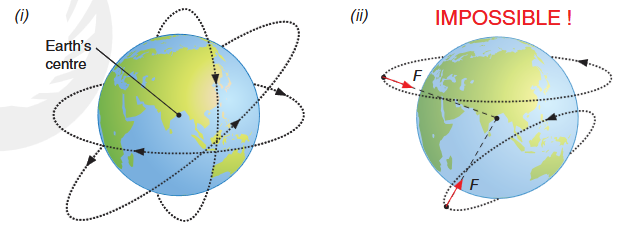
The centre of any valid circular orbit MUST coincide with the centre of gravity of the central planet.
Reason: Centripetal force must point toward the orbit's centre, and gravitational force points toward the planet's centre.
HKEAA Trap: An orbit lying in a plane of latitude (e.g. parallel to equator but north/south of it) is IMPOSSIBLE because the gravitational force pointing to Earth's centre has an unbalanced component perpendicular to the orbital plane, pulling the object out of that plane.
Geostationary Orbit Definition & Mandatory Conditions
A unique circular orbit in which a satellite revolves around Earth with the same period and direction as Earth's rotation, appearing stationary relative to Earth.
Mandatory Conditions: 1. Period T = 24 hours (86400 s).
2. Plane: Equatorial plane (directly above Equator).
3. Direction: West to East.
4. Fixed Radius: r = 4.22 * 10^7 m (altitude h = 3.58 * 10^7 m).
HKEAA Trap: A geostationary satellite CANNOT be parked above Hong Kong or any non-zero latitude city; its plane MUST be equatorial.
Cause of Apparent Weightlessness in Orbit (HKEAA Trap)
An astronaut inside an orbiting spacecraft experiences apparent weightlessness because both astronaut and spacecraft are in free fall towards Earth with the same acceleration (a = g = G * M / r^2).
Reaction Force: N = m * g - m * a = 0 (Normal reaction from floor is zero).
HKEAA Exam Report Trap: Candidates incorrectly state "gravity is zero in space" or "gravitational force is balanced by centripetal force".
REJECTION: Gravitational force is NOT zero, and it is NOT balanced by centripetal force; gravity IS the net force providing centripetal acceleration.
Radial Free-Fall Motion from Deep Space (HKEAA Trap)
Motion of an object released from rest far from a planet falling radially towards it (no atmosphere).
Motion Analysis: As distance r decreases, gravitational field strength g = G * M / r^2 increases, causing acceleration a = g to INCREASE continuously during fall.
v-t Graph Feature: Non-linear graph with an increasing gradient (curves upwards / concave upwards) because slope = acceleration a.
HKEAA Trap: Candidates wrongly draw a straight line assuming constant acceleration.
[IMAGE NEEDED: Graph of velocity v against time t curving upwards with increasing gradient for radial fall | Source: DSEPHY Ch 10 Revision Q15 / p.441]

Orbital Parameters vs Radius Comparison Matrix
For satellites orbiting the same planet at radii r_A > r_B: 1. Field Strength / Acceleration: g_A < g_B (g proportional to 1 / r^2). 2.
Linear Speed: v_A < v_B (v proportional to 1 / sqrt(r)). 3.
Angular Speed: w_A < w_B (w proportional to 1 / sqrt(r^3)). 4.
Orbital Period: T_A > T_B (T proportional to sqrt(r^3)).
Mass Dependency Trap: Kinematic quantities (v, w, T, a) are completely independent of satellite mass m.
Only force (F = G * M * m / r^2) and kinetic energy (KE = 1/2 * m * v^2) depend on satellite mass m.
Connection Between Projectile Motion and Circular Orbit
Orbital motion is a special case of horizontal projectile motion.
Working Principle: When an object is projected horizontally near a planet, increasing initial speed u causes the landing distance to increase.
Orbital Speed Condition: When launch speed reaches u = sqrt(G * M / r), the rate at which the projectile falls towards the planet equals the rate at which the curved surface falls away, creating a continuous circular orbit.

Derivation of Kepler's Third Law (T^2 proportional to r^3)
Mathematical derivation relating orbital period T and radius r:
1. Set F_grav = F_centripetal: G * M * m / r^2 = m * r * (2 * pi / T)^2.
2. Simplify and isolate T^2: T^2 = (4 * pi^2 / (G * M)) * r^3.
Key Conclusion: T^2 is directly proportional to r^3 for all bodies orbiting the same central mass M.
A graph of T^2 against r^3 is a straight line through the origin with slope = 4 * pi^2 / (G * M).
[NOT IN DSE FORMULA SHEET - MUST MEMORIZE/DERIVE]
Mass vs Weight on Different Celestial Bodies
Mass (m) is the amount of matter in an object (unit: kg) and remains constant everywhere.
Weight (W) is the gravitational force exerted on the object (unit: N), calculated by W = m * g = G * M * m / r^2.
Comparison: On the Moon (g = 1.62 N kg^-1), an object's mass is unchanged, but its weight is 1/6 of that on Earth.
A plot of mass against weight gives a straight line through the origin with slope = 1 / g.
Cavendish Experiment for Gravitational Constant G
Experimental determination of universal gravitational constant G ("weighing the Earth").
Principle: Uses a torsion balance with two small lead balls on a suspended rod and two large lead balls placed nearby.
Gravitational attraction F = G * M * m / r^2 creates a torque twisting the suspension wire by angle theta.
Calculation: Measuring torque yields F, allowing determination of G = 6.67 * 10^-11 N m^2 kg^-2, from which Earth mass M_E was first calculated.
