Exam II
 Call Kai
 Learn
 Practice Test
 Spaced Repetition
 Match
 Flashcards
 Knowt Play
1/24

There's no tags or description
Looks like no tags are added yet.
25 Terms
Primary Structure
Linear sequence of aa in a polypeptide.
connected by (covalent) peptide bonds
Secondary Structure
Folding of polypeptide backbone
stabilized by H-bonds between C=O and N-H
alpha helix & beta pleated
Tertiary Structure
3D folding of one polypeptide chain
- interactions between side chains
Interactions:
Hydrophobic interactions
Hydrogen bonds
Ionic bonds
Disulfide bridges
Van der Waals forces
Weak attractions between closely packed atoms
Quaternatry Structure
Assembly of multiple polypeptide chains
dimer
trimer
tetramer
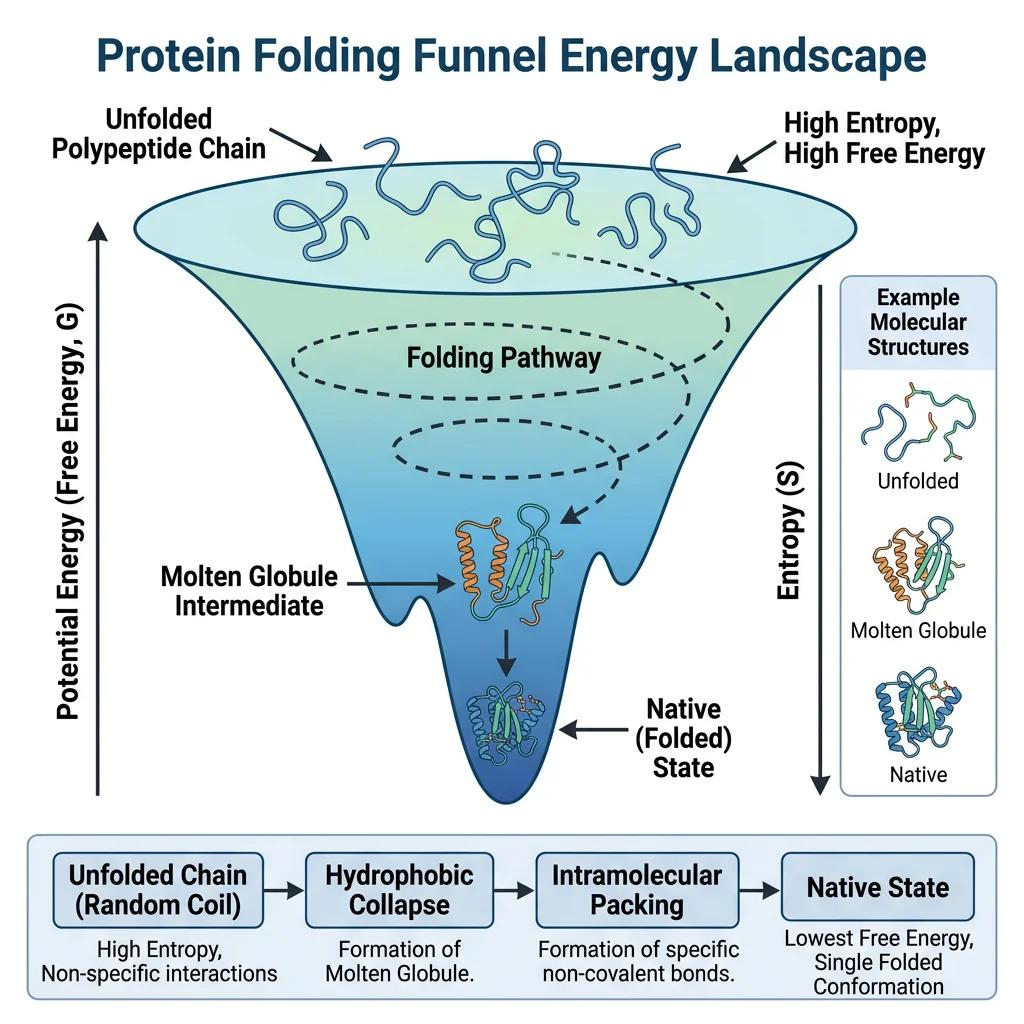
What is the protein folding funnel?
what is the most stable (functional) state called?
A model showing how a protein moves from many unfolded, high-energy conformations toward fewer, lower-energy conformations until reaching its stable, functional native state.
Native state
What are the WEAK protein stabilizing interactions? (strongest to weakest)
Ionic
Hydrogen
Hydrophobic Interactions
Van der waals
What is a salt bridge.
why might the energy gain be lower than expected
Ionic interations + & - amino acid side chain
Desolvation (bonds were stabilized by water must be broken)
What are van der waals effects
e weak attractions between atoms caused by temporary or permanent dipoles (uneven distributions of electrons).
They help stabilize proteins by allowing closely packed atoms to attract one another.
Psi & Phi Torsion angle
Psi: Rotation around the Cα–C' (carbonyl carbon) bond.
Phi (φ): Rotation around the N–Cα bond.
allows rotation
Omega angles
peptide bonds (cis or trans)
partial double bond character = very RIGID
96% trans due to sterics
Alpha Helix
Polypeptide backbone right handed spiral around helical axis.
side chains protrude
3.5 residues/ turn
7 residues/ integral turn
Phi: -60
Psi: 45 to -50
H-bonds between backbone atoms
What is the n-4 rule
Donor is n (N-H)
Acceptor is n-4 (C=O)

What is a helical wheel diagram

Helical Stability
bulkiness of side chains → steric hinderance = instability
Interactions between side chains 3-4 residues apart (hydrophobic / electrostatic)
Proline & Glycine = instability
Terminal AA electrostatic attraction/ repulsion
How does Proline change Helical Stability?
Proline is too rigid & can’t function as a H-bond donor
can still be in a helix
BENDS → local instability
How does Glycine change Helical Stability?
Decreases stability
Alpha helices require relatively consistent φ and ψ angles. Glycine's flexibility makes it easier for the helix to bend or lose its regular structure.
How does Electrostatic attraction/ repulsion with terminal amino acids affect helical stability?

Beta Strands → Sheets
created by H-bonds between strands
pleated sheets comes from planarity of peptide bonds
side chains alternate directions
± 120 degrees
Anti parallel B sheets
Strands run in opposite directions.
OPTIMAL H-bonding (STRAIGHT)
alternates H-bond donors/ acceptors

Parallel B-sheets
Strands run in the same direction.
Hydrogen bonds are angled.

B-Turn
4 residues connecting AP B -strands
Typically, a hydrogen bond forms between:
The C=O group of amino acid 1.
The N-H group of amino acid 4.
IMPORTANT Amino Acids:
Proline - rigid ring restricts backbone movement, bends the chain
Glycine - Small side chain allows it to fit in tight turn
Super Secondary Structures (Motifs)
Commonly observed, stable arrangements of 2ary structures
recognizable arrangement of multiple secondary structure elements (alpha helices, beta strands, and turns) that come together to form a recurring pattern.
What is a Globular Protein?
compact, rounded proteins with hydrophobic cores.
Protein Domains
Independently forming & folding region of a protein.
