Bioinformatics Exam 4 review
 Call Kai
 Learn
 Practice Test
 Spaced Repetition
 Match
 Flashcards
 Knowt Play
1/125

There's no tags or description
Looks like no tags are added yet.
126 Terms
What is genetic variation?
Differences in DNA content or structure among individuals
any two individuals have
~99.5% identical DNA
But the human genome is big
The human genome is big
each haploid set of 23 chromosomes has 3.1 billion nucleotides
how many known genetic variants in the human genome
>100,000,000 (100 million)
between 2 humans
99.5% DNA is the same
types of genetic variation
SNP
INDELs
SVs
SNP
single-nucleotide polymorphisms
“DNA spelling mistakes”

INDELs
Insertion-deletion polymorphisms
“extra or missing DNA”
short
2 base pairs of insertion or deletion

SVs
structural variants
“ Large blocks of extra, missing or rearranged DNA”
copy number gain or loss
deletions

Population-scale genetic studies
1000 genome project
Existing population scales
UK biobank is the most commone one at 500k-

SNP calling and genotyping with
next-generation sequencing reads
SNP calling is
identifying polymorphic site
identify where SNPS are/occur
Genotype calling is
assigning genotypes to individuals
assign genotype after finding where SNP occurs
Old approach of next-generation sequencing reads
count number of alleles at a site at a site (use a threshold 20-80% to call non-reference alleles). Requires high coverage reads (>20 read coverage)
count number of reads
modern approach of next-generation sequencing reads
use uncertainty in probabilistic framework
Site-frequency spectrum
most genetic variants today are rare
around 1%

most genetic variants today are
rare
Linkage disequilibrium (LD) block
where SNPs are correlated with each other
highly related with each other
LD haplotype block


LD haplotype block
a cluster of linked SNPs with strong LD, block boundaries reflect recombination hotspots
association studies using haplotype is
more robust than using individual SNPs
Hardy-Weinberg Equilibrium
p + q = 1
p2 + 2pq + q2 = 1
know how to do math
Structural variation (SVs)
genomic rearrangements that affect more than 1 kb of DNA:
Duplication
Deletion
Inversion
Translocation
4 types
Deletion often called
loss of heterozygosity if deletion occurs somatically
ex. cancer
Duplication
1st line always reference genome
2 copies

Deletion
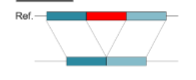
Inversion
copy number doesn’t change, but inverts

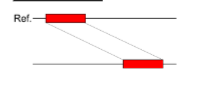
Translocation
Doesn’t change orientation or copy number
copy number variation (CNV)
large deletions or duplications
Abundance source of variation (ex. germline CNVs)
Associated with diseases (ex. somatic CNVs in cancer)

copy number variation (CNV) is
change in actual copy number
refers to deletion and duplication
CNVs can be source of
germline variance, exist in all of our cells
some copy number cells are
somatic
ex. breast cancer
Somatic CNVs in
cancer and changes in brain such as aging
whole-exome sequencing (WES)
study copy number changes
a cheaper, faster, but still effective alternative to whole-genome sequencing
method of choice for large-scale studies

Exome/exons
“functional” protein coding regions (1%) of the genome
Whole-exome sequencing encodes for
RNA
T or F: WES is cheaper and faster than whole genome sequencing
True
Read depth matrix
2 kinds of bias’:
sample-specific
exon-specific
other latent factors

sample specific bias
library size, batch effect, population stratification
Exon-specific bias
exon length, GC content, exon capture and amplification efficiency, etc.
T or F: Read depth matrix is similar to RNA
Read depth matrix normalize with the
library size factor
hotspot CNVs associated
neuropsychiatric disorders
identified some CNVs that are used as biometric markers

GWAS visualization: Manhattan plot
dots= one SNP
x-axis = location or SNPs?
higher y-axis = stronger association
y-axis = significance of association, disease outcome, trait, test whether SNP is associated with SNP

GWAS provides
list of p-values
effect sizes and their direction
GWAS hits are mostly
noncoding
Mapping expression quantitative trait locus (eQTL)
different type of association from GWAs, only difference is Y
encode SNP genotypes by the number of minor alleles
Y of eQTL
change it from diseased outcome to
Unique Molecular Identifiers (UMIs)
single- celled study
“hack” to alleviate biased from PCR
tag-based protocols allow for UMIs to improve quantification by removing PCR duplicated

what is a “hack” to alleviate biased from PCR
Unique Molecular Identifiers (UMIs)
Technical vs biological zeros/noise
a lot of zeros from single cell sequencing can be biological or technical
Standard QC measures
number of observed genes per cell
number of reads per cell
relationship between the 2

Calculated QC measures
amount of mitochondrial reads
amount of ribosomal reads
marker genes (ex. MALAT1)
Cell cycle

QC and Cell Filtering
single celled study have to adopt stringent polycule
identification of highly variable features
• Calculate a subset of features that exhibit high cell-to-cell variation in the dataset.
• Focusing on these genes in downstream analysis helps to highlight biological signal in single- cell datasets.
• Keep only the most variable genes (by default top 2000) for PCA and clustering

marker gene identification
column = one cell, grouped based on annotated cluster?
genes = cluster specific
heat map to cell type specific marker genes
how to tell which is which?

how to tell which marker gene is which
can ask GPT to tell what cell types are
large language model for cell-type annotation
inversions and translocations don’t change
copy number
CNV means only
deletions and duplications
Germline CNVs are
inherited and in all cells
while somatic ones are acquired, as in cancer.
Hotspot CNVs
hotspots such as 16p11.2 and 15q13.3 are enriched in autism, epilepsy and schizophrenia compared with controls.
can serve as biomarkers
about of 90% of hits in GWAS are
noncoding
eQTL
it uses the same regression as GWAS but with expression as Y. Genotypes are coded 0/1/2 and the null hypothesis is β = 0
UMIs
the tags go on before PCR, so identical UMI + sequence reads collapse into one molecule.
A lot of SNP are correlated to each other, this is called the
LD block
all of these different SNPs in this LD plot are highly related to each other
change in the actual copy number specifically refers to the
deletion and duplication
copy number is less than two for a ___ and more than two for a _____
deletion; duplication
copy number variation is
kilobases long
copy number variation can be
germline or somatic
with whole-exome sequencing, you can directly tell what can be
changed
cheaper because you only sequence 1% compared to whole genome sequencing
the heatmap shows
DNA sequencing read count across exons (rows) and samples (columns)
some samples (ex. middle) are much brighter, meaning they are sequenced much deeper, therefore similar to RNA sequencing, you also need to correct for library-size factor (ex. how deeply a sample is sequenced)