Module 9: Cognitive Behavioral Therapy Quiz
 Call Kai
 Learn
Learn Practice Test
 Spaced Repetition
 Match
Match Flashcards
 Knowt Play
1/39

There's no tags or description
Looks like no tags are added yet.
Name | Mastery | Learn | Test | Matching | Spaced | Call with Kai | Chat |
|---|
No analytics yet
Send a link to your students to track their progress
40 Terms
1. Who are the prominent figures associated with Rational Emotive Behavior Therapy (REBT)?
A) Aaron T. Beck and Judith Beck
B) Albert Ellis
C) Donald Meichenbaum
D) Sigmund Freud
Answer: B
Explanation: Albert Ellis is noted as the founder of rational emotive behavior therapy (REBT).
2. Which of the following is NOT listed as a basic characteristic and assumption of Cognitive Behavior Therapies?
A) A collaborative relationship between client and therapist
B) A focus on changing cognitions to produce desired changes in affect and behavior
C) An open-ended, timeless focus with no specific endpoint
D) An active and directive stance by the therapist
Answer: C
Explanation: CBT is specifically characterized as a present-centered, time-limited focus rather than timeless or open-ended.
3. According to the basic characteristics of CBT, psychological distress is largely viewed as a function of what?
A) Unconscious instinctual conflicts
B) Disturbances in cognitive processes
C) Genetic and chromosomal abnormalities
D) Past childhood environmental neglect exclusively
Answer: B
Explanation: CBT operates on the premise that psychological distress is largely a function of disturbances in cognitive processes.
4. Which cognitive behavior approach is specifically associated with Aaron T. Beck and Judith Beck?
A) Rational Emotive Behavior Therapy (REBT)
B) Cognitive Therapy (CT)
C) Cognitive Behavior Therapy (CBT)
D) Behavior Modification
Answer: B
Explanation: Aaron T. Beck and Judith Beck are associated with Cognitive Therapy (CT).
5. Which theorist is prominently linked to Cognitive Behavior Therapy (CBT) alongside Ellis and the Becks?
A) Donald Meichenbaum
B) Carl Rogers
C) B.F. Skinner
D) Fritz Perls
Answer: A
Explanation: Donald Meichenbaum's cognitive behavior therapy (CBT) is listed among the prominent cognitive behavioral approaches.
6. In Rational Emotive Behavior Therapy (REBT), therapy is described as highly didactic and very directive. What else is it equally concerned with?
A) Unconscious dreams as with waking life
B) Thinking as with feeling
C) Physiological responses as with cognitive insights
D) Past history as with present actions
Answer: B
Explanation: REBT is highly didactic, very directive, and concerned as much with thinking as with feeling.
7. REBT teaches that our emotions stem mainly from which of the following?
A) External life situations directly without mental filtration
B) Our beliefs, evaluations, interpretations, and reactions to life situations
C) Chemical imbalances in the bloodstream
D) Early childhood psychosexual fixations.
Answer: B
Explanation: REBT teaches that emotions stem mainly from our beliefs, evaluations, interpretations, and reactions to life situations.
8. Through the therapeutic process of REBT, clients learn skills that give them the tools to identify and dispute irrational beliefs maintained by what mechanism?
A) Social conditioning
B) Self-indoctrination
C) Biological heredity
D) Parental reinforcement
Answer: B
Explanation: Clients learn tools to identify and dispute irrational beliefs maintained by self-indoctrination.
9. Regarding human nature, what does REBT state about human thinking potential?
A) We are born exclusively with rational thinking potential.
B) We are born with a potential for both rational and irrational thinking.
C) We are born completely irrational and cannot change.
D) Human thinking is entirely dictated by external environmental stimuli.
Answer: B
Explanation: The view of human nature states that we are born with a potential for both rational and irrational thinking.
10. According to REBT's view of human nature, how do we keep ourselves disturbed?
A) By learning and inventing disturbing beliefs and keeping ourselves disturbed through our self-talk
B) By repressing memories into the collective unconscious
C) By failing to engage in physical exercise
D) By maintaining strong interpersonal relationships
Answer: A
Explanation: We learn and invent disturbing beliefs and keep ourselves disturbed through our self-talk.
11. Which of the following is one of the "three basics musts" (irrational beliefs) identified by Ellis & Dryden (2007)?
A) "I must do well and win the approval of others for my performances or else I am no good."
B) "People are inherently good and never act irrationally."
C) "Life should always be comfortable, easy, and painless."
D) "I must control every outcome in my professional career."
Answer: A
Explanation: One of the three basic musts is: "I must do well and win the approval of others for my performances or else I am no good.".
12. What is a core consequence of holding irrational ideas in cognitive-behavioral theory?
A) They lead directly to self-defeating behavior.
B) They foster high levels of objective self-actualization.
C) They promote unconditional positive regard for others.
D) They result in permanent cognitive balance.
Answer: A
Explanation: Irrational ideas lead to self-defeating behavior.
13. What is defined as a central technique of cognitive therapy that teaches people how to improve themselves by replacing irrational beliefs with rational beliefs?
A) Systematic desensitization
B) Cognitive Restructuring
C) Free association
D) Operant conditioning
Answer: B
Explanation: Cognitive restructuring is a central technique of cognitive therapy that teaches people how to replace irrational beliefs with rational beliefs.
14. What does cognitive restructuring involve helping clients learn to do regarding their internal monologue?
A) Monitor their self-talk, identify maladaptive self-talk, and substitute adaptive self-talk for their negative self-talk
B) Suppress all thoughts completely whenever they become stressful
C) Record every dream immediately upon waking
D) Analyze the biological origin of each spoken word
Answer: A
Explanation: Restructuring involves helping clients monitor their self-talk, identify maladaptive self-talk, and substitute adaptive self-talk for negative self-talk.
15. When applying CBT to group counseling, what is a primary purpose of assigning homework?
A) To punish members who do not participate actively
B) To allow lessons learned in group to generalize to the client's daily environment
C) To increase the administrative paperwork required by the clinic
D) To test whether clients can read medical journals independently
Answer: B
Explanation: The use of homework allows lessons learned in group to generalize to the client's daily environment.

16.
Statement 1: Prominent cognitive behavioral approaches include Albert Ellis's rational emotive behavior therapy (REBT).
Statement 2: Donald Meichenbaum's approach is excluded from cognitive behavior therapy models.
Answer: B (Statement 1 is True; Statement 2 is False)
Explanation: Albert Ellis's REBT is a prominent approach, but Donald Meichenbaum's cognitive behavior therapy is also explicitly listed as a prominent cognitive behavioral approach.

17.
Statement 1: Cognitive behavior therapies are characterized by a collaborative relationship between client and therapist.
Statement 2: Psychological distress in CBT is viewed as a function of disturbances in cognitive processes.
Answer: A (Both statements are True)
Explanation: Both statements reflect the core basic characteristics and assumptions of cognitive behavior therapies.

18.
Statement 1: CBT maintains a present-centered, time-limited focus.
Statement 2: The therapist adopts a passive, non-directive stance in CBT.
Answer: B (Statement 1 is True; Statement 2 is False)
Explanation: CBT is present-centered and time-limited, but the therapist maintains an active and directive stance rather than a passive one.

19.
Statement 1: Rational Emotive Behavior Therapy (REBT) stresses thinking, judging, deciding, analyzing, and doing.
Statement 2: REBT assumes that cognitions, emotions, and behaviors interact in a reciprocal cause-and-effect relationship.
Answer: A (Both statements are True)
Explanation: Both are core theoretical assumptions and characteristics of REBT.

20.
Statement 1: REBT is highly didactic and very directive.
Statement 2: REBT is exclusively focused on feelings while completely ignoring rational thinking.
Answer: B (Statement 1 is True; Statement 2 is False)
Explanation: REBT is highly didactic and directive, but it is concerned as much with thinking as with feeling.

21.
Statement 1: REBT teaches that our emotions stem mainly from our beliefs, evaluations, interpretations, and reactions to life situations.
Statement 2: External life situations directly cause our emotional distress without any mediation from beliefs.
Answer: B (Statement 1 is True; Statement 2 is False)
Explanation: Statement 1 is a core teaching of REBT. Statement 2 is false because REBT emphasizes that beliefs and evaluations of situations dictate emotional outcomes.
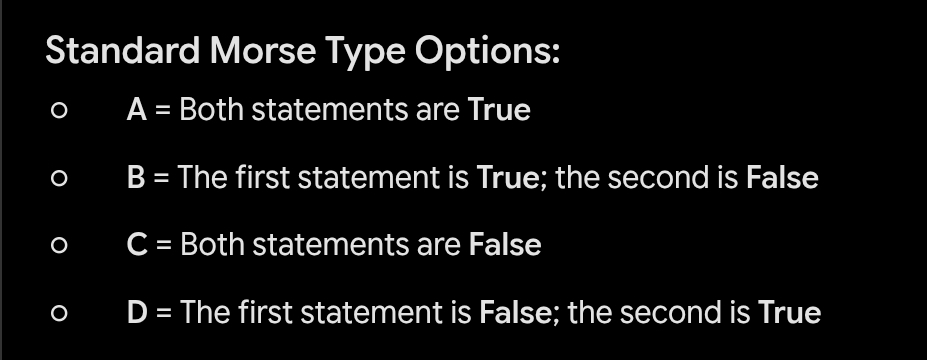
22.
Statement 1: Through REBT, clients learn skills to identify and dispute irrational beliefs maintained by self-indoctrination.
Statement 2: Therapy from an REBT perspective is seen as an educational process.
Answer: A (Both statements are True)
Explanation: Both statements accurately describe the therapeutic process and learning objectives of REBT.

23.
Statement 1: Clients in REBT learn to identify the interplay of their thoughts, feelings, and behaviors.
Statement 2: Clients are encouraged to maintain absolutistic thinking and repeat false beliefs.
Answer: B (Statement 1 is True; Statement 2 is False)
Explanation: Clients learn thought-feeling-behavior interplay, but the goal is to stop absolutistic thinking, blaming, and repeating false beliefs.

24.
Statement 1: Humans are born with a potential for both rational and irrational thinking.
Statement 2: People have a biological and cultural tendency to think crookedly and needlessly disturb themselves.
Answer: A (Both statements are True)
Explanation: Both points are foundational components of the REBT view of human nature.

25.
Statement 1: People keep themselves disturbed through their own self-talk.
JPEG
Statement 2: Humans possess zero capacity to change their cognitive, emotive, or behavioral processes.
Answer: B (Statement 1 is True; Statement 2 is False)
Explanation: We learn, invent disturbing beliefs, and keep ourselves disturbed via self-talk, but humans do have the capacity to change their cognitive, emotive, and behavioral processes.

26.
Statement 1: One of Ellis and Dryden's basic musts is: "I must do well and win the approval of others for my performances or else I am no good."
Statement 2: This belief is considered completely rational and adaptive in REBT.
Answer: B (Statement 1 is True; Statement 2 is False)
Explanation: Statement 1 is an exact quote of one of the three basic irrational musts; however, these internalized beliefs lead to self-defeat and are irrational.

27.
Statement 1: Another basic irrational belief is: "Other people must treat me considerately and fairly; if they don't, they deserve to be condemned and punished."
JPEG
Statement 2: Rational thinking avoids self-defeating behaviors and irrational demands.
Answer: A (Both statements are True)
Explanation: Statement 1 matches the second basic must, and irrational ideas inherently lead to self-defeating behaviors.

28.
Statement 1: The third basic must states that if we do not get what we want, it is terrible and we cannot stand it.
Statement 2: Irrational ideas promote psychological health and flawless emotional stability.
Answer: B (Statement 1 is True; Statement 2 is False)
Explanation: Statement 1 matches the third basic must. Statement 2 is false because irrational ideas lead to self-defeating behavior and distress.

29.
Statement 1: Irrational ideas lead directly to self-defeating behavior.
JPEG
Statement 2: An example of an irrational idea is: "I must perform important tasks competently and perfectly."
Answer: A (Both statements are True)
Explanation: Both statements are explicitly outlined under the concepts of irrational ideas and self-defeating actions.

30.
Statement 1: Cognitive restructuring is a central technique of cognitive therapy.
Statement 2: Cognitive restructuring teaches people how to improve themselves by replacing irrational beliefs with rational beliefs.
Answer: A (Both statements are True)
Explanation: Both sentences accurately define cognitive restructuring based on the source text.

31.
Statement 1: Cognitive restructuring involves helping clients monitor their self-talk.
JPEG
Statement 2: Restructuring encourages clients to maintain and reinforce their negative self-talk without changes.
Answer: B (Statement 1 is True; Statement 2 is False)
Explanation: Monitoring self-talk is correct, but restructuring aims to substitute adaptive self-talk for negative self-talk.

32.
Statement 1: CBT applications in group counseling are often tailored for specific diagnoses like anxiety, panic, eating disorders, and phobias.
Statement 2: Treatments in CBT group counseling are completely unstandardized and lack empirical evidence.
Answer: B (Statement 1 is True; Statement 2 is False)
Explanation: Group applications are tailored for specific diagnoses, but treatments are standardized and based on empirical evidence.

33.
Statement 1: The use of homework in CBT group counseling allows lessons learned in group to generalize to the client's daily environment.
Statement 2: CBT group counseling avoids psychoeducation and focuses exclusively on unconscious dream analysis.
Answer: B (Statement 1 is True; Statement 2 is False)
Explanation: Homework aids generalization into daily life, and CBT places a heavy emphasis on psychoeducation and prevention of symptoms rather than dream analysis.

34.
Statement 1: CBT group counseling helps members gain awareness of how their self-defeating thoughts influence what they feel and how they behave.
Statement 2: Thoughts, feelings, and behaviors operate completely independently of one another in CBT theory.
Answer: B (Statement 1 is True; Statement 2 is False)
Explanation: Statement 1 is true. Statement 2 is false because cognitive approaches emphasize the interactive, reciprocal cause-and-effect relationship between cognitions, emotions, and behaviors.

35.
Statement 1: Aaron T. Beck and Judith Beck are key figures in Cognitive Therapy (CT).
JPEG
Statement 2: Cognitive behavior therapies rely on educational treatments focusing on specific and structured target problems.
Answer: A (Both statements are True)
Explanation: Both statements correctly state foundational facts from the cognitive behavioral chapters.

36.
Statement 1: Cognitive behavior therapies focus on changing cognitions to produce desired changes in affect and behavior.
JPEG
Statement 2: CBT views psychological distress as entirely unrelated to cognitive processes.
Answer: B (Statement 1 is True; Statement 2 is False)
Explanation: Changing cognitions alters affect and behavior, but psychological distress is explicitly viewed as a function of disturbances in cognitive processes.

37.
Statement 1: REBT teaches clients to identify and dispute irrational beliefs maintained by self-indoctrination.
Statement 2: Human beings are incapable of inventing disturbing beliefs through self-talk.
Answer: B (Statement 1 is True; Statement 2 is False)
Explanation: Self-indoctrination dispute is a core REBT skill, but humans do learn and invent disturbing beliefs through self-talk.

38.
Statement 1: Cognitive restructuring teaches people how to improve themselves by replacing irrational beliefs with rational beliefs.
Statement 2: Cognitive restructuring has no role in cognitive therapy techniques.
Answer: B (Statement 1 is True; Statement 2 is False)
Explanation: Cognitive restructuring is accurately described in Statement 1, making Statement 2 false since it is a central technique of cognitive therapy.

39.
Statement 1: Homework assignments in CBT bridge group learning with real-world daily environments.
Statement 2: Group counseling utilizing CBT avoids structured target problems and psychoeducation.
Answer: B (Statement 1 is True; Statement 2 is False)
Explanation: Homework bridges group lessons to daily environments, but CBT group counseling features a heavy emphasis on psychoeducation and structured target problems.

40.
Statement 1: People have the capacity to change their cognitive, emotive, and behavioral processes.
Statement 2: REBT assumes that emotions and cognitions operate in complete isolation from one another.
Answer: B (Statement 1 is True; Statement 2 is False)
Explanation: Humans have the capacity for change, but REBT assumes that cognitions, emotions, and behaviors interact in a reciprocal relationship rather than operating in isolation.