Antibacterial Modes of Actions
 Call Kai
 Learn
Learn Practice Test
 Spaced Repetition
 Match
Match Flashcards
 Knowt Play
1/33

There's no tags or description
Looks like no tags are added yet.
Name | Mastery | Learn | Test | Matching | Spaced | Call with Kai | Chat |
|---|
No analytics yet
Send a link to your students to track their progress
34 Terms
What does antimicrobial mean?
Any chemicals which kill or inhibit microbial growth in or on a body surface (Fungal, viral, bacteria…)
What does antibacterial mean?
Any chemical which specifically targets bacteria and kills or inhibits its growth.
What does antibiotic mean?
A drug used to treat bacterial infections
What does selective toxicity mean?
Selectively kills or inhibits the target organism, whilst causing no or minimal harm to the host
We want antibiotics to be selectively toxic
What does bacteriostatic mean?
Slow down or stall bacterial growth
What does bactericidal mean?
Kills bacteria
Why is it harder to find selective toxicity in antifungals / antivirals?
Fungi are eukaryotic
Viruses live in host cells so use our cells to replicate
What are ideal properties & activities of antibacterials?
Specific: the ability of a drug/chemical agent to interact with a defined target
Selective: selectively kills or inhibits the target organism, whilst causing no or minimal harm to the host.
Less selectivity means more adverse effects
Bactericidal
Minimal emergence of resistance to the drug
What are the pharmacological activities of antibacterials?
Non toxic to host
Long plasma half life
Good tissue distribution
Low plasma protein binding
Oral & parenteral (options to treat people)
No interference with other drugs
Where are the 4 main antibacterial targets in a bacterial cell?
Cell wall (major target - many drugs target this)
Protein synthesis
Cell membrane (fewer drugs target this)
Nucleic acid (many drugs target)
Why do we have few drugs which target the bacteria cell membrane?
Cell wall as a target
Unique to prokaryotes
Provides selective target
Mainly bactericidal
Protein synthesis as a target
Many drugs exploit differences between prokaryotic and eukaryotic ribosomes - selective target
Many drugs are bacteriostatic
Cell membrane as a target
High similarity to eukaryote cell membrane
Few targets selective for bacteria
Fewer drugs target the cell membrane
Mainly Bactericidal
Nucleic synthesis as a target
Gram Negative bacteria
Gram negative bacteria
Stains pink
E.coli
Outer-membrane
Thin peptidoglycan layer
LPS (red)
Hard to get into gram negative bacteria because of the charged LPS
Porin channels
Any antibiotic to treat gram negative bacteria has to get through porin channels, making them harder to treat

Gram positive bacteria

Peptidogylcan

Most prescribed type of antibiotic
B-Lactams
All contain B-lactam ring
Differences in structure of ring attached to B-lactam and side chains
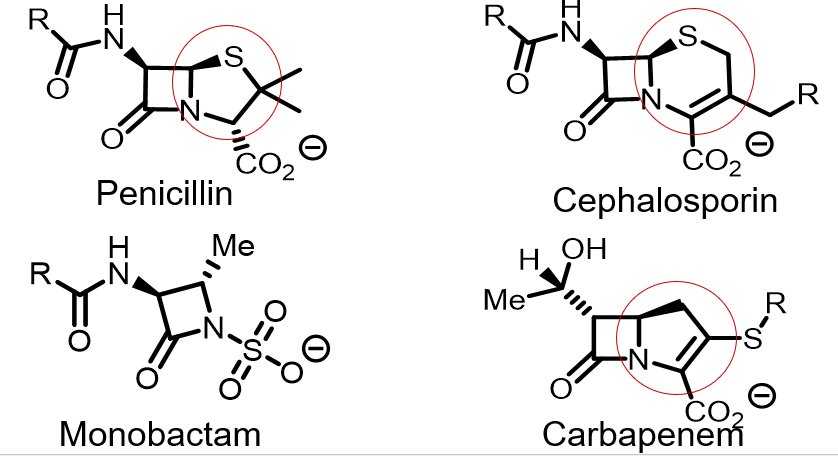
What is B-lactam 1st mode of action?
The enzyme Penicillin Binding Protein (PBPs) also known as transpeptidases catalyse the crosslinking of the peptide side chains of the peptidoglycan monomer when it is incorporated into the cell wall
Beta lactam antibiotics bind and inhibit action of the PBP enzyme. They mimic the D-alanine D-alamine, forming an antibiotic enzyme complex
What is B-lactam 2nd mode of action?
The presence of beta lactams stimulate the bacteria to produce enzymes known as autolysins
These enzymes breaks down cell wall
Leads to cell lysis due to osmotic pressure and loss of integrity of the cell wall
What are the other classes of antibiotics?
Glycopeptides
Fosfomycin
Cycloserine
Bacitracin
Antibiotics which target the cell membrane
Polymyxins
Lipopeptides
Polymyxin E (Colistin)
Can only be used to target Gram Negative bacteria
Nucleic acid synthesis inhibitors
Protein synthesis inhibitors
Protein synthesis is similar between eukaryotes and prokaryotes
Prokaryotes actually synthesise proteins 10x faster than eukaryotes do
But bacterial and mammalian ribosomes differ in their structure. Prokaryotic subunits are smaller
Within subunits, the structure also differs
We can exploit these differences to give us selective drug targets which inhibit bacterial protein synthesis