I3 - DNA ,RNA as drug targets ,replication ,transcription and translation 2
 Call Kai
 Learn
 Practice Test
 Spaced Repetition
 Match
 Flashcards
 Knowt Play
1/11

There's no tags or description
Looks like no tags are added yet.
12 Terms
Why is RNA important as an antibacterial drug target?
RNA polymerase is essential for bacterial transcription (DNA → RNA)
It synthesises RNA using DNA as a template
Bacterial RNA polymerase differs structurally from human RNA polymerases
These differences allow selective targeting by antibacterial drugs
Rifampicin - an antibiotic that targets bacterial RNA polymerase
How does rifampicin work?
● Rifampicin is an antibiotic that targets bacterial RNA polymerase
● It binds to the β subunit* of bacterial RNA polymerase
● This prevents the extension of newly initiated RNA template strands
● As a result, bacterial RNA synthesis is inhibited
● Without RNA – no protein synthesis growth/survival

What is bacterial translation?
● Translation is the synthesis of proteins using mRNA as a template
● Takes place on ribosomes in the bacterial cytoplasm
● The mRNA sequence determines the order of amino acids
● tRNA (transfer RNA)delivers amino acids to the ribosome
● Amino acids are joined to form a polypeptide chain, which folds into a protein
Note - Prokaryotic translation can start while transcription is still ongoing!

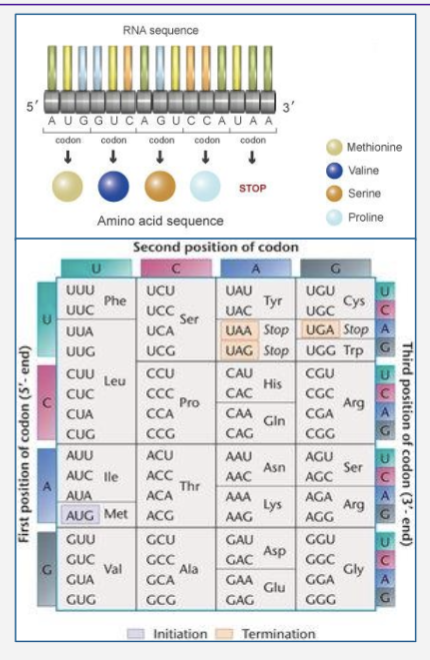
What makes up the genetic code - codons and mrna ?
● mRNA is read in groups of three bases called codons
● Each codon specifies an amino acid or a stop signal
● AUG is the usual start codon (methionine)
● There are 64 codons, including three stop codons
● The code is degenerate – several codons can specify the same amino acid
● Codon sequence determines the amino acid sequence of a protein
What is tRNA and anticodons?
● tRNA carries amino acids to the ribosome
● Each tRNA has an anticodon complementary to an mRNA codon
● Aminoacyl-tRNA synthetases attach the correct amino acid to each tRNA
● Codon-anticodon pairing ensures the correct amino acid is added to the growing polypeptide

Describe the bacterial ribosomes
Bacterial ribosomes are 70S, consisting of two subunits:
● The 30S subunit binds mRNA and helps decode codons
● The 50S subunit catalyses peptide bond formation
Human cytoplasmic ribosomes are 80S
(40S + 60S)
● These structural differences allow selective antibacterial drug targeting

How is bacterial translation initiated ?
● The 30S ribosomal subunit binds to mRNA near the start codon (AUG)
● The initiator tRNA carries formyl methionine (fMet)
● The initiator tRNA binds to the P site of the ribosome
● The 50S subunit joins, forming the functional 70S ribosome
● Translation is ready to begin

What is the elongation phase in translation ( sites) ?
● A site (Aminoacyl): Incoming tRNA delivers the next amino acid
● P site (Peptidyl): Holds the tRNA carrying the growing polypeptide
● Peptide bonds form between amino acids
● E site (Exit): Empty tRNA leaves the ribosome
● The ribosome moves along mRNA 5′ → 3′, repeating the cycle

How is translation terminated?
● Translation ends when a stop codon (UAA, UAG or UGA) enters the A site
● Stop codons do not code for amino acids
● Release factors recognise the stop codon and trigger release of the polypeptide
● The ribosome separates into its subunits, ready for reuse

Describe the process of translation (protein synthesis) in bacteria.
1. Initiation
The 30S ribosomal subunit binds to mRNA near the start codon AUG.
An initiator tRNA carrying formylmethionine (fMet) binds to the start codon at the ribosome's P site.
The 50S ribosomal subunit joins the 30S subunit, forming the functional 70S ribosome.
Translation is now ready to begin.
2. Elongation
The ribosome moves along the mRNA in the 5′ → 3′ direction, reading three-base sequences called codons.
tRNA molecules carry specific amino acids to the ribosome, with their anticodons pairing with complementary mRNA codons.
The ribosome has three sites:
A site (Aminoacyl): Incoming tRNA delivers the next amino acid.
P site (Peptidyl): Holds the tRNA carrying the growing polypeptide chain.
E site (Exit): Empty tRNA leaves the ribosome.
The 50S subunit catalyses peptide bond formation, joining amino acids together.
The ribosome moves forward by one codon, and the cycle repeats, extending the polypeptide chain.
3. Termination
Translation ends when a stop codon (UAA, UAG or UGA) enters the A site.
Stop codons do not code for amino acids, so release factors bind instead of tRNA.
Release factors trigger the release of the completed polypeptide chain.
The ribosome separates into its 30S and 50S subunits, which can be reused.
The polypeptide folds to form a functional protein.
How are bacterial ribosomes antibiotic targets?
● Bacterial ribosomes are important targets for antibiotics
● Antibiotics can bind to either the 30S or 50S subunit
● Tetracyclines (30S): Prevent aminoacyl-tRNA binding to the A site
● Macrolides (50S): Block the peptide exit tunnel, disrupting elongation

summary of antibiotic targets
