Bio exam, Unit 3
 Call Kai
 Learn
 Practice Test
 Spaced Repetition
 Match
 Flashcards
 Knowt Play
1/81

Earn XP
Description and Tags
you can do it!
82 Terms
CNS (central nervous system)
the primary processing center of the body, composed exclusively of the brain and spinal cord.
PNS (peripheral nervous system)
consists of all the nerves and ganglia outside of the brain and spinal cord, serving as the communication relay between CNS and rest of the body.
Sensory neuron
carries information from the environment, towards the CNS
motor neuron
carries information from interneurons to the effector cells in glands or muscles.
interneuron
carries information from one neuron to other neurons.

diagram of a neuron: 1
dendrite
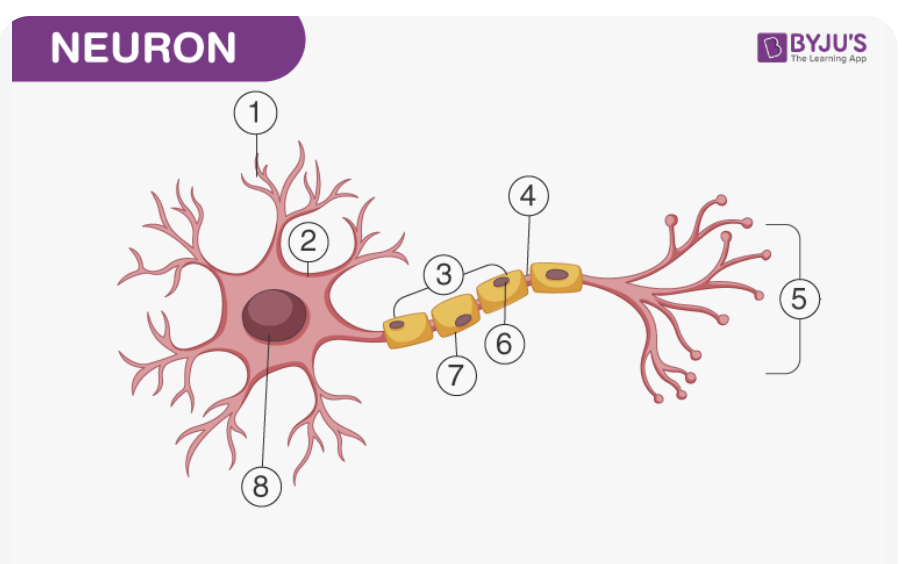
diagram of a neuron: 2
soma

diagram of a neuron: 3
axon

diagram of a neuron: 5
axon terminal

diagram of a neuron: 8
nucleus
Presynaptic action potential
What it is: An electrical signal traveling down the axon of the sending neuron toward the axon terminal.
Signal type | Location | Key event | |
|---|---|---|---|
Electrical | Sending neuron's axon | Na⁺ enters |
Presynaptic neurotransmitter (NT) release
What it is: The release of chemical messengers from the sending neuron into the synaptic cleft.
Signal type | Location | Key event | |
|---|---|---|---|
Chemical | Sending neuron's axon terminal | Ca²⁺ enters; vesicles release NT |
Postsynaptic graded potential
What it is: A change in the electrical charge of the receiving neuron's membrane after neurotransmitters bind to its receptors.
Signal type | Location | Key event | |
|---|---|---|---|
Electrical | receiving neuron’s membrane | NT binds receptors; ion flow changes voltage |
Postsynaptic action potential
What it is: An electrical signal generated by the receiving neuron if its membrane reaches threshold.
How it happens:
Signal type | Location | Key event | |
|---|---|---|---|
electrical | Receiving neuron's initial segment and axon | Threshold reached; Na⁺ enters |
Botulinum neurotoxin is naturally produced by the bacterium Clostridium botulinum and causes flaccid paralysis (an inability to contract muscles). This toxin is sold under the trade name Botox, and is used to cause paralysis for both therapeutic and cosmetic reasons. It works by preventing synaptic vesicles from fusing with the presynaptic membrane.
a. Which of the steps in the flow of neural information is directly affected by the presence of botulinum neurotoxin? and why…
b. Which of the steps in the flow of neural information is indirectly affected by the presence of botulinum neurotoxin? (Circle all that apply – there may be more than one answer.)
a: presynaptic NT release: It works by preventing synaptic vesicles from fusing with the presynaptic membrane.
b: postsynaptic graded potential, postsynaptic action potential
Procaine is a synthetic molecule that is chemically similar to cocaine, which is produced by coca plants. This molecule is sold under the trade name Novocain, and is used as a local anesthetic, typically in dentistry. It works by binding to voltage-gated sodium channels and preventing the flow of sodium ions across the cell membrane.
a. Which of the steps in the flow of neural information is directly affected by the presence of procaine? and why…
b. Which of the steps in the flow of neural information is indirectly affected by the presence of procaine? (Circle all that apply – there may be more than one answer.)
a: presynaptic action potential: It works by binding to voltage-gated sodium channels and preventing the flow of sodium ions across the cell membrane.
b: presynaptic NT release, postsynaptic graded potential, postsynaptic action potential
Which of the following correctly summarizes the major event when postsynaptic ion channels open?
Ions flow through ligand-gated ion channels, causing a change in postsynaptic membrane potential.
Which of the following steps of synaptic transmission describes when a chemical signal is converted to an electrical signal?
Ion channels in the postsynaptic membrane open when bound by their neurotransmitter ligand.
Calciseptine is a neurotoxin that is produced by black mamba snakes, and can cause analgesia (the inability to sense pain). Calciseptine binds to voltage-gated calcium channels in the presynaptic membrane and prevents them from functioning correctly. Which of the following processes would the application of calciseptine most directly affect?
Fusion of the synaptic vesicle with the presynaptic membrane.
Strychnine is a potent neurotoxin that is derived from the seeds of the strychnine tree. It works by binding to glycine receptors to prevent the binding of the neurotransmitter glycine, therefore preventing activation of the glycine receptor.
a. Which of the steps in the flow of neural information is directly affected by the presence of strychnine? and why…
b. Which of the steps in the flow of neural information is indirectly affected by the presence of strychnine?
a: postsynaptic action potential: binding of a neurotransmitter (such as glycine) to its receptor is necessary for allowing ions to cross the postsynaptic membrane and generate a postsynaptic graded potential
without binding of glycine to its receptor, the receptor cannot be activated, so ions cannot cross the postsynaptic membrane, and a graded potential cannot be generated
b: postsynaptic action potential
transduction
converts stimulus to an electrical signal for the nervous system
transmission
carries an electrical signal along neuron to another cell through the synapse.
taste transduction
chemical tastant
receptor protein
ion channels and ligand-gated channels (NA+ & H+) (taste)/ mechanically-gated ion channels (hearing)

epithelial sensory cell
taste receptor cell/ hair cell

vesicle with neurotransmitter
taste: serotonin or ATP/ hearing: glutamate

neurotransmitter receptor
taste: ligand-gated channels/ hearing: ligand-gated channels

dendrite of afferent neuron
passed to primary afferent neuron: gustatory neuron (taste)/ passed to primary afferent neuron: spiral ganglion (hearing)

saltiness
sodium ions (Na+)
sourness
protons (H+)
bitterness
PTC (phenylthiocarbamide)
sweetness
sweet tasting compounds that bind to sweet tasting receptors
umani
MSG (monosodium glutamate)
sound transduction
line labeled
taste transduction
population coded
base of the basilar membrane
narrower, stiff/less flexible, high frequency sounds
apex of the basilar membrane
wider, more flexible/less stiff, low frequency sounds.
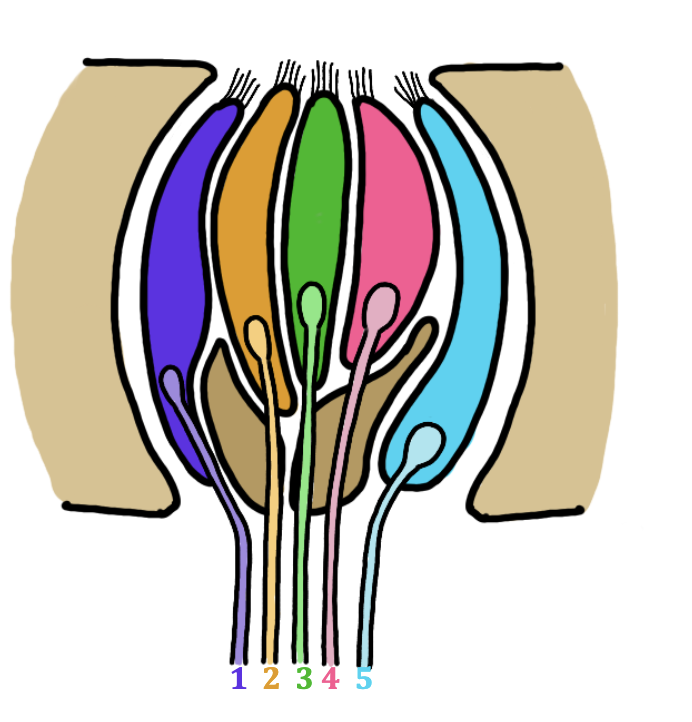
The diagram below shows a cluster of taste receptor cells within a taste bud, with each cell represented by a different color. The labeled segments of membrane above the taste bud show which types of receptors are present in each taste receptor cell membrane: 1
umami and sour: MSG and citric acid
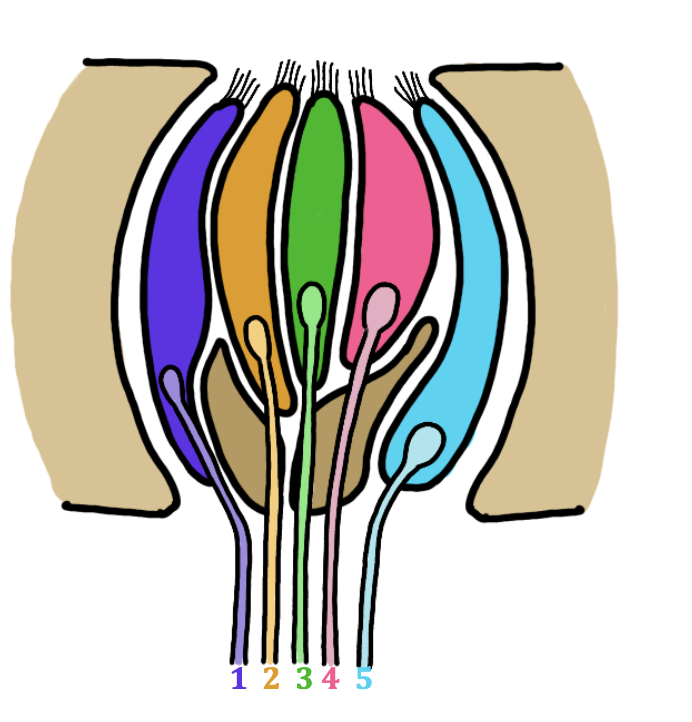
The diagram below shows a cluster of taste receptor cells within a taste bud, with each cell represented by a different color. The labeled segments of membrane above the taste bud show which types of receptors are present in each taste receptor cell membrane: 2
sweet and bitter: sucrose and caffeine

The diagram below shows a cluster of taste receptor cells within a taste bud, with each cell represented by a different color. The labeled segments of membrane above the taste bud show which types of receptors are present in each taste receptor cell membrane: 3
bitter and umami: caffeine and MSG

The diagram below shows a cluster of taste receptor cells within a taste bud, with each cell represented by a different color. The labeled segments of membrane above the taste bud show which types of receptors are present in each taste receptor cell membrane: 4
salt and sweet: Na and Sugar (sucrose)
The diagram below shows a cluster of taste receptor cells within a taste bud, with each cell represented by a different color. The labeled segments of membrane above the taste bud show which types of receptors are present in each taste receptor cell membrane: 5
Salt: Na
gustation salty
Na+ starts polarized, goes through channels and becomes depolarized
gustation sour
H+ are going to come in, become depolarized, neurotransmitters are released, sensory neuron is stimulated
gustation sweet
doesn’t easily cross the membrane, sugars bind to external, ligand-gated ion channels, the receptor is specific for different signals, sugars go to G proteans go to second messenger go to K- channels close go to depolarization go to simulation (primary afferent neuron).
compressed sounds:
higher amplitude, louder sounds
less compressed sounds
lower amplitude, softer sound
lower frequency
low pitch (waves are spread out)
higher frequency
high pitch (waves are tighter together)
outer cochlea
20,000 hz (stiff and narrow), high pitch sounds are detected here
inner cochlea
20 hz (loose and floppy), low pitch sounds detected here
presynaptic action potential
depolarization
presynaptic NT release
blocks calcium, or release of neurotransmitters
postsynaptic graded potential
neurotransmitter can’t bind
postsynaptic action potential
everything that maybe could happen after postsynaptic graded potential
species change overtime four pieces of evidence
the earth is very old & fossil records show this
extinctions: most species have gone extinct and don’t exist (a form of change)
phenotypic & genetic similarities (changes in form): Law of succession: there are similarities between extant and extinct individuals in common location. Transitional forms: there is intermediate forms between ancestors and descendants.
presence of vestigial traits: useless or redundant traits that is useful in related species. (transitional features)
Descent with modifications
species change over time.
species are related by common ancestry: three factors
similar species found in same geographic area.
different species share similar DNA and anatomical structures.
speciation has been observed (one species splits into two or more descendant species).
artificial selection
humans choose which organisms reproduce, selection is directional (has a goal)
natural selection
environment chooses which organisms reproduce, selection is not directional (no goal)
darwin’s four postulates
individuals vary in trait/phenotype
trait is heritable
more offspring produced than can survive
offspring with certain heritable traits are more likely to survive and reproduce.
structural homology
the similarity in the physical shape, 3D architecture, or anatomical composition of biological features (such as proteins or skeletal bones) in different organisms
evidence for common ancestry
similar species are near each other geographically
homology: common structures, genetics, development
speciation: observable changes in species over time.
directional selection
favors one extreme phenotype, causes the average phenotype in a population to change in one direction.
stabilizing selection
favors phenotypes near the middle range of phenotypic variation, maintaining average phenotype.
disruptive selection
favors extreme phenotypes at both ends of the range of phenotypic variation.
balancing selection
no single phenotype is favored in all populations of a species at all times.

what type of selection
disruptive selection

what type of selection
directional selection
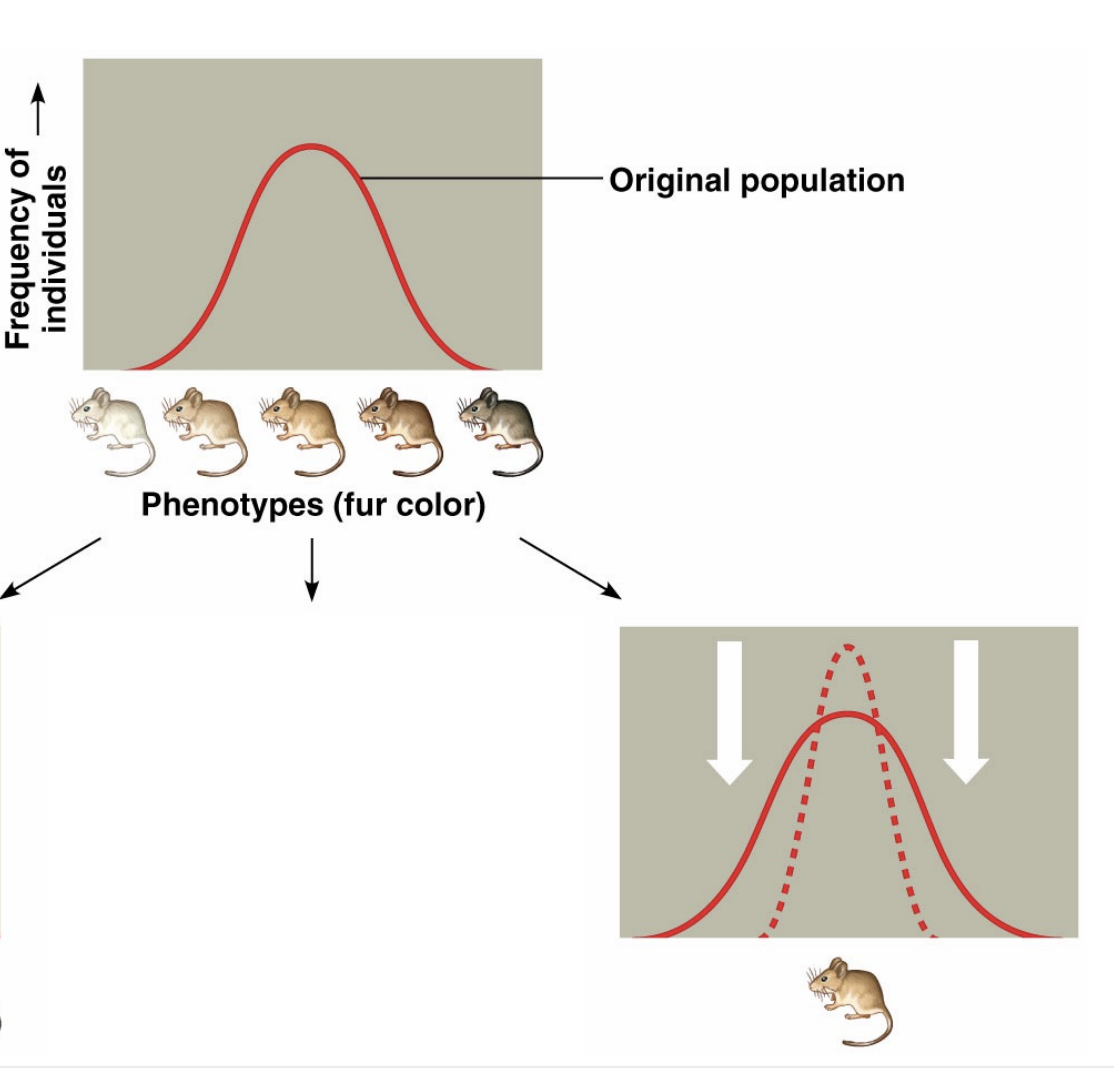
what type of selection
stabilizing selection
Four processes of evolution
mutations: maintains increases or reduces genetic variation, increases fitness
genetic drift: usually reduces genetic variation, can increase or decrease fitness
gene flow: increases or reduces genetic variation, can increase or decrease fitness.
natural selection: increases genetic variation, increase decrease or have no effect on fitness.
genetic drift
how the frequency of alleles in a population changes from one generation to the next purley due to random chance.
gene flow
the transfer of genetic material from one population to another, this happens when individuals migrate to a new population and interbreed or when gametes are carried between separate populations.
types of mutations
somatic mutations: not in the gamete, not evolved in evolution.
germ-line mutations: necessary for evolution to occur, creates variation, these are inherited.
founder effect
large population to small population due to physical movement of subset.
genetic bottleneck
large population to small population due to mortality hitting individuals randomly.
morphology
characteristics, differences in physical characteristics (ex: black bear vs grizzly bear); do they look different?
biological species concept
ability to reproduce and produce fertile offspring
phylogenetic species concept
genetics and morphology information combine to form a family tree. (looking at family tree relation). (a species is the smallest possible monophyletic group)
morphospecies concept
species are identified base on similarities and differences in characteristics.
reproductive isolation
prezygotic barriers: geographic, ecological, temporal, behavioral, mechanical, gametic.
postzygotic: reduced viability or reduced fertility.
behavorial isolation.