17.4 - Cardiac Cycle (Mechanical Physiology of the Heart)
 Call Kai
 Learn
Learn Practice Test
 Spaced Repetition
 Match
Match Flashcards
 Knowt Play
1/16

There's no tags or description
Looks like no tags are added yet.
Name | Mastery | Learn | Test | Matching | Spaced | Call with Kai | Chat |
|---|
No analytics yet
Send a link to your students to track their progress
17 Terms
Mechanical Physiology:
Actual mechanical processes by which blood fills the cardiac chambers and is pumped out of them
Heartbeat
Cardiac Muscle Cells contract as a unit to perform one coordinated contraction
Cardiac Cycle:
The sequence of events that take place within the heart during a single heartbeat
What happens when the left ventricle contracts?
Pressure difference
Valve changes
Pressure of left ventricle (PV) rises higher than the pressure in the left atrium (PA) and the aorta.
Blood flows form the ventricle to the aorta.
Valve Changes
Mitral Valve (between left ventricle and atria) shuts due to high pressure pushing against it.
Aortic valve (between left ventricle and aorta) is forced open due top pressure of outgoing blood.
What happens when the left ventricle relaxes?
Pressure difference
Valve changes
Pv is less than PLA and the aorta
Higher pressure in the left atrium forces mitral valve open, allowing blood to drain into left ventricle.
Higher pressure in the aorta pushes the cusps of the aortic valve closed
What is a stethoscope for? What sounds are heard? What are the sounds called?
Used to auscultate (listen) to rhythmic heart sounds.
Heard Sounds
The Atrioventricular (AV) and Semilunar (SL) Valves are relatively quiet.
The AV and SL are heard when they shut due to the vibrations of vessel walls.
Names of Heart Sounds
S1 = AV Valves close; longer and louder than S2
S2 = SL Valves close
What are the 4 main phases of the Cardiac Cycle?
Ventricular Filling Phase
Isovolumetric Contraction Phase
Ventricular Ejection Phase
Isovolumetric Relaxation Phase
What is the (1) Ventricular Filling Phase of the Cardiac Cycle?
What
Pressure differences
What valves are open
What valves are closed
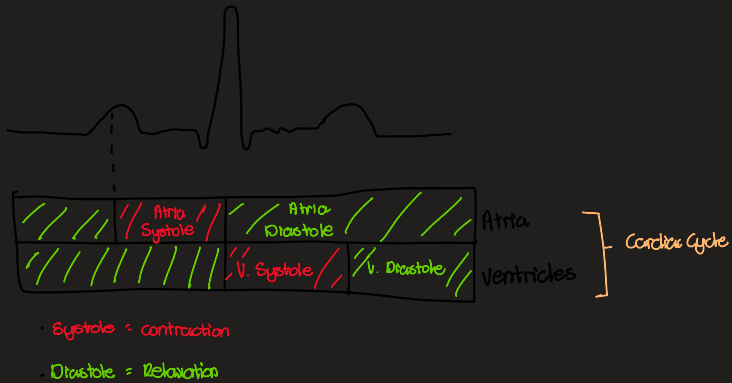
Ventricles in diastole and atrial systole occurs = blood fills ventricles.
PV is less than the PA, Paorta, Ppulmonary trunk.
Semilunar Valves Open: Higher pressure in the pulmonary trunk + aorta = prevents backflow into ventricles.
Atrioventricular Valves Open: Higher pressure in the atria allow blood to flow through AV valves and dump blood into ventricles.
Tricuspid + Mitral Valves
How much total blood volume of the atria drains passively into the ventricles during atria diastole?
How much total blood volume of the atria drains during atrial systole.
80%
The remaining 20% requires the contraction of the atria.
What is End Diastolic Volume (EDV)? When phase of the cardiac cycle does it occur?
The ventricular volume at the end of ventricular diastole, or atrial systole.
Occurs during the Ventricular Filling Phase (1).
What is the (2) Isovolumetric Contraction Phase of the Cardiac Cycle?
What
Pressure differences
Valves open/close
Ventricular Systole begins while Atrial Diastole begins.
Pv rise rapidly as the ventricles contract:
AV Valves close: [PV > Patria] = Blood no longer fills ventricles; ventricular volume stays constant.
SL Valves still closed: [ PV < Paorta + pulmonary trunk] = Pressure is not high enough to push open SL valves, which is why ventricular volume does not change.
Shortest phase in cardiac cycle
What is the (3) Ventricular Ejection Phase of the Cardiac Cycle?
What
Pressure differences
Valves open/close
Ventricular Systole and Atrial Systole continue, but pressure rises high enough to open the SL valves.
SL Valves opened: [PV > Paota + pulmonary trunk] = Rapid outflow of blood from ventricles into great vessels.
As blood leaves, pressure gradient gets smaller = ejection of blood decreases rapidly.
AV Valves still closed: [PV > Patria] = Pressure is not high enough to push blood into ventricles.
What is End Systolic Volume (ESV)? What phase of the cardiac cycle is it recorded?
Ventricular Volume at the end of ventricular systole, or atrial diastole.
Occurs during Ventricular Ejection Phase (3).
What is (4) Isovolumetric Relaxation Phase?
What
Pressure differences
Valves open/close
Blood Volume
Ventricular Diastole begins and Atrial Diastole continues.
SL Valves close: [Pv < Paorta + pulmonary trunk] = Higher pressure in vessels cause SL valves to close during this phase
Prevents backflow back into ventricles.
Creates the S2 sound.
AV Valves still closed: [PV > PA] = Higher pressure in ventricles cause AV valves to stay closed.
Blood volume stays the same as both SL and AV valves are closed.
Stroke Volume (SV)
Volume of blood ejected during ventricular systole.
Systolic Blood Pressure
Pressure in the aorta as the aortic SL valves open.
N/A