Chapter 16- Nasal Cavity (BOOK)
 Call Kai
 Learn
Learn Practice Test
 Spaced Repetition
 Match
Match Flashcards
 Knowt Play
1/85

There's no tags or description
Looks like no tags are added yet.
Name | Mastery | Learn | Test | Matching | Spaced | Call with Kai | Chat |
|---|
No analytics yet
Send a link to your students to track their progress
86 Terms
what are the structures of the external nose?
-apex
-root
-dorsum
-nares or nostrils
-ala
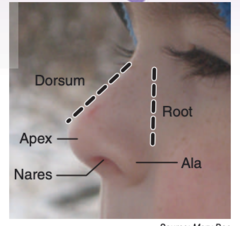
what is the apex?
the tip of the nose
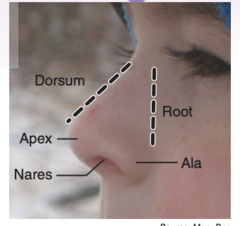
what is the root?
the base of the nose
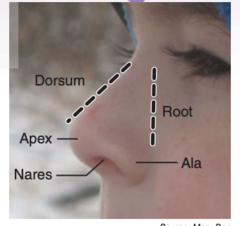
what does the root of the nose attach to?
the face
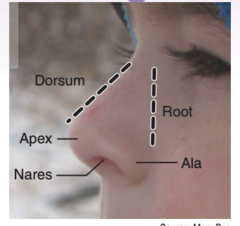
what is the dorsum?
the superior aspect of the nose

what is the dorsum covered by?
skin
what is the upper part of the dorsum called?
bridge of the nose
what are the nares or nostrils?
the two openings at the inferior aspect of the external nose

what is the ala?
the lateral skin of the nose

what is the upper half of the external nose composed of?
skin and muscle (procerus) covering bone

what bone is the skin and muscle of the upper half of the external nose covering?
the nasal bone

what is the lower half of the external nose composed of?
skin and muscle (nasalis) covering cartilage
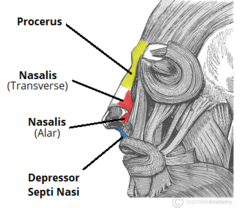
what are the cartilages of the external nose?
1. septal cartilage
2. lateral expansion of the septal cartilage
3. greater alar cartilage
4. possibly several smaller cartilages
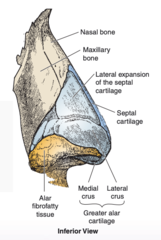
how is the greater alar cartilage bent?
so that it forms the medial and lateral wall of the NARES

what is the vestibule?
the space just inside the nares
what is the vestibule bounded by?
bounded medially and laterally by the greater alar cartilage
what does the skin located at the vestibule contain?
hair and sebaceous glands
what is the vestibule limited above by?
a curved elevation called the limen nasi

what is the limen nasi formed by?
a ridge formed by the lateral expansion of septal cartilage
what happens at the limen nasi?
it is at this point that the skin of the vestibule gives way to the mucous membrane of the nasal cavity
what is the part of the nasal cavity just above the limen nasi?
the atrium
where is the nasal cavity?
the space between the cranial cavity superiorly and the oral cavity inferiorly
what is the nasal cavity divided by?
a median nasal septum

what does the nasal septum divide the nasal cavity into?
two symmetrical chambers, the right nasal cavity and left nasal cavity
how is the nasal cavity open anteriorly?
via the nares
what is the nasal cavity open posteriorly to?
the nasopharynx

how is the nasal cavity open to the nasopharynx posteriorly?
via the bony aperture called the choanae
how is the choanae formed medially?
by the vomer
how is the choanae formed inferiorly?
by the palatine bone
how is the choanae formed laterally?
by the medial pterygoid plate of sphenoid
how is the choanae formed superiorly?
by the body of sphenoid
when the cartilages of the external nose are removed, what does the dried skull present?
another bony aperture called the piriform aperture
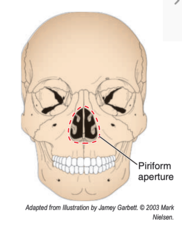
what is the piriform aperture bounded by?
-the nasal bones superiorly
-the maxilla laterally and inferiorly

what are the boundaries of the nasal cavity?
-superior boundary or ROOF
-inferior boundary or FLOOR
-lateral boundary
-medial boundary
superior boundary is aka
roof
how many bones is the superior boundary formed by?
4 bones
what are bones that form the superior boundary of the nasal cavity?
from anterior to posterior:
1. nasal
2. frontal
3. ethmoid (cribriform plate)
4. sphenoid (body)
inferior boundary is aka
floor
how many bones is the inferior boundary formed by?
2 bones
what are bones that form the inferior boundary of the nasal cavity?
the maxilla anteriorly and the palatine bone posteriorly
what bones form the hard palate?
the maxilla and palatine bone
what does the inferior boundary separate?
the nasal cavity from the oral cavity
how many bones is the lateral boundary formed by?
7 bones
what are bones that form the lateral boundary of the nasal cavity?
Because she is always "LATE" NEVER LET ESTER IN MY PALACE MAN
1. nasal
2. lacrimal
3. ethmoid
4. inferior nasal concha (turbinate)
5. palatine
6. medial pterygoid plate of the sphenoid
7. maxilla
the lateral boundary is characterized by the presence of what?
three chonchae (or turbinates)
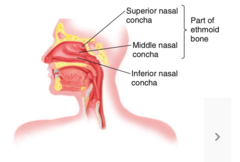
what are the three conchae (or turbinates)?
-superior nasal choncha
-middle nasal concha
-inferior nasal concha

what is the superior nasal concha part of?
the ethmoid bone
what is the middle nasal concha part of?
the ethmoid bone
what is the inferior nasal concha part of?
it is a separate bone (not part of the ethmoid bone)
what is the meatus?
the space deep to each concha

where is the superior meatus?
the space just below the superior nasal concha

where is the middle meatus?
the space just below the middle nasal concha

what does the middle meatus contain?
an elevation or bulge of bone called the ethmoidal bulla

what is the ethmoidal bulla bounded by?
antero-inferiorly by the semilunar slit, known as the hiatus semilunaris

where is the inferior meatus?
just below the inferior nasal concha

what is the medial boundary composed of?
the nasal septum
what is the nasal septum?
the median partition separating the right and left nasal cavities
what is the nasal septum formed by?
1. vomer (posteriorly and inferiorly)
2. perpendicular plate of the ethmoid (superiorly)
3. septal cartilage (anteriorly)
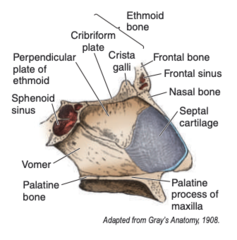
what are the surfaces of the bones and cartilages forming the boundaries of the nasal cavity covered by?
a mucous membrane
what are the two different regions of the mucous membrane?
-olfactory region
-respiratory region
what/where is the olfactory region?
the mucous membrane in the upper third of the nasal septum and the superior concha
what does the olfactory region do?
filaments of the olfactory nerve are distributed here SO it mediates olfaction, or the sense of smell
where is the respiratory region?
lower 2/3 of the mucous membrane of both the lateral and medial walls
what is the function of the respiratory region?
-dust removal from inspired air
-process of warming and humidifying incoming air
what is a sinus?
a true cavity within bone
what is a sinus lined with?
mucous membrane
how do the sinuses communicate with the nasal cavity?
via a canal or space termed an opening
what are the four types of paranasal sinuses?
1. maxillary sinus
2. frontal sinus
3. ethmoidal sinus
4. sphenoid sinus

what is the largest of all paranasal sinuses?
the MAXILLARY sinus
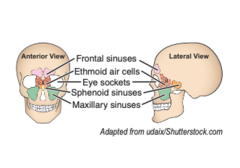
where is the maxillary sinus located?
within the maxilla
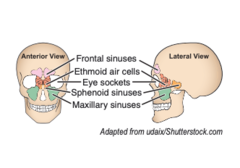
what is the shape of the maxillary sinus?
-single chamber, pyramidal in shape
-the base is medial
-the apex is lateral

where is the floor of the maxillary sinus?
adjacent to the upper teeth
because the floor of the maxillary sinus is adjacent to the upper teeth...
maxillary sinusitis is often accompanied by a toothache
-what is the opening of the maxillary sinus?
-what is the meatus/space it opens into?
-hiatus semilunaris
-middle meatus
where is the frontal sinus?
the single sinus on each side of the head contained within the frontal bone in the supraorbital area

-what is the opening of the frontal sinus?
-what is the meatus/space it opens into?
-hiatus semilunaris
-middle meatus

ethmoidal sinus is aka
labyrinthine sinus
what does the ethmoidal sinus contain?
numerous air cells--> collectively called the ethmoidal labyrinth

where is the ethmoidal labyrinth located?
within the lateral mass of the ethmoid
what are the two types of ethmoidal air cells?
1. anterior ethmoid air cells
2. posterior ethmoid air cells

-what is the opening of the anterior ethmoid sinus?
-what is the meatus/space it opens into?
-ethmoidal bulla
-middle meatus

where do the posterior ethmoid air cells open into?
the superior meatus
*unnamed opening*

where is the sphenoid sinus located?
a single sinus on each side, both contained within the body of the sphenoid

-what is the opening of the sphenoid sinus?
-what is the meatus/space it opens into?
-sphenoethmoidal recess
-posterior to the superior meatus

where is the sphenoethmoidal recess located?
above the superior nasal concha

where does the nasolacrimal duct open into?
the inferior meatus