Unit 7 - Evolution
 Note
Note Multiple Choice & FRQ
 Call Kai
1/47

Earn XP
Description and Tags
Name | Mastery | Learn | Test | Matching | Spaced | Call with Kai | Chat |
|---|
No analytics yet
Send a link to your students to track their progress
48 Terms
Evolution
The change in a population over generations at a genetic level, which we can see as a change in phenotypes over time.
Adaptation
A trait that increases the probability of successful reproduction in a specific environment.
Natural Selection
The mechanism for evolving adaptations where individuals with traits that increase their likelihood of survival and reproduction leave more offspring.
Microevolution
The change in the genetic structure of a population from one generation to another, reflected in phenotypic changes.
Macroevolution
Large scale change in species over paleontological time, such as the appearance of new species.
Allopatric Speciation
Speciation that occurs due to geographic separation of populations from a parent species.
Sympatric Speciation
Speciation occurring within a parent species that remains in one location.
Polyploidy
The unequal division of chromosomes during meiosis, which can lead to speciation.
Autopolyploidy
When all the of the chromosomes move into one new cell instead of separating due to an error in meiosis
Allopolyploid
When gametes from two different species combine (notice how it takes two generations, or two reproductive acts, before the viable fertile hybrid results)
Intrasexual Selection
Competition among males for access to females that can lead to the development of certain traits.
Intersexual Selection
Females choose males based on certain desired characteristics.
Divergent Evolution
When two species evolve in diverse directions from a common point.
Convergent Evolution
When similar traits evolve independently in two species that do not share a recent common ancestry.
Genetic Variation
Differences in DNA sequences within a population that contribute to phenotypic variation.
Dispersal Group
When a few members of a species move to a new geographical area
Vicariance Group
When a natural situation arises to physically divide organisms

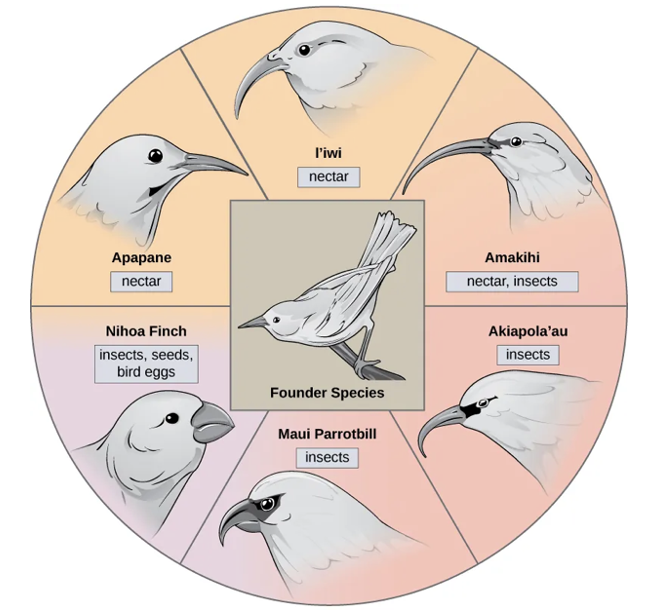
Adaptive Radiation
Where many adaptations evolve from a single point of origin; thus, causing the species to radiate into several new ones
Reproductive Isolation
The ability to interbreed
Prezygotic barrier
A mechanism that blocks reproduction from taking place
Postzygotic barrier
Occurs after zygote formation
Temporal isolation
A form of reproductive isolation (differences in breeding schedules)
Habitat isolation
When populations of a species move to a new place that no longer overlaps with the same species’ other populations
Behavioral isolation
When the presence or absence of a specific behavior prevents reproduction
Gametic barrier
When differences in a species gamete cells (eggs and sperm) prevent fertilization from taking place
Hybrid inviability
When hybrid individuals cannot form normally in the womb and simply do not survive past the embryonic stages
Hybrid sterility
When reproduction leads to hybrid birth that is sterile
Hybrid Zone
An area where two closely related species continue to interact and reproduce, forming hybrids.

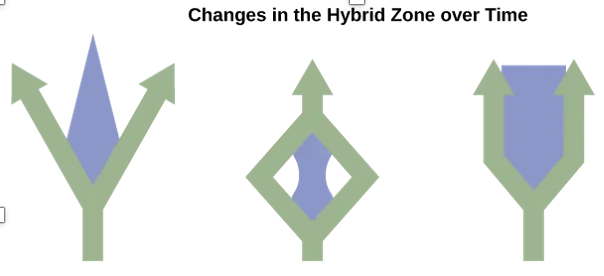
Changes in Hybrid Zone: Reinforcement
Hybrids are less fit than either purebred species. The species continue to diverge until hybridization can no longer occur.

Changes in Hybrid Zone: Fusion
Reproductive barriers weaken until the two species become one.

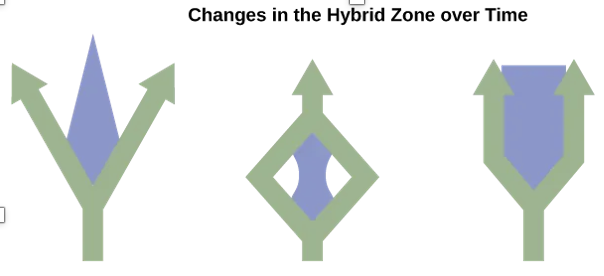
Changes in Hybrid Zone: Stability
Fit hybrids continue to be produced.

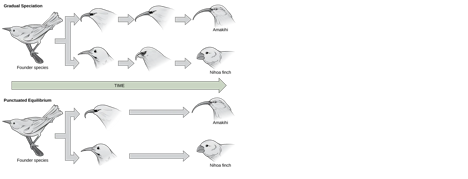
Gradual Speciation Model
Where species diverge gradually over time in small steps
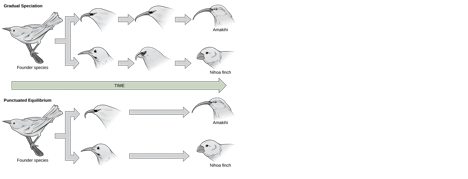

Punctuated Equilibrium Model
Where a new species undergoes changes quickly form the parent species, and then remains largely unchanged for long periods of time afterwards

Chi-Square Analysis
A statistical method used to determine if there is a significant difference between observed and expected frequencies in categorical data.
Null Hypothesis (H_0)
The hypothesis that there is no difference between the two different groupings, with any difference due to chance alone.
P-value
A statistic that describes the probability of observing the data under the null hypothesis.
Evidence of Evolution: Fossils
Show the gradual evolutionary changes over time (over millions of years)
Evidence of Evolution: Anatomy
Allows us to see the similarities between different species’ bone structures to trace evolution through change in bone structure and function, revealing common ancestry.
Evidence for Evolution: Embryology
Studying the development of embryos across different species reveals similarities that suggest common ancestry and evolutionary relationships.
Evidence for Evolution: Biogeography
Examines the geographic distribution of species and how it reflects evolutionary history, showing how related species are often found in close geographical proximity.
Evidence for Evolution: Molecular Biology
Analyzing DNA, RNA, and protein similarities among different organisms provides insight into evolutionary relationships and common ancestry, highlighting genetic similarities and variations.
Vestigial Structures
Unused structures in an organism that have lost their original function through evolution.
Homologous Structures
Anatomical features that are similar in different species due to shared ancestry.
Analogous Structures
Structures that serve similar functions in different species but do not share a common ancestor.
Species
A group of actual or potential interbreeding individuals that can produce fertile offspring.
Genetic Drift
Random changes in allele frequencies in a population, which can lead to evolutionary change (random, not selective, not adaptive)
Founder Effect
New population is founded by a small group previously part of a larger population

Bottleneck Effect
The occurrence of a catastrophic event that results in a major decline in population size, leading to a reduction in genetic diversity and potential loss of alleles
