Chapter 6 + Chapter 27: Bacterial Growth, Nutrition, and Differentiation
 Call Kai
 Learn
 Practice Test
 Spaced Repetition
 Match
 Flashcards
 Knowt Play
1/34

There's no tags or description
Looks like no tags are added yet.
35 Terms
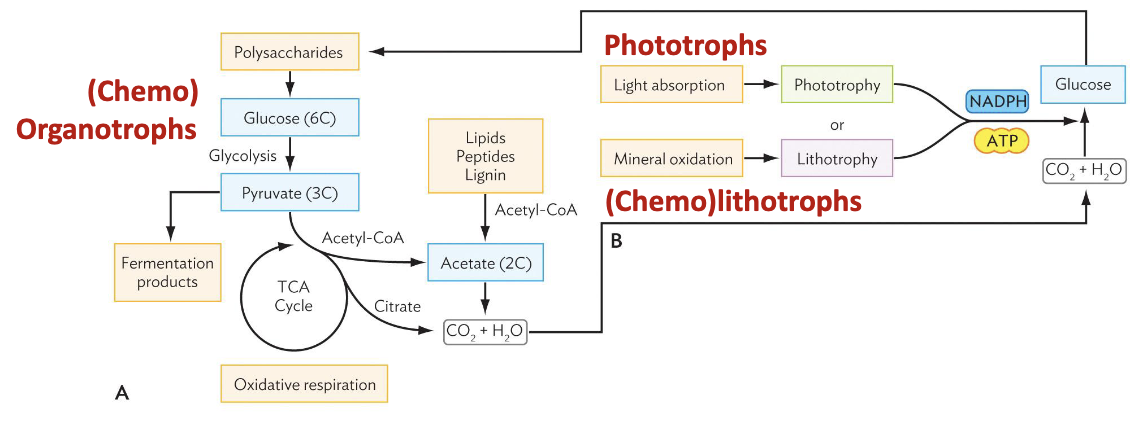
What are the different ways organisms can capture energy?
phototrophs use light as energy source
chemotrophs use potential energy stared in chemical compounds (e- energy)
chemolithotrophs need inorganic chemicals
chemoorganotrophs need organic compounds
What are the different ways organisms can capture carbon?
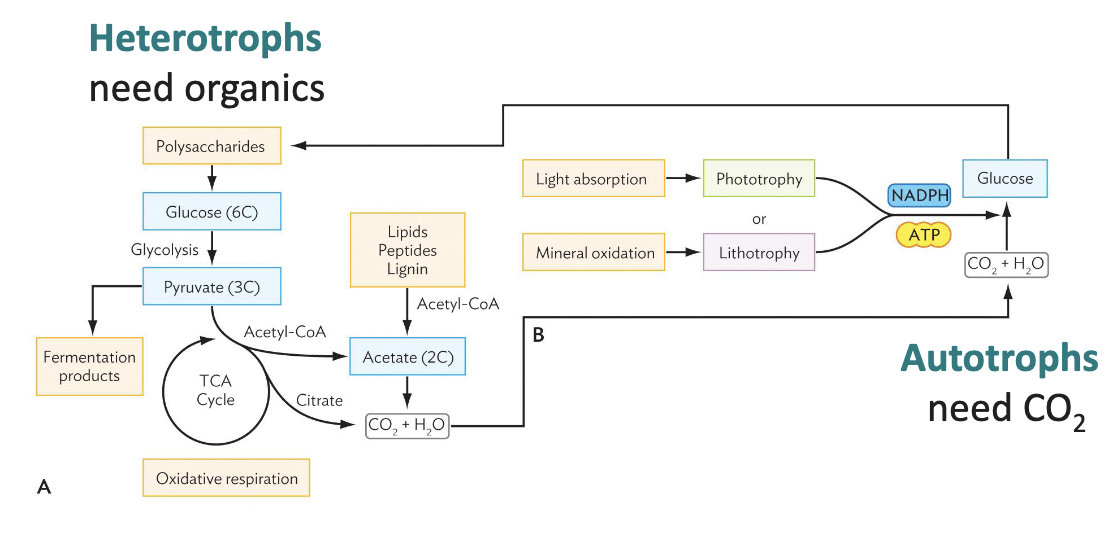
autotrophs make their own carbon compounds starting w/CO2 carbon fixation (producers)
heterotrophs obtain carbon compounds from other organism (consumers)
Explain the carbon cycle linked to oxygen.
methanotrophy - a metabolic process in which specialized microorganisms use methane as their sole source of carbon and energy
methanogenesis - the biological process by which microscopic organisms called methanogens produce methane gas (CH₄) as a metabolic byproduct

Why do some organism need nitrogen?
important for making amino acids (proteins) and nucleic acids (DNA/RNA)
most plantified
Explain the nitrogen cycle.

nitrogen fixation - converts nitrogen to ammonia or nitrates
nitrification - transforms ammonia or ammonium into nitrites (NO2-) and then to the nitrates (NO3-)
denitrification - converts nitrates and nitrites in soil or water into nitrogen gas, releasing it back into the atmosphere
Define assimilation and decomposition.
assimilation - how useful forms of nitrogen are taken up by other organism
decomposition - how nitrogen is released back into the cycle
What is nitrogenase?
enzyme that catalyzes nitrogen fixation and is very sensitive to O2
How might nitrogen fixing microbes adapt? Give an example.
by developing mechanisms that protect nitrogenase from O2 like living inside of root modules containing symbiotic bacteria capable of nitrogen fixation
Nitroplast - newly discovered organelle in an algae for nitrogen fixation
Explain the oxygen requirements of aerobes and anaerobes. What are the options in culturing anaerobes?

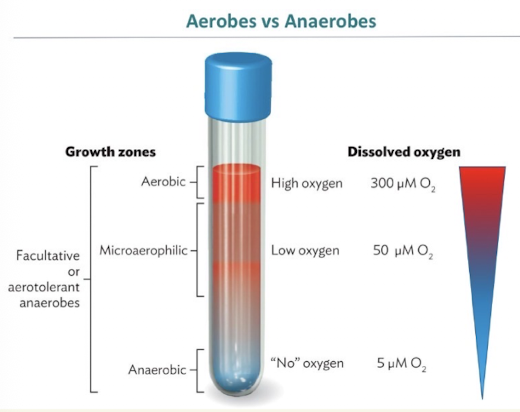
anaerobe jar and anaerobic chamber
What are reactive oxygen species and what are superoxide dismutase?
ROS produced as byproducts of aerobic metabolism that damages DNA, proteins, membranes (OH, O2-, H2O2)
SOD and catalase - enzymes that break down ROS
obligate anaerobes does not have SOD or catalase so cannot detoxify ROS
What is an essential nutrient and how to combat the lack of it?
compounds a microbe cannot make itself but must gather from its immediate environment
auxotroph is when a microbe cannot synthesize an essential nutirent, it must be added to culture media for the organism to grow and divide aka “growth factors”
ex: essential amino acids
What are the different types of culture media and their purpose?
complex media (aka “rich” medium) often dead things (yeast, plant or tissue extract)
chemically defined media (aka synthetic medium) all the chemical components are known and usually used to test where organisms thrive
What are considered typical physiological conditions?
temp btwn 20-40C (68-104F)
near-neutral pH
salt concentration of 0.9%
ample nutrients
What is an extremophile? What are the classification of the optimal temperature ranges? What temperature in food safety is the danger zone?
bacteria, archaea and some eukaryotic microbes that can grow in extreme environments where most organisms cannot
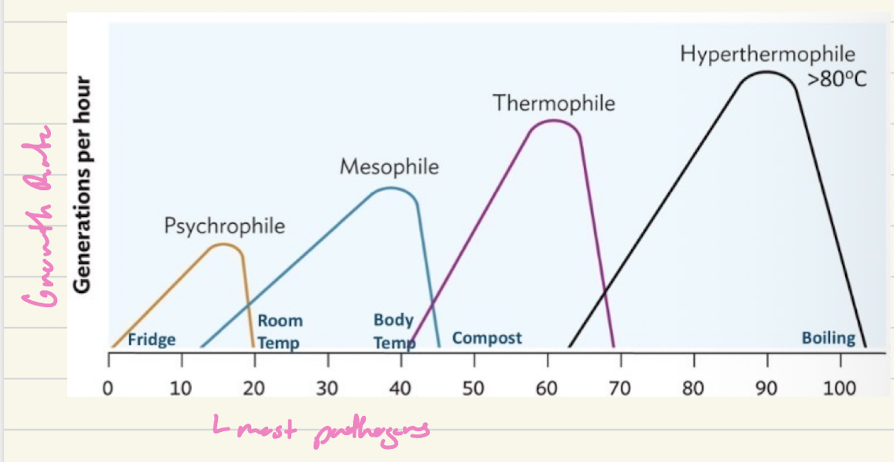
the food safety danger zone is 60-120F or 15-50C
What are barophiles and how do they adapt?
aka piezephiles: microrganims deep within the ocean that have adapted to grow at oppressively high pressures
ex) mariane trench
adapted membranes and amino acid sequence in proteins
What are halophiles?
that have evolved to require high concentration of salt (NaCl)
additional sodium ion pumps to maintain osmotic balance and avoid plasmolysis
halotolerant microbes can deal with moderately higher salt core but don’t thrive/survive in extreme conc.
What are pH sensitive microbes called?
acidophiles - low pH/acidic
neutralophiles
alkaliphiles - high pH/basic
these extremophiles pump protons (H+) into or out of the cell to maintain neutral internal pH
acid tolerant microbes - can survive and maybe grow at acidic pH but don’t thrive at vary low pH
ex) helicobacter pylori (stomach) makes urease (not an extremophile)
cytoplasm has neutral inside
How do bacterial cells grow?
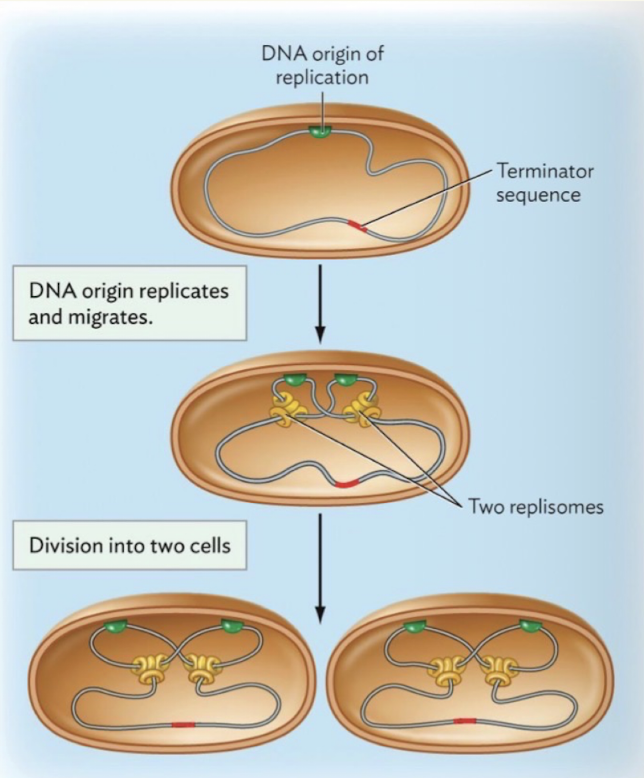
bacterial growth is measured as increasing # of cells in population
most reproduced by binary fission (one parent cell divides and forms 2 offspring or daughter cells)
bacterial cell division steps:
DNA replication
protein synthesis and expansion of cytoplasm (cells elongates)
septum forms and the cell divides
eukaryotic cells typically divide by mitosis - bacteria does not
Explain the growth cycle of bacteria.
binary fission is exponential growth
generation (doubling) time - time it takes for the population to double or cell to complete one round of division
low GT = fast growth
high GT = slow growth
bacteria will divide at a constant time interval, assuming an abundance of resources
Explain the bacterial growth curve. Where would you measure GT? Where is generation time the lowest?

1) Lag phase: bacteria are preparing their cell machinery for growth
2) Log phase: growth approximates an exponential curve (straight line, on a logarithmic scale)
3) stationary phase: cells stop growing and shut down their growth machinery while turning on stress responses to help retain viability
4) death phase: cells begin to die at an exponential rate
lowest at log phase
Bacterial Growth Curve:
At what phase are primary metabolites produced (produced during very active growth and metabolism e.g. amino acids, ethanol. citric acid)?
At what phase are secondary metabolites produced (not essential for rapid growth and often made for defense or survival (antibiotics, toxins)?
log phase
stationary phase
How to prolong log phase?
extend log phase/prevent stationary phase by
Chemostat: a continuous-culture bioreactor that keeps microbial cell populations growing at a constant, steady-state rate by continuously adding fresh nutrient media while simultaneously removing spent culture fluid at the exact same rate
How do we measure bacterial growth in the lab? What are some of their limitations?
microscope count or cell-counting instruments (direct)
measuring biomass (indirect) - turbidity or dry weight
limitation: can’t distinguish living or dead cells
plate counts - CFUs (colony forming units-viable)
serial dilution and plate counts (indirect) used for high amount
filtration and plate counts (indirect) used for low amounts
Metabolic activity - viable cells (indirect)
e.g. ATP or Co2 production
What are biofilms and how are them made?
polymer-encased matrix community of microbes
initial attachment and adherence of initial cells is important
EPS (extracellular polymeric substances) (e.g. polysaccharides, DNA) -sticky structural glue and protective house that holds a bacterial or fungal biofilm together
secretion is regulated through quorum sensing (cell-to-cell communication that allows bacteria to track their population density and change their behavior in unison) - high population or late log
matrix helps provide protection from antibiotics, host immunity, flow
facilitates movement of nutrients and waste through channels
can consist of more than one species or domain
pieces of biofilm can detach and spread
ex) plaque, can grow on tissue, teeth and medical implants devices
can grow on organic, living or abiotic surfaces
Pellicle are biofilms at a liquid/air interface
attachment (reversible), rapid population growth, increased quorum sensing, Secretion of Extra-Polymeric Substance (EPS), Mature matrix, Dispersion of cells or mass of cells

What are endospores and how are they made?
A cryptobiotic (suspended life) state that allows bacteria to withstand harsh conditions like high heat, UV radiation, desiccation, and chemical disinfectant
produced by gram + bacteria differentiated cells like Clostridium botulinum and Bacillus
sometimes call cell’s resting state
found via sporulation - a complex, multi-stage survival process where certain genera (like Bacillus and Clostridium) transform from active vegetative cells into highly resistant, dormant structures called endospores/ cured by environmental conditions like starvation)
germination - process where endospore returns to vegetative (normal, rapid growth)
Tyndall and Cohn discovered endospores 10 yrs after Pasteurs S-flask
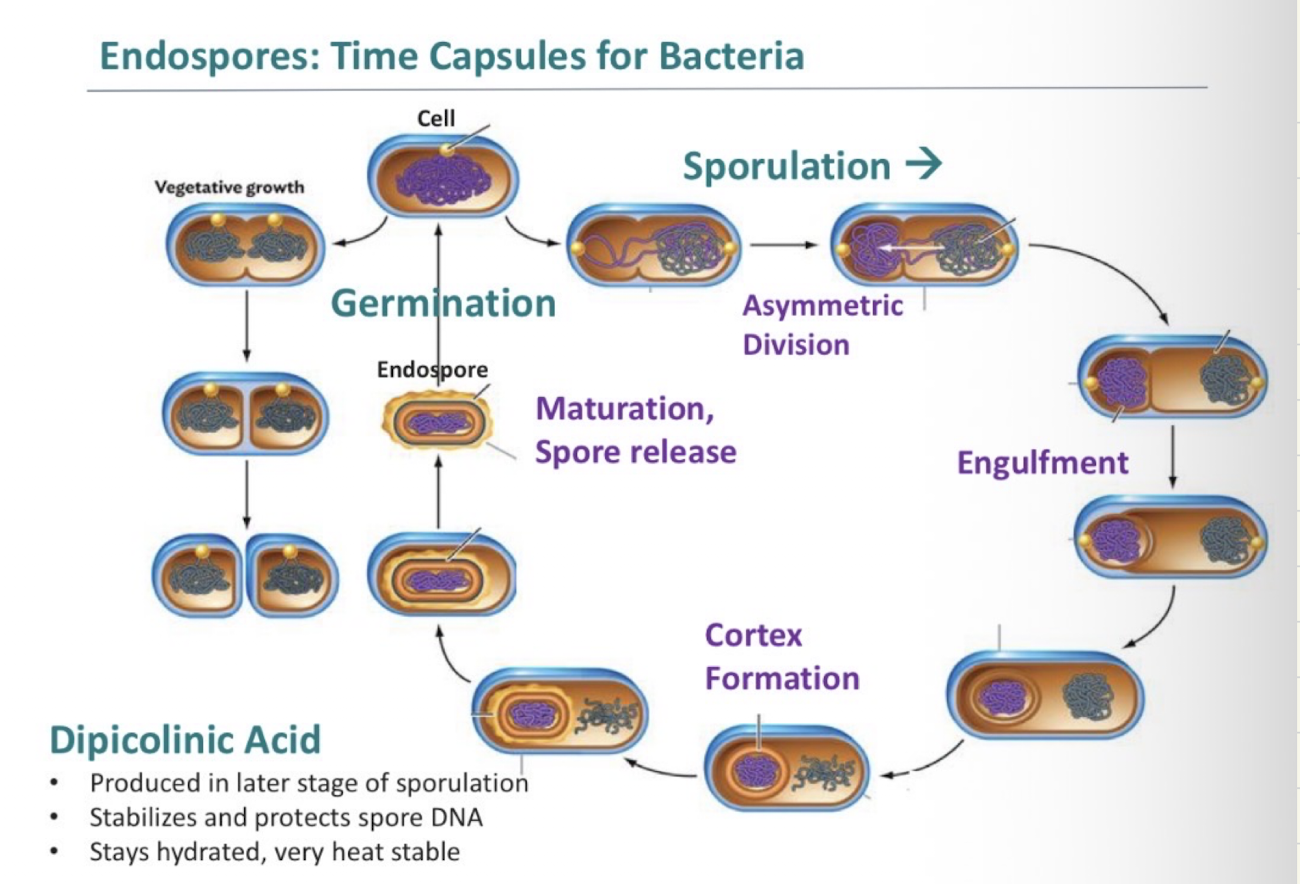
What is dipicolinic acid?
produced in later stage of sporulation
stabilizes and protects spore DNA
stays hydrated, very heat stable
What is food spoilage?
when microbial changes and metabolism affect the food chemistry and make the food unfit or unpalatable for consumption
different food spoil differently depending on sugar, fat, protein constant, microbes likely present and storage environment
What is food contamination?
the presence of pathogens or harmful microbes in a food or beverage
this could lead to food borne illness (aka food poisoning)
food can be contaminated and cause illness even with low numbers of microbes and even without obvious changes in taste or smell
e.g. viruses or bacterial that produce toxin
Define bactericidal, bacteriostatic, preservation.
bactericidal - agents or methods have lethal effects they kill the microbe (fungicidal or fungicide, virucidal, algicidal, germicides)
bacteriostatic - agents or methods slow or stop metabolism or, but are not necessarily lethal
preservation - to delay spoilage of foods or perishable products, adjust storage conditions or add “-static” antimicrobial compounds to slow or prevent growth of pathogens and food spoilage organism
What are the chemical methods for food preservations?
often bacteriostatic
organic acids - lowering pH of a food through microbial fermentation or addition of week organic acids
other organic compounds w/antimicrobial activity - alcohol via fermentation or addiction of cinnamon, cloves and other plant-based compounds can inhibit microbial growth
inorganic compounds - salts, phosphate, nitrites, sulfite inhibit aerobic respiration and may have harmful effects on humans (toxicity, allergy)
Physical Methods of Food Preservation: Desiccation
dehydration - removal of water, can also be combined with increase sugar or salt (hypertonic), cells are in a state of plasmolysis, protein coagulation in cheese making helps to reduce water content (hard cheese) or addition of salt helps preserve (feta)
water limitation (bacteriostatic)
does not sterlize
Physical Methods of Food Preservation: Using nitrogen gas when packing, Refrigeration/freezing/freeze drying
controlled or modified atmosphere - food packed in low O2 or high N2 or CO2 limits aerobic growth and prevents abiotic (non-microbial) oxidation (ex. single serve coffee)
does not sterilize and bacteriostatic
cold temperatures/refrigeration (4-8C) is used for food preservation because most pathogens are mesophilic
freezing - inhibit growth
freeze-drying - food is quickly frozen at very low temps in a vacuum, cold + water limitation
Physical Methods to Control Growth in Food: Pasteurization
high temperature (moist heat)
kill spoilage bacteria w/o affecting the texture, color, taste or nutrients which extends shelf life, moderately high temp (usually no pressure) for short time
bactericidal - kills/destroys microbes
but does not sterilize
Physical Methods to Control Growth in Food: Canning
high heat and pressure
cooking food under pressure destroys most microbes w/o harming food quality
commercial canning - industrial size autoclaves are designed to destroy Clostridium botulinum endospores
autoclave - device that uses high pressurized steam to increase boiling point
Physical Methods to Control Growth in Food: Food Irradiation
Food irradiation - damages cells and DNA, useful for heat and moisture sensitive items (no microwaves)
ionizing radiation (gamma rays, electron beams, x-rays)
improves shelf life
bactericidal
can sterilize
cons: possible effects on food chemistry and potential hazards to workers