CHAPTER 8 - IS
 Call Kai
 Learn
 Practice Test
 Spaced Repetition
 Match
 Flashcards
 Knowt Play
1/75

There's no tags or description
Looks like no tags are added yet.
76 Terms
Accounting Information Systems (AIS)
are systems that combine accounting and technology to collect, record, process, and store financial information for a business
a specialized subsystem of an information system.
It may be integrated with the organization’s overall information system and organized into business processes or AIS subsystems.
TOOLS OF TRADE IN AIS
1. Microsoft Excel
2. QuickBooks
3. SAP
4. Accounting Software
5. Database Systems
6. Point of Sale (POS) Systems
Microsoft Excel
Used to calculate expenses, income, and financial reports
QuickBooks
Used to record transactions and manage business finances.
SAP
Used to manage accounting, financial data, and other business operations.
Accounting Software
Used to prepare financial statements and monitor business transactions.
Database Systems
Used to store and organize financial records.
Point of Sale (POS) Systems
Used to record sales and payments automatically
SECTION 404 (AS MODIFIED BY PCAOB AUDITING STANDARD NO. 5)
Management must identify, document, and evaluate significant internal controls.
Auditors must report on the effectiveness of the organization’s system of internal controls.
PORTER’S VALUE CHAIN ANALYSIS
focuses on the systems and activities with customers as the central principle rather than on departments and accounting expense categories.
This system links systems and activities to each other and demonstrates what effect this has on costs and profit.
Consequently, it makes clear where the sources of value and loss amounts can be found in the organization.
consists of a number of activities, namely primary activities and support activities.
PRIMARY ACTIVITIES
have an immediate effect on the production, maintenance, sales and support of the products or services to be supplied.
Inbound Logistics
Receiving, storing, and internal distribution of raw materials/ingredients; supplier relationships are essential.
Production
Activities (production floor/line) converting inputs into semi-finished or finished products.
Outbound Logistics
Activities related to delivering products and services (storage, distribution systems, transport).
Marketing and Sales
Processes putting products/services in markets, managing/generating customer relationships, and setting the company apart.
Service
Activities maintaining the value of products/services after procurement.
SUPPORT ACTIVITIES
assist the primary activities and they form the basis of any organization.
Firm Infrastructure
Enables daily operations (line management, administrative handling, financial management).
Human Resource Management
Workforce development (recruiting, training, coaching, compensating, and retaining staff).
Technology Development
Internal/external product and service development (IT, technological innovations, new products based on new tech).
Procurement
Purchasing support activities (managing supplier relationships, negotiating prices, purchase/outsourcing agreements).
FOUR BASIC STEPS IN USING PORTER’S VALUE CHAIN ANALYSIS
1. Identify sub-activities for each primary activity
2. Identify sub-activities for each support activity
3. Identify links between activities
4. Identify opportunities and solutions to optimize and create value
Identify sub-activities for each primary activity
Categorized into Direct Activities (directly create value), Indirect Activities (support smooth performance), and Quality Assurance (ensure quality of work/outputs).
Identify sub-activities for each support activity
Determine how support activities (Infrastructure, HRM, Tech Development, Procurement) contribute value to primary activities.
Identify links between activities
Crucial step for increasing competitive advantage by finding links between added values.
Identify opportunities and solutions to optimize and create value
Determine improvements (quantitative/qualitative investments) to increase customer base, competitive advantage, and profitability.
ELEMENTS IN THE STUDY OF ACCOUNTING INFORMATION SYSTEMS (AIS)
Purpose: These elements work together to collect, process, store, and communicate accounting information that supports business operations and decision-making.
TECHNOLOGY
Provides the foundation of AIS and business operations.
Essential for understanding how information systems function.
Technological advancements significantly affect information systems.
DATABASES
Store and organize business data.
Include public and private data sources.
Support data retrieval, analysis, auditing, and decision making.
REPORTING
Converts processed data into useful information.
Helps management make decisions.
Assists organizations in meeting reporting requirements
CONTROL
Ensures business processes operate as intended.
Protects assets and information.
Helps maintain accuracy, reliability, and compliance.
BUSINESS OPERATIONS
Includes daily organizational activities such as: Hiring employees, Purchasing inventory, Collecting customer payments
AIS supports and monitors these operations.
EVENTS PROCESSING
Records and processes business events such as: Sales, Purchases, and Payments
Ensures transactions are accurately captured and monitored.
MANAGEMENT DECISION MAKING
Provides information needed for managerial decisions.
Information should be relevant and tailored to decisionmakers ' needs.
Supports planning, controlling, and evaluating performance.
SYSTEMS DEVELOPMENT AND OPERATION
Involves designing, implementing, and maintaining information systems.
Ensures systems meet organizational requirements.
Accountants may participate in system design and control implementation.
COMMUNICATIONS
Facilitates information exchange within and outside the organization.
Connects employees, managers, customers, and suppliers.
Makes accounting information understandable and useful.
ACCOUNTING AND AUDITING PRINCIPLES
Accounting focuses on recording and analyzing financial transactions.
Auditing examines financial records and statements.
Ensures compliance with laws and Generally Accepted Accounting Principles (GAAP).
SYSTEM
A set of interdependent elements that work together to accomplish specific objectives.
Characteristics: Organization, Interrelationships, Integration, Central objectives.
SUBSYSTEM
A part of a larger system that performs a specific function.
FUNCTIONAL INFORMATION SYSTEM (FUNCTIONAL MODEL)
follows a simple cycle: it receives input, processes the input, stores or retrieves data when needed, and produces output.
Users interact with the system by providing data and using the results.
Feedback from the output can guide later inputs or corrections.
BUSINESS PROCESS IN AN ENTERPRISE SYSTEM
is a set of related steps or procedures designed to produce a specific outcome.
For example, an order may pass through order entry, credit checking, inventory checking, scheduling, invoicing, and customer notification.
These steps work together rather than operating as isolated tasks
Input
Data or requests entered into the system
Processing
Checks, calculations, and updates
Storage
Saved records used now or later
Output
Information produced by the system
Users
People who supply input and use results
INFORMATION PROCESS
The part of the overall information system related to a particular business process.
OPERATIONS PROCESS
People, equipment, organization, policies, and procedures used to accomplish the work.
MANAGEMENT PROCESS
People, authority, organization, policies, and procedures used to plan and control operations.
BUSINESS PROCESS ACTIVITIES (EVENTS)
A simplified view of how decisions and operations generate information
The diagram in the source groups events into decision/management events, operating events, and information events.
Management decisions can define or trigger operating activity.
Both decision and operating events can trigger information events, so records are created to support control and later decisions.

TRANSFORMING DATA INTO INFORMATION
The value comes from processing data for a purpose.
Data are raw facts.
A transformation step—such as sorting, checking, calculating, or summarizing—turns them into information that is easier to understand and use.
A database stores data and supports the transformation process.
Users supply data and interpret the resulting information.

BASIC SYSTEM MODEL & PAYROLL SYSTEM
Everyday systems can be examined using the same three-stage pattern
presents three connected stages: input, process, and output.
This model is useful because it gives a clear way to identify what information a system needs, what work it performs, and what results it produces.

INFORMATION QUALITIES TABLE
1. Understandability
2. Relevance
3. Predictive / Feedback Value
4. Timeliness
5. Reliability
6. Validity
7. Accuracy
8. Completeness
9. Verifiability
10. Comparability/Consistency
11. Neutrality
Understandability
Information is presented so users can interpret reports correctly.
Relevance
Information is connected to the decision or question at hand.
Predictive / Feedback Value
Information helps estimate outcomes or confirm expectations to support planning and learning.
Timeliness
Information is available when needed.
Reliability
Information is trusted as a fair representation, reducing decision risks.
Validity
Information measures or represents what it is intended to represent.
Accuracy
Values and details are correct, preventing decision errors.
Completeness
Important information is not missing.
Verifiability
Others can check how information was produced.
Comparability/Consistency
Information can be compared across periods or situations using consistent approaches.
Neutrality
Information is not deliberately biased toward a preferred result.
Structured Decisions
Routine or repetitive; predictable phases.
Semi-Structured Decisions
Partly routine, but human judgment is still needed.
Unstructured Decisions
Non-routine; require significant judgment and analysis.
NO-RISK
decisions with little or no expected risk and predictable outcomes.
RISKY
decisions with uncertain outcomes and a possibility of loss.
HIGH-RISK
decisions that could lead to major losses or serious consequences.
HORIZONTAL FLOW
moves across operational units for a specific business event or item

VERTICAL FLOW
Information flow describes how information moves through different parts and levels of an organization. moves across management levels, from operations and transaction processing toward managerial and strategic management.

ORGANIZATIONAL INFORMATION SYSTEMS
support operations, management, and strategic decision-making at different levels.
OPERATIONAL LEVEL (STRATEGY)
handles transactions and day-to-day activities.
Information systems automate repetitive tasks and improve efficiency.
Decisions are usually structured and recurring.
Many operational decisions can be automated using information systems.

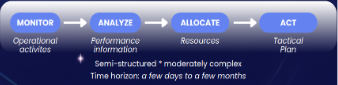
MANAGERIAL LEVEL (MANAGEMENT)
uses information to monitor and control operational activities and provides information to the executive level.
Midlevel and functional managers focus on effectively using and deploying resources.
Managers work toward strategic objectives.
Decisions are generally semi-structured, moderately complex, and usually limited to a business function. Typical time horizon: a few days to a few months.
EXECUTIVE LEVEL (TRANSACTIONS)
uses broader information for strategic decisions.