CD 1303: M2W3
 Call Kai
 Learn
 Practice Test
 Spaced Repetition
 Match
 Flashcards
 Knowt Play
1/39

There's no tags or description
Looks like no tags are added yet.
40 Terms
anterior joint capsule of cervical facets
blends with ligamentum flavum
can kink or hypertrophy
may project into IVF secondary to inflammation, fibrosis, synovitis
posterior joint capsule of cervical facets
strong and fibrous
sweeps upward and medially
continuous with interspinous ligament
when might the multifidus affect the joint capsule?
in extension
functional problems of CFJS
myofascial
stress
occupational
functional problems of CFJS - myofascial
prolonged low level tension or contraciton
‘motion is lotion’
functional problems of CFJS - stress
c-spine and shoulders hold stress
not always a facet problem
difficult to research and clearly define
functional problems of CFJS - occupational
sustained positions
headware
repetitive tasks
structural problems of CFJS
scoliosis
lack of normal lordosis is not always associated with neck pain
treatment with SMT may not restore lordosis
degeneration problems of CFJS
osteoarthritis
loose bodies
surface erosions
fibrous adhesions
aberrant loading
previous trauma
cervical facets - pain patterns

MOI for facet synovitis/hemarthrosis
awkward movement
sudden acute pain
stiffness in neck
sleeping on stomach/firm pillow
cold draft
presentation for facet synovitis/hemarthrosis
usually one sided and localized to one level
may spread as muscles begin to spasm/guard
differentiating between synovitis and hemarthrosis
synovitis generally recovers ROM in 1-2 days
hemarthrosis keep ROM in mid-range for 7-10 day
SMT for facet synovitis/hemarthrosis
may prolong intra-articular bleeding or generally aggravate hemarthrosis
facet restricted motion: stiff joint
could be identified during a normal visit
early moderate stiffness
may progress to impingement
facet mechanical lock
synovial joints prone to locking due to intra-articular inclusions/menisci
caused by ‘jamming’ of joint surfaces via motion
treatment for facet mechanical lock
SMT with more of a distraction component
traction + passive ROM
facet painful block
any attempt to ‘straighten up’ is painful
perhaps due to en/extrapment of a synovial fold
treatment for facet painful block
isometric neck exercise
SMT as tolerated
traction
electrotherapy
how to the annulus fibrosus fibres in the cervical IVDS compare to those in the lumbar?
cervical: run vertically
lumbar: 50% run perpendicular to the other 50% at an angle of 120 degrees
what increases in IVD with age?
fibronectin
enzygmatic activity which breaks down various matrix and collagen components
DDD: pathogenesis
end-plate fracture
radial tears of NP
circumferential tears of AF
where do most disc herniations occur in the cervical spine?
C5/C6
classifications of disc herniation
bulge (symmetric, concentric, all direction)
small focal protrusion (contained herniation)
extrusion (NP material beyond vertebral boundary, no free fragments)
sequestration (fragmentation of NP material that may migrate within canal)
soft disc vs. hard disc
soft: mass of prolapsed disc material outside of the vertebral boundary
hard: uncodiscarthrosis; degenerative process with associated osteophytic reaction adjecent to uninvolved disc
risk factors for disc herniation
male gender
heavy lifting
smoking
driving
frequent diving from a board
occupation
maybe golfing
symptoms of disc herniation
arm pain #1!
neck pain/stiffness
cervico-brachial neuralgia
cervical radiculopathy
weakness of shoulder, arm, and/or hand
dysphagia
headache ± dizziness
dysphagia
sympathetic chain irritation
aggravating factors of disc herniation
neck motion (especially flexion)
coughing, sneezing, staining
sudden neck ± arm movement
poor posture
dejarine’s triad
increases intradiscal pressure
coughing, sneezing, staining
which muscle causes myofascial pain syndrome (stiff neck)?
levator scapulae
signs of cervical disc herniation
decrease cervical ROM
joint fixations/stiffness/rigidity/spasm
muscle atrophy in chronic cases
paraspinal muscle spasm/guarding or torticollis
gait disturbance
altered joint position sense
orthopaedic tests for cervical disc herniation
spurling’s
arm squeeze test
pain relief with
cervical axial distraction
abducted arm
valsalva’s
cervical doorbell test
palpation of the nerve root under the scalene musculature
spurling’s test
lateral flexion of neck and compression onto the head
positive if arm symptoms are reproduced

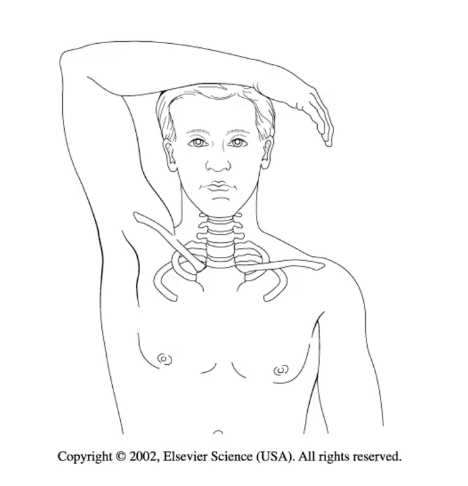
abducted arm sign
takes compression of cervical disc
positive if alleviated arm pain
upper limb tension test
similar to SLR
move head away, compress shoulder, extend wrist, raise 120 degrees
positive with symptoms reproduced

what is being stressed in the upper limb tension test
median nerve
radial nerve
ulnar nerve
wainner’s clinical prediction rule
for cervical radiculopathy
spurling’s test - positive
upper limb tension test - median nerve
cervical distraction test - positive
cervical rotation less than 90 degrees
when does cervical disc herniation become a contraindication for SMT/mobilization?
when there is evolving evidence of radiculopathy and/or myelopathy