Transcription and RNA processing in eukaryotes
 Call Kai
 Learn
 Practice Test
 Spaced Repetition
 Match
 Flashcards
 Knowt Play
1/24

There's no tags or description
Looks like no tags are added yet.
25 Terms
Two types of transcription factors
Basal (general) transcription factors, required for all genes; and gene specific-transcription factors
Function of general transcription factors
Recognise and bind promoters
Melt promoter DNA (generating single stranded DNA to initiate transcription)
Bind and stabilise RNA polymerase (these are similar to the function of bacterial sigma factors, but the step-wise assembly is different to the sigma factor)
Function as a hub for gene-specific regulation
They are sufficient to promote transcription at a basal level
Complex between general transcription factors and RNA polymerase
The PIC - preinitation complex (analogous to sigma factor-RNA polymerase complex in bacteria)
What is the mediator complex
A large multi protein complex that serves as an interface/bridging factor between the PIC (pre-initiation complex: RNA polymerase and basal transcription factors) and gene-specific activators
Where do gene-specific transcription factors bind
To cis-regulatory sequences, upstream of the promoter, to further activate transcription
Final step in transcription initiation in eukaryotes
C-terminus of the RNA polymerase is phosphorylated by a kinase that is part of the general transcription factors, which allows RNA polymerase to leave the promoter
The basal transcription factors, mediator complex and gene-specific transcription factors are left behind on the promoter - like the bacterial sigma factor

Structure of a eukaryotic gene
Key components: promoter, enhancers, exons, introns, polyadenylation sequence

RNA polymerase in eukaryotes
Three distinct RNA polymerase complexes (I, II, III) - II is critical for the synthesis of protein-coding mRNAs
Assembly of general transcription factors
TFIID recognises the promotor, using the TATA binding protein (the sequence is TATA box only in a minority of promoters, the TBF will bind to any promoter)
TFIIA and TFIIB enter the complex
RNA polymerase II enters teh complex, escorted by TFIIF
TFIIE and TFIIH - which includes a kinase that phosphorylates the C-terminal domain of the polymerase II, releasing the polymerase so that it can initiate transcription, and also an ATP dependent helicase to unwind promoter DNA - then assemble into the complex
All of these functions are carried out by the sigma factor in bacteria, whereas in eukaryotes it is this multi-protein complex, which assembles in stages
How does the TATA binding protein work
It consists of 10 beta sheets, and bends the DNA at the AT-rich promoter - the high AT proportion allows for kinks to form
How do cis-acting transcription factors work
They bind to cis regulatory elements (proximal control elements) - just upstream of the promoter
They increase expression by accelerating the assembly of the basal machinery (e.g. by promoting entry of TFIIB onto the complex, or by loading TFIID onto DNA)
They also stabilise the RNA polymerase complex through cooperative interactions, making it more likely to stay on the gene
There is a huge diversity of gene-specific TFs which allows specific genes to be activated at specific times
Function of enhancers
Short (promoters are also short), cis-acting (meaning that they regulate DNA on the same chromosome) regulatory sequences that stimulate transcription from promoters of nearby genes
Operate at a distance from promoters (but generally work on the most proximal gene)
Can be found downstream of genes or even within genes
Can function in either orientation
How do enhancers work to stimulate transcription
The mediator complex forms a bridge between transcription factors at the enhancer and promoters
Often common transcription factors bind to both enhancers and promoters
DNA acts as a tether between the two protein complexes, with the intervening DNA looping out to allow proteins bound to enhancers to interact directly with general transcription factors or RNA polymerase
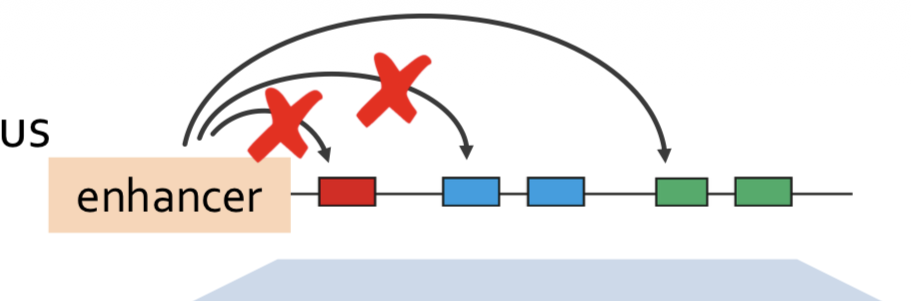
Enhancers drive combinatorial action: one enhancer can control multiple genes at different times and cells, or multiple enhancers can control one gene - this ensures tissue specificity
What type of regulation do enhancers allow?
Locus control region - one enhancer stimulates transcription of multiple genes
Allows for mutually exclusive gene expression
E.g. beta-globin expression - only one gene is transcribed at a given moment, the others are looped out
Allows for control of sequential gene activation in development
Levels of control of gene expression
Transcription initiation (crucial)
RNA processing (capping, cleavage and polyadenylation, splicing)
RNA transport
mRNA stability (degradation)
Translation
RNA capping
Capping machinery associates with the phosphorylated C-terminal domain of RNA polymerase II shortly after transcription initiation (so it happens co-transcriptionally)
A 7-methylguanosine cap is added to the 5’ end of the nascent RNA transcript: first a phosphatase removes the gamma-phosphate from the 5’ end, then guanyl transferase adds a GMP in a reverse linkage (5’ to 5', not 5’ to 3’), then methyl transferase adds a methyl group to the guanosine
Function of RNA capping
THe 5’ end of DNA is very unstable, attracts exonuclease - the cap protects from 5’-3’ exoribonucleases
Required for efficient nuclear transport - proteins bind to the cap to transport the RNA to the cytoplasm
Facilitates translation
How does splicing work
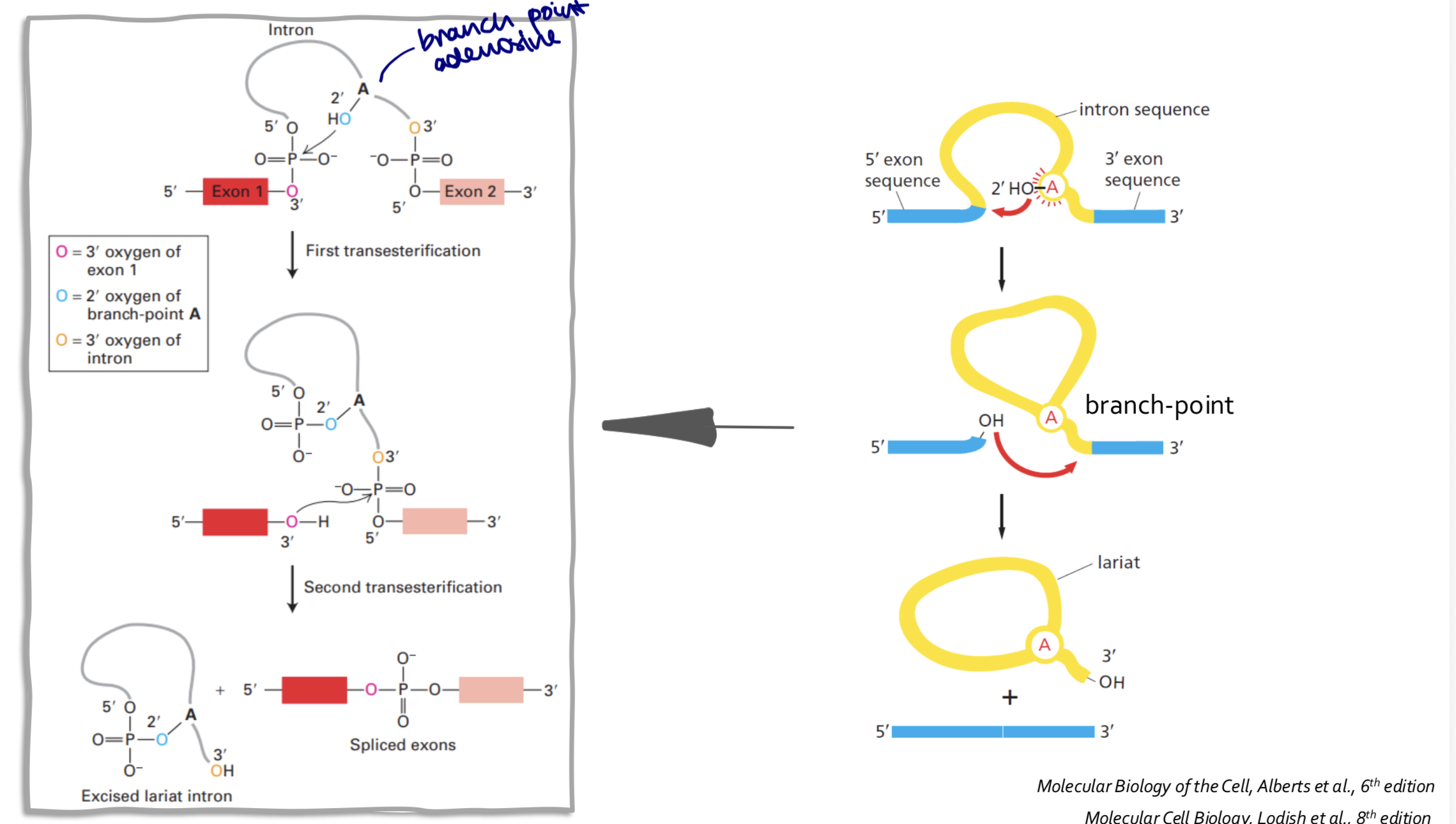
Two transesterification (forms different esters) reactions
The 2’ OH on the ribose of an adenosine nucleotide (so this wouldn’t work on DNA) attacks the phosphate of the nucleotide at the end of the exon sequence - this results in a free 3’ OH on that nucleotide
The 3’ OH group attacks the phosphate on the nucleotide at the start of the next exon, which is near to the branch-point adenosine
The intron is released as a lariat
Structure and function of the spliceosome
Complex of 5 snRNAs, which is each complexed with multiple proteins to form small nuclear ribonucleoprotein complexes (snRNPs) - combined, they form the spliceosome
Key splicing reactions are catalysed by the RNA - proteins are there to stabilise
Many factors play a role in detecting introns, as the consensus splice-site sequences are short
Functions of splicing
Accelerate evolution - allows different functional domains to be easily stitched together - translocation of exons
A mechanism to generate mRNA and protein diversity - alternative splicing (works when the reading frame is maintained across exons)
How is alternative splicing regulated
By regulatory proteins - repressors inhibit splicing, so that the would-be intron is now part of the exon, and acitvators promote splicing
Cleavage and polyadenylation
polyadenylation signal (AAUAAA - conserved) lies 10-30 nucleotides upstream of a poly(A) site - this is where cleavage and polyadenylation will occur
GU or U rich sequences downstream of this contributes to efficiency of polyadenylation and cleavage
Cleavage and polyadenylation specificity factor (CPSF) recognises the polyadenylation signal sequence
Recruits cleavage factors CFI and CFII
Poly(A) polymerase (PAP) is part of the factor and adds up to 200-250 adenine residues - not template dependent
Poly(A) binding protein (PABNP) strongly binds poly(A) RNA, regulates the length of the poly(A) tail and regulates the stability of the mRNA
Importance of the poly(A) tail
mRNA transport into cytoplasm
Efficiency of translation - polyA binding proteins important for translation initiation
Protection against exonuclease
(Same functions as 5’ end)
What part of RNA polymerase is important for capping, splicing and polyadenylation
The C-terminal domain tail: a binding platform for many different proteins involved in capping, splicing and polyadenylation
Transcription differences between bacteria and eukaryotes
Bacteria: RNA is capped (different mechanism); eukaryotes: RNA is capped, cleaved and polyadenylated
Polycistronic vs monocistronic - single open reading frame per mRNA
No splicing vs splicing to generate diversity
No spatiotemporal separation of transcription and translation - they occur simultaneously vs spatiotemporal separation, with dedicated RNA transport machinery from the nucleus to the cytoplasm