AB2, L4: Introduction to Veterinary Parasites

0.0(0)
Studied by 0 people
call kaiCall Kai
learnLearn
examPractice Test
spaced repetitionSpaced Repetition
heart puzzleMatch
flashcardsFlashcards
GameKnowt Play
Card Sorting

1/19

flashcard set

Earn XP

Description and Tags

Given definition, answer w/ term

Last updated 11:58 AM on 9/29/26
Name
Mastery
Learn
Test
Matching
Spaced
Call with Kai
Chat

No analytics yet

Send a link to your students to track their progress

20 Terms

1
New cards

Parasite

  • An animal or plant that lives in or on a host from which it obtains nourishment from. They often co-evolve with their hots

  • The host does not benefit from this association, and is often harmed by it

  • Classified as pathogens


2
New cards

Protozoans, helminths, and arthropods

List the 3 main categories of parasites

3
New cards

Protozoans

1 of the 3 Main Categories of Parasites:

  • Single cell animals


<p><strong>1 of the 3 Main Categories of Parasites:</strong></p><ul><li><p>Single cell animals</p></li></ul><p></p>
4
New cards

Helminths

1 of the 3 Main Categories of Parasites:

  • Subcategories include:

    • Nematodes – roundworms

    • Trematodes – squished, cornflake appearance

    • Cestodes – tapeworms


<p><strong>1 of the 3 Main Categories of Parasites:</strong></p><ul><li><p>Subcategories include:</p><ul><li><p>Nematodes – roundworms </p></li><li><p>Trematodes – squished, cornflake appearance</p></li><li><p>Cestodes – tapeworms </p></li></ul></li></ul><p></p>
5
New cards

Arthropods

1 of the 3 Main Categories of Parasites:

  • Subcategories include:

    • Insects

    • Ticks

    • Mites


<p><strong>1 of the 3 Main Categories of Parasites:</strong></p><ul><li><p>Subcategories include:</p><ul><li><p>Insects</p></li><li><p>Ticks</p></li><li><p>Mites</p></li></ul></li></ul><p></p>
6
New cards

High production, low survival

1 of the 2 Types of Parasite Reproductive Mechanisms:

_______ production, _______ survival

  • Definition: Massive feeding to support reproduction, low chance of ingestion by intermediate host

  • Example: Tapeworm

  • Most common mechanism


<p><strong>1 of the 2 Types of Parasite Reproductive Mechanisms:</strong></p><p>_______ production, _______ survival</p><ul><li><p><u>Definition</u>: Massive feeding to support reproduction, low chance of ingestion by intermediate host</p></li><li><p><u>Example</u>: Tapeworm</p></li><li><p>Most common mechanism</p></li></ul><p></p>
7
New cards

Low production, high survival

1 of the 2 Types of Parasite Reproductive Mechanisms:

_______ production, _______ survival

  • Definition: Selective host number, emerging directly from host

  • Example: Warble fly


<p><strong>1 of the 2 Types of Parasite Reproductive Mechanisms: </strong></p><p>_______ production, _______ survival </p><ul><li><p><u>Definition</u>: Selective host number, emerging directly from host </p></li><li><p><u>Example</u>: Warble fly </p></li></ul><p></p>
8
New cards

Overdispered distribution

Distribution most commonly in populations of animals with parasites

  • Note, most animals have a very low burden, and only a few have a very high burden

  • The prevalence of infection is high, but the prevalence of disease is low


<p>Distribution most commonly in populations of animals with parasites </p><ul><li><p>Note, most animals have a very low burden, and only a few have a very high burden </p></li><li><p>The prevalence of infection is high, but the prevalence of disease is low </p></li></ul><p></p>
9
New cards

Endemic stability

  • Definition: Host populations consist of individuals with acquired immunity, poor immunity, or no immunity


10
New cards

Pruritic stress

1 of the 5 Harms Associated with Parasites:

  • Definition: Aka, itching

  • Example: Sarcopts scabei buries into the dermis and causes mange. Most commonly seen in dogs and pigs


<p><strong>1 of the 5 Harms Associated with Parasites:</strong></p><ul><li><p><u>Definition</u>: Aka, itching</p></li><li><p><u>Example</u>: <em>Sarcopts scabei</em> buries into the dermis and causes mange.  Most commonly seen in dogs and pigs </p></li></ul><p></p>
11
New cards

Biting

1 of the 5 Harms Associated with Parasites:

  • Example: Sharp mouthparts on Stomaoxys calcitrans (stable fly) fly irritate animal, associated with drop in milk production


<p><strong>1 of the 5 Harms Associated with Parasites:</strong></p><ul><li><p><u>Example</u>: Sharp mouthparts on <em>Stomaoxys calcitrans</em> (stable fly) fly irritate animal, associated with drop in milk production </p></li></ul><p></p>
12
New cards

Acute inflammatory response

1 of the 5 Harms Associated with Parasites:

  • Example: Babesia infected red blood cells leads to release of haem and exponential rate of infection of red blood cells, which ultimately leads to an acute inflammatory response


<p><strong>1 of the 5 Harms Associated with Parasites:</strong></p><ul><li><p><u>Example</u>: <em>Babesia</em> infected red blood cells leads to release of haem and exponential rate of infection of red blood cells, which ultimately leads to an acute inflammatory response </p></li></ul><p></p>
13
New cards

Physical damage to host tissues and organs

1 of the 5 Harms Associated with Parasites:

  • Example: Coccidiosis – massive reproduction of Eimeria protozoa in poultry disrupts the epithelium of cecum


<p><strong>1 of the 5 Harms Associated with Parasites:</strong></p><ul><li><p><u>Example</u>: Coccidiosis – massive reproduction of <em>Eimeria </em>protozoa in poultry disrupts the epithelium of cecum</p></li></ul><p></p>
14
New cards

Competition for resources

1 of the 5 Harms Associated with Parasites:

  • Example: Parascaris equorum, a roundworm which commonly presents as clinical signs in foals, will monopolize nutrients in gut


<p><strong>1 of the 5 Harms Associated with Parasites:</strong></p><ul><li><p><u>Example</u>: <em>Parascaris equorum</em>, a roundworm which commonly presents as clinical signs in foals, will monopolize nutrients in gut</p></li></ul><p></p>
15
New cards

Dead-end hosts

What kinds of hosts are humans typically in the zoonotic disease process?

16
New cards

Louping ill virus

  • Transmitted by: Ixodes ricinus ticks

  • Infects: Sheep and red grouse

  • Symptoms: Fever, depression, neurological signs, “________ gait” in sheep, & death

  • Vector-borne, zoonotic disease that is continuing to expand due to global warming
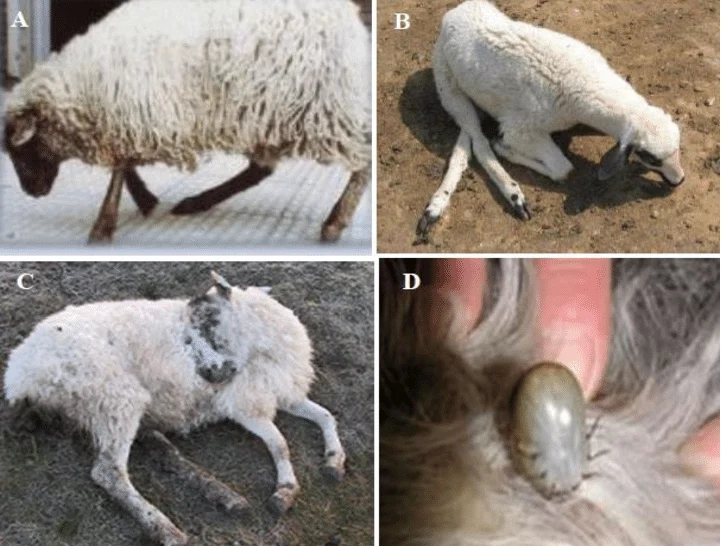

<ul><li><p><u>Transmitted by</u>: Ixodes ricinus ticks</p></li><li><p><u>Infects</u>: Sheep and red grouse</p></li><li><p><u>Symptoms</u>: Fever, depression, neurological signs, “________ gait” in sheep, &amp; death</p></li><li><p>Vector-borne, zoonotic disease that is continuing to expand due to global warming </p></li></ul><p></p>
17
New cards

African horse sickness virus

  • Caused by: Orbivirus

  • Transmitted by: Culicoides imolica midges

  • Infects: Horses

  • Symptoms: Fever, respiratory signs, cardiac signs, death

  • Prevention: Live attenuated vaccine


<ul><li><p><u>Caused by</u>: Orbivirus</p></li><li><p><u>Transmitted by</u>: Culicoides imolica midges</p></li><li><p><u>Infects</u>: Horses</p></li><li><p><u>Symptoms</u>: Fever, respiratory signs, cardiac signs, death</p></li><li><p><u>Prevention</u>: Live attenuated vaccine</p></li></ul><p></p>
18
New cards

Blue tongue virus

  • Caused by: Orbivirus

  • Transmitted by: Culicoides spp

  • Infects: Ruminants, most severe in sheep

  • Symptoms: Fever, swelling of head/neck, ocular/nasal discharge, lameness, respiratory signs, milk drop (cattle), death

  • Prevention: Vaccine


<ul><li><p><u>Caused by</u>: Orbivirus </p></li><li><p><u>Transmitted by</u>: Culicoides spp</p></li><li><p><u>Infects</u>: Ruminants, most severe in sheep </p></li><li><p><u>Symptoms</u>: Fever, swelling of head/neck, ocular/nasal discharge, lameness, respiratory signs, milk drop (cattle), death </p></li><li><p><u>Prevention</u>: Vaccine </p></li></ul><p></p>
19
New cards

Schmallenberg virus

  • Caused by: Orthobunyavirus

  • Transmitted by: Midges

  • Infects: Sheep & cattle

  • Symptoms: Fever, milkdrop, diarrhea, abortion, stillborns, and congenital abnormalities

  • Cyclical outbreaks seen


<ul><li><p><u>Caused by</u>: Orthobunyavirus</p></li><li><p><u>Transmitted by</u>: Midges</p></li><li><p><u>Infects</u>: Sheep &amp; cattle</p></li><li><p><u>Symptoms</u>: Fever, milkdrop, diarrhea, abortion, stillborns, and congenital abnormalities</p></li><li><p>Cyclical outbreaks seen </p></li></ul><p></p>
20
New cards

Shamonda-like virus

  • Caused by: Orthobunyavirus

  • Transmitted by: Midges

  • Infects: Cattle

  • Symptoms:


<ul><li><p><u>Caused by</u>: <em>Orthobunyavirus</em></p></li><li><p><u>Transmitted by</u>: Midges</p></li><li><p><u>Infects</u>: Cattle </p></li><li><p><u>Symptoms</u>:</p></li></ul><p></p>