chem uni 3
 Call Kai
 Learn
Learn Practice Test
 Spaced Repetition
 Match
Match Flashcards
 Knowt Play
1/23

There's no tags or description
Looks like no tags are added yet.
Name | Mastery | Learn | Test | Matching | Spaced | Call with Kai | Chat |
|---|
No analytics yet
Send a link to your students to track their progress
24 Terms
What are Alkali Metals
The most reactive metals
What are Alkaline earth metals
Second most reactive metals
What are Noble gasses
The least reactive nonmetals, and the least reactive elements overall.
What are transition Metals
The least reactive metals.
what are halogens
The most reactive nonmetals
What are the representative elements
Groups 1,2, and 13-18
What is atomic radius
the distance from the nucleus to the edge of its electron cloud. It increases to the left and down on the periodic table.
The increase arrows for Atomic Radius

The Increase arrows for Atomic Mass

Atomic Mass
the weighted average of the sum of protons and neutrons an element’s naturally occurring isotopes. Also, the weight of one mole of that element, in grams. Increases to the right and down. (See picture)

Ionization energy
the amount of energy it takes to remove an electron from an atom. (Increases right and up.)
Electron affinity
the amount of energy an atom will give up to gain a new electron. (Increases right and up.)
Electronegativity
the attraction an atom has for a shared electron in a chemical bond. The atom with a stronger electronegativity will pull a shared electron closer. (Increases right and up.)
Increase arrows for all trends besides radius and mass

Nonpolar covalent bond
A bond in which the electronegativity difference is 0.4 or less
Polar covalent bond
A bond in which the electronegativity difference is between 0.4 and 1.7
Ionic bond
A bond in which the electronegativity difference is greater than 1.7
Isotope
An atom of an element with a different number of neutrons.
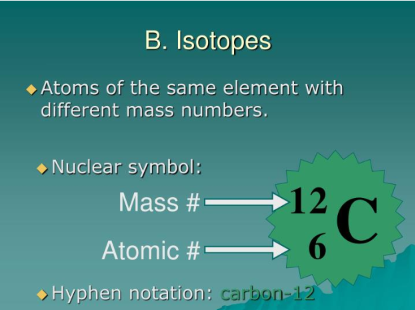
Isotopic notation
Consists of two numbers on the left, one on top of the other, and the elements symbol on the right. The top number is the mass number, which is the total number of neutrons plus protons. The bottom number is the atomic number, which is the protons alone. The name of the isotope is derived from the name of the element, followed by a dash, followed by the mass number. (See Picture for an example of Carbon-12.)
Electronic configurations

valence electrons
elements in a group have similar properties due to these
law of octaves
this law did not work for group 2 elements
law of triads
this law revealed that the math did not work for all groups of elements, like the halogens
How do you find Atomic mass
Protons + Neutrons = Atomic Mass Number (Mass Number - Atomic number = Number of Neutrons)
