test 2
 Call Kai
 Learn
 Practice Test
 Spaced Repetition
 Match
 Flashcards
 Knowt Play
1/124

There's no tags or description
Looks like no tags are added yet.
125 Terms
Communication
The process in which a specialized signal produced by one individual affects the behaviour of another.
Signal
An evolved trait that is selected specifically for its effect on altering the behaviour of the receiver.
Cue
Consistent aspects of the environment that can guide an animal's behaviour in a way that enhances fitness, but are not evolved signaling traits.
Waggle dance
A symbolic dance performed by honeybees (Apis mellifora) whose linear waggle run communicates the direction and distance to a distant food source relative to gravity and the sun.

Alarm calls
Unique vocalizations produced by social animals (such as vervet monkeys or titmice) when a predator is nearby to alert conspecifics or coordinate defensive responses.

vervet monkey example of alarm calls
different calls based on the specific predator present. when eagle, alarm, is to hide in bushes, when leopard, alarm is to climb on tree, and when snake, alarm is to stand and watch ground for snakes
Robert Seyfarth
Professor of Psychology who studied primate vocal communication and social behavior in species such as vervet monkeys and chacma baboons in Botswana.
Dr. Penny Patterson
Developmental psychologist from Stanford University who in 1972 began working with Koko, a western lowland gorilla, initiating the longest ongoing interspecies communication study.
Chemical signals
Relatively long-lasting signals that can travel great distances around physical barriers, but cannot be modified once transmitted and are volatile under higher ambient temperatures.
Visual signals
Signals that travel rapidly through the environment and require adequate ambient light and background contrast, but are easily obstructed by physical objects.
bright body colours are often visual signs, the effectiveness of such signs should depend on the spectral properties of the environment and background colour contrast; visual signs should be most effective when they contrast w background light environment
Auditory signals
Vocal or acoustic signals that travel around barriers and can be turned on and off rapidly, but attenuate (diminish in intensity) as they travel through the environment.
Honest signals (Accurate indicators)
Signals that reliably convey signaler quality or environmental conditions, favored when:
fitness interests of signaler and receiver overlap
signals cannot be faked
signals are costly to produce.
Aposematic colouration
Brightly coloured morphology that stands out from the environment and serves as an honest warning signal that the prey possesses noxious chemicals, poison, or unpalatability.

methods of bee study
placed food at feeding station east of hive
recorded wind speed and direction (could affect movement)
marked bees w transponders from hive that had not yet visited feeding station
released bees at hive or at one of three other locations
measured movement of bees
results of bee study
displaced bees also flew 200m due east
in response to waggle dance, bees flew 200m due east of hive too
therefore waggle dance does signal distance and direction of food

tufted titmouse alarm calls observation
tt produce alarm calls to recruit others to mob the predator, vocalizations can be visualized in sonogram

tufted titmouse research question
do alarm calls of titmice differ with the size and degree of threat of a predator
tufted titmouse methods
placed model predator near feeding station
recorded tt behaviour and alarm calls
treatments included small, high risk predators such as eastern screech owl, and large low risk predators such as great horned owl
results and conclusions of tufted titmouse alarm calls
tt produce more D notes in alarm calls during high risk predation treatments
more mobbing behaviour during high risk treatments w small raptors
C: titmice prod different alarm calls that lead to different behaviours
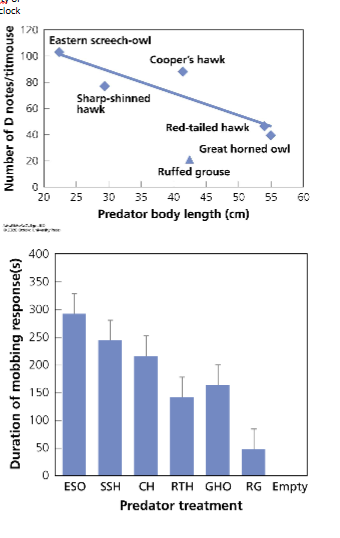
observations of ant chemical signals study
socially foraging ant recruit others to a food source by producing chemical pheromone trail as they travel back to colony
socially foraging ant species tend to stop foraging when ambient temperature rises
solitary foraging species are active thorughout the day
research question, hypothesis, and prediction for ant chemical signals
RQ: how does the temperature of the surface affect any food trails
H: chemical pheromones in ant trails are volatile. ambient temperatures will affect their persistence
P: the persistence of pheromone trails will be negatively affected by temperature
methods of ant chemical study
trained ants to find food by crossing bridge; ants deposited pheromones on bridge
removed bridge and heated og and new bridge to 1 of 6 temperatures
allows bridges to cool; replaced og bridge and new bridge to form Y leading to 2 new food sources
recorded percent of recruits using og and new bridge

results and conclusion of ant chemical study
R: most recruits used og bridge for bridges that heated to less than 40, no difference in bridge use for og bridges heated to 40 or more
C: surface temp affects chemical pheromone persistance, may explain why social foraging ants do not forage at high temps

observation and research question of habitat light environment of fish
O: freshwater fish males are either all blue or all yellow, females are a cryptic grey. M court F in two distinct habitats, shallow sandy beach and deep water root habitat sites; each one has different spectral properties
RQ: is M signal (body colour) most effective when it displays in a site with high chromatic contrast?
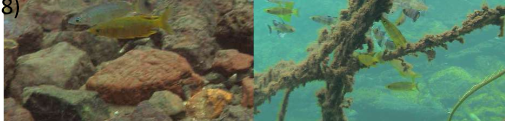
methods of habitat light environment of fish
established transects in each habitat
captured M and recorded their body colour spectrum
recorded the colour spectrum of each habitat
two type of M: active mating displays and sneakers (no displays)\
observing spawning events
recorded type(s) of M present at each spawning event
results and conclusion of habitat light environment of fish
R: blue M contrasted most w background in beach habitat, yellow M contrasted most in the root habitat, blue morphs had higher success in beach, yellow morphs had higher success in root
C: colour signal effectiveness was affected by light environment

observation, research question, and prediction of habitat structure and bowerbird vocal signs
O: auditory signal lose intensity as they travel; higher freq signals do so faster in dense vegetation which could favour use of lower freq
RQ: how does habitat structure affect bowerbird vocal signs?
P: bc higher freq lose intensity (attenuate) faster in dense vegetation, call freq should be lower in more densely vegetated habitats
methods of habitat structure and bowerbird vocal signs
satin bowerbirds
M construct a stick bower on the ground where they display to attract mates
recorded M advertisement calls from multiple locations in Australia
determined min and max freq, dominant (loudest) freq and call duration
characterized vegetation at locations
counter num of tree stems wider than 5cm at 1m above ground

results and conclusion of habitat structure and bowerbird vocal signs
R: calls varied across sites. min and dominant freq were lower in sites w more trees
C: habitat structure favours vocal signals that minimize attenuation (loss of intensity)

research question, hypothesis, and predictions of aposematic colouration in frogs
RQ: why are dendrobatid frogs brightly coloured?
H: the bright reddish-orange body colour w blue appendages is an aposematic signal
P: frogs w bright reddish-orange body colour and blue appendages will be attacked by predators less often than brown-coloured frogs
methods of aposematic colouration in frogs
created models of: dendrobatid frog, and brown leaf litter frogs from other genus that do not contain poisons
placed many frog models on forest floor or white paper (to rule out camouflage)
after 2 days, collected models and recorded predation attempts
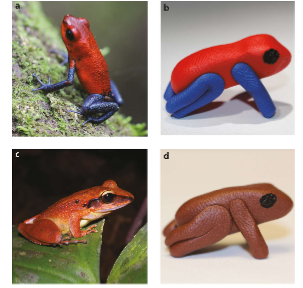
results and conclusion of aposematic colouration in frogs
R: over 12% of models attacked, brown models attacked twice as often as brightly coloured models
C: bright colouration is an aposematic signal to predators that prey are unpalatable

courtship signalling
many males engage in courtship displays (visual signals to F), these displays can be lengthy and intense and so can be energetically costly, are they accurate indicators of a M condition?
Research question, hypothesis, and prediction of signaling in male wolf spiders experiment 1
RQ: do M spider leg raises provide an accurate signal to F?
H: M condition affects leg-raising rate
P: good-condition M will display at a higher rate than poor-condition M
methods of of signaling in male wolf spiders experiment 1
collect juvenile M and F spiders and raised them in the lab for 3 weeks, PC spiders fed one cricket 2/week, GC spiders fed 4 crickets 2/week
create 4 mate-pairing test groups
measured M courtship rate in a cylindrical arena
repeated the trial for next 3 days using same individuals to test for consistency
results and conclusion of signaling in male wolf spiders experiment 1
R: GC M displayed at higher rates than PC M, display rate was consistent across sample, except for GC M mated to PC F.
C: mate condition affects M courtship display rate is an accurate signal of M quality and fitness

research question, hypothesis, and prediction of signaling in male wolf spiders experiment 2
RQ: do M spider leg raises provide an accurate signal to F?
H: high display rate in M indicates high quality
P: F mated to M w high leg display will have higher reproductive success
methods of signaling in male wolf spiders experiment 2
mated F w M in two groups:
1: M w high leg display rates
2: M w low leg display rates
measured the number of spiderlings and their survival
results and conclusion of signaling in male wolf spiders experiment 2
R: F mated to M w a high display rate had more spiderlings and higher offspring survival than F mated to M w a low display rate
C: mate condition affects M courtship display rate and is an accurate signal of M quality and fitness

aggressive displays
aggressive behaviour often involves energetic displays before more intense fighting occurs, want to know if these displays an accurate indicator of the condition and fighting ability of a M?
research question, hypothesis, and prediction of fighting fish opercular flare study
RQ: does opercular display behaviour vary w the condition of a fish?
H: opercular displays are costly to perform at high rates because they reduce water ventilation over the gills
P: M in the best physiological condition will perform opercular displays at a higher rate than individuals in poorer conditions
methods of fighting fish opercular flare study
manipulated M by placing individuals in water that differed in oxygen level:
normoxic water and hypoxic water
recorded fish display behaviour in trials for 2 treatments: w or w/out intruder (mirror image in tank)
recorded percentage of time a fish spent displaying (flare) over the trials
results and conclusion of fighting fish opercular flare study
R: fish in normoxic water displayed significantly more than fish in hypoxic water
C: only M in good physiological condition can display at high rate. opercular displays are an accurate signal of M condition

inaccurate indicators
when the fitness interests of signaler and reciever differ. works bc of co-evolution
co-evolution and signals
inaccurate indicators. signalers are selected to prod signals that affect behaviour of receivers, and receivers are selected for better discrimination abilities
mimicry
adaptive resemblance of one species (the mimic) to another (the model)
batesian mimicry
a palatable (edible) mimic resembles an unpalatable (toxic) model. Morphology and colouration, common in amphibians. Mimic colouration of poisonous version but is not acc poisonous
observation, research question, and hypothesis of toxic salamander and its mimic
O: palatable, yellow-eyed, ensatina, salamander resembles a toxic newt
RQ: is the yellow-eyed salamander a batesian mimic?
H: the yellow-eyed salamander is a mimic of aposematic newts

methods of toxic salamander and its mimic
most ensatina sp are cryptically coloured but the yellow-eyed salamander is brightly coloured. researchers conducted feeding trials w captured Western Scrub Jays housed individually in a large aviary.
Day 1: all jays fed edible salamander
Day 2: all kays fed toxic newt
Day 3: presented w either edible yellow-eyed salamander (mimic) or palatable cryptically coloured ensatina
Day 4: presented w opposite of day 3
results and conclusion of toxic salamander and its mimic
yellow-eyed salamanders effectively mimics toxic newt

aggressive mimicry
predator mimics a nonthreatening model so that it can approach prey

methods of aggressive mimicry in fish
juvenile bluestreak cleaner wrasse
bluestriped fangblenny
client fish, staghorn damselfish
treatment: damselfish parasitize
control: no parasites on damselfish
allowed all three fish to interact for 15 mins and recorded behaviours
results and conclusion of aggressive mimicry in fish
R:
parasitized damselfish cleaned for longer and avoided cleaner fish less
fangblennies were more successful at attacking parasitized fish
C: fangblennies are aggressive mimics

intraspecific deception
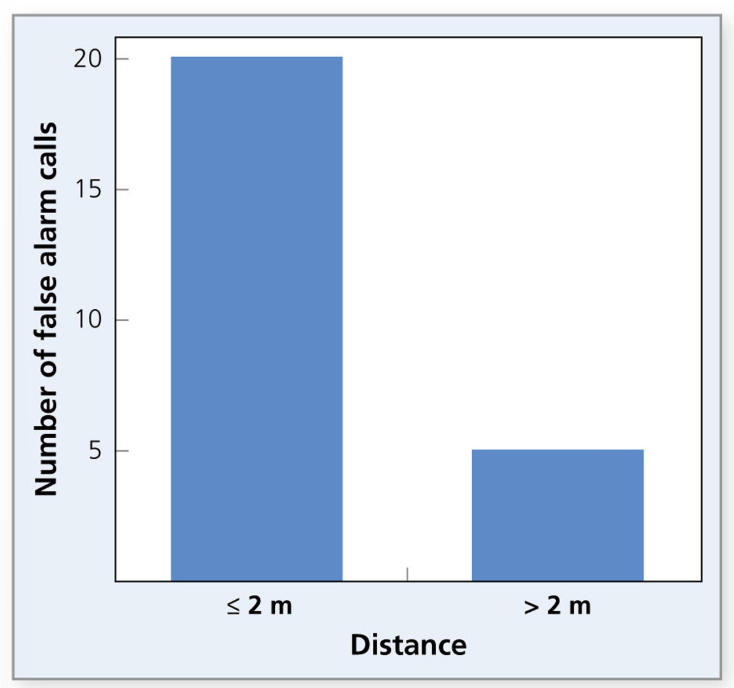
inaccurate within same sp. many examples of inaccurate signalling occur bw sp (goby), inaccurate signaling bw individuals within a sp is less common, one example is production of false alarm calls
research question, hypothesis, and prediction of topi antelope false alarm calls study
RQ: do M topi give false alarm calls?
H: false alarm calls deceive F into staying on a M territory so they can obtain more matings
P: M will only give false alarm calls when an estrus F is in their territory and only when she is about to leave
methods of topi antelope false alarm calls study
Topi, researchers observed F in and not in estrus; recorded territorial location, all matings, alarm snort, and departure attempts; also scanned area for potential predators
results and conclusion of topi antelope false alarm calls study
R: real and false alarm snorts were acoustically identical; following false alarm snorts , F stayed on the territory and M obtained additional matings; M false snort, then attempt copulation
C: M topi give inaccurate alarm signals to keep F topi from leaving their territory

bystanders
“eavesdroppers”, a third-party individual that detects a signal transmitted bw a signaler and a receiver
audience effect
occurs when the presence of bystanders influence the behaviour of a signaler
observation, and two research questions of audience effects in fighting fish
O: M fighting fish are highly aggressive and compete for territories and mates
RQ1: how does the sex of the audience affect M display behaviour
RQ2: how does familiarity w an opponent influence M display behaviour?
methods of audience effects in fighting fish
examined aggressive behaviour of focal M as it interacted a familiar or unfamiliar opponent M when M, F, or no bystander present
placed matched M in adjacent tanks w opaque partition
familiar treatment, removed partition for 10 mins
audience was M or F or no bystander
at start of trial, partition bw audience and opponent tank was removed to allow opponents to observe the audience. after 5 mins, the partition bw the opponent tanks was also removed
recorded M display at opponent
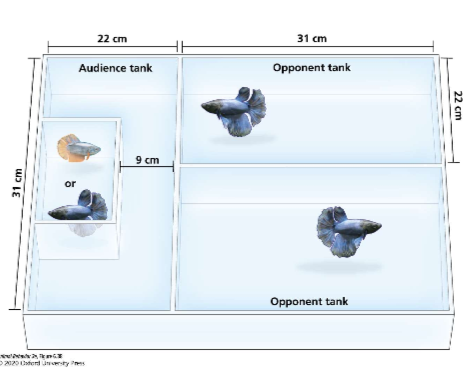
results and conclusion of audience effects in fighting fish
R: M displayed highest rate of gills flaring toward unfamiliar opponents w M audience present, M displayed highest rate of tail when F audience present
C: signaling behaviour is affected by presence of audience w M possibly perceiving familiar M as less of a threat to courtship. and tail beats might be a courtship behaviour

effectiveness of pheromones in controlling damage by light-brown apple moths in citrus orchards
compared 2 orange groves: control and one w release of F sex pheromone
F in treatment almost not inseminated
almost 50% inseminated in control
urban sounds affecting signal production
many birds today live in noisy, urban environments
investigated whether urbanism affected the songs of great tits
GT song is 2-4 note phrases of diff freq
compared bw a few Eu cities and matching forests nearby
found urban birds had higher min freq shorter and faster than in forests
change in freq due to better transmission of signal

human luxury brands as costly signals
participants were rated as better for a job when wearing more expensive logos
capuchin monkeys and inaccurate signals
older usually have preferential access to resources, dominant often feed first and if food is limited and easily defendable, they may prevent subordinates from feeding. researchers wanted to see if inaccurate alarm calls allow subordinates to gain access to food. predictions would be:
calls should be produced by subordinated and not by dominant individuals, who already have free access to resources
the calls should be given when food is clumped rather than dispersed, bc it is more difficult for subordinates to gain access to clumped resources
calls should be given when a caller is close enough to food to take advantage of distraction
calls should benefit caller by eliciting antipredator behaviour in dominants like moving to safer location (away from food)
results showed that subordinate capuchins produce inaccurate alarm calls to distract others so that they can gain access to clumped food. such calls were given sparingly, probably bc of freq-dependent selection (ones that produce them too often can be ignored)
sticklebacks decorating their nests
three-spined stickleback M construct nests of soft algae within shallow sand depression. F lay eggs in nest and only M cares for eggs. some M decorate entrance to nest w materials that provide striking colour contrast.
captured wild individuals and housed them to breed
all males readily added coloured decorations, preference for red
all F tested prefered M whose nest had been decorated

squirrel eavesdropping research
EGSs freq cache food items for later, but other sp can steal their food like BJs. researchers wondered whether squirrels eavesdropped on vocal communication signals of potential cache pilferers to learn about their proximity. H: S might alter feeding preferences for diff food items depending on whether jays were nearby or too far away to watch, and predicted that when jays are nearby, squirrels should reduce their preference for feeding on cacheable food items that could be stolen by jays
Methods: established food patches w hazelnuts for swuirrels, recorded number of nuts left in each patch for 3 treatments (1. BJ call from nearby, 2. BJ call from far away, 3. cardinal call as control group)
significantly more nuts left in patch when BJ was nearby
therefore they eavesdrop of BJ

observation and research of bowerbirds constructing and decorating bowers
O: M bowerbirds construct and decorate elaborate stick structures, bowers, used to attract F
RQ: does the quantity of decorations at a bower correlate w M quality?
methods of bowerbirds constructing and decorating bowers
quantified number of decorations on the bowers of 22 M satin bowerbirds
quantified number of copulations he obtained
bowerbird copulation
results and conclusion of bowerbirds constructing and decorating bowers
R: there was a positive correlation bw decorations and copulations
C: bowers appear to function as a signal of M quality
sensory modalities and natural selection
animals use several sensory modalities when searching for food (vision, olfaction, hearing, etc). NS favours sensory modalities that most efficiently and effectively provide information about the location of food
example of natural selection and sensory modalities
mechanoreceptors are used by fish for detecting their body position, and for information about water pressure or movement. a lateral line system contains mechanoreceptors that provide hydrodynamic information about water velocity and acceleration
lateral line system
used by fish for hearing, for detecting their body position, and for information about water pressure or movement
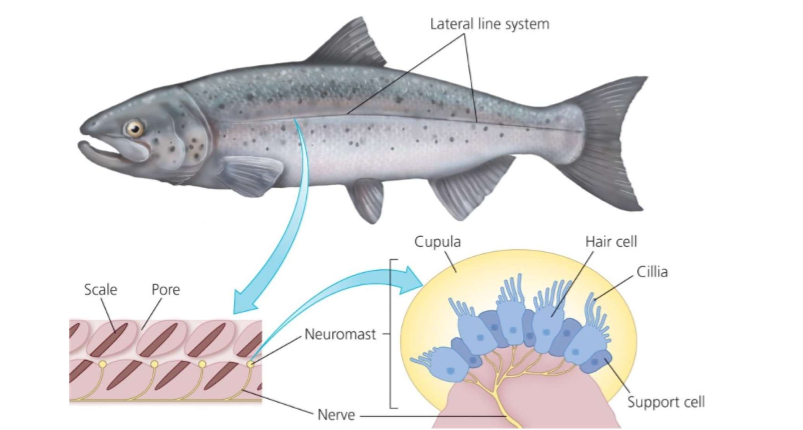
mechanoreception fish
animals find food using many sensory modalities, such as lateral line system and neuromasts. use it for hearing, detection of body position and orientation, water pressure/velocity/direction, and movement/presence of others

first research question, hypothesis, and prediction of catfish tracking the wake of their prey
RQ: how do nocturnal catfish find food in the dark?
H: catfish use their lateral line system to detect cues provided by the wake of their fish prey
P: catfish will follow the wake of their prey while hunting
first methods of catfish tracking the wake of their prey
observed catfish hunting individual guppies
used an infrared video system to track the movement of both predator and prey in complete darkness
classified movement sequences as “path following”, “head on encounters”, or “attack on stationary guppy”
first results and conclusion of catfish tracking the wake of their prey
R: 80% of attacks occurred on moving guppies, catfish usually followed same path as guppy before attack
C: catfish appear to follow path of their prey to find and attack them

second research question and methods of catfish tracking the wake of their prey
RQ: do catfish use chemical or hydrodynamic cues to track their prey in the dark?
M:
used an infrared video system to track the movement
manipulated either the lateral line or external gustation
classified hunting success and movement sequences of treatment fish
second results and conclusion of catfish tracking the wake of their prey
R: without lateral line, mostly head-on attacks and low capture rate
C: the lateral line provides important information for catfish to track the wake of their prey

research question of bees using multiple senses to enhance foraging efficiency
us foraging more efficient when multiple senses are used? (colour & shape, and odour)
methods of bees using multiple senses to enhance foraging efficiency
visual cue (cross contained sugar water, circle no sugar water)
olfactory cue (peppermint w reward, clove w no reward)
shape and odour (clove and circle indicated reward flowers and peppermint plus cross indicated non-reward flowers)
results and conclusion of bees using multiple senses to enhance foraging efficiency
R: bees trained to use both visual and odour cues had the highest feeding performance
C: the use of multiple sensory cues facilitates efficient feeding

research question, hypothesis, and prediction of prey detection by gray mouse lemurs
RQ: how important are vision, hearing, and smell in prey detection by nocrurnally foraging mouse lemurs?
H: lemurs will detect prey more accurately w the use of multiple sensory modalities
P: lemur prey detection rate will be lowest w use of one sensory modality and highest w use of multiple sensory modalities
methods of prey detection by gray mouse lemurs
used a choice test experimental design in which a single mealworm was placed under one of two dishes, few cm apart, covered w cone lids
manipulated sensory cues so that one, two, or three cues were present in the dish w food
conducted experiments under low light levels, testing six lemurs on each treatment 14 times
results and conclusion of prey detection by gray mouse lemurs
R: individuals used all 3 senses to locate prey successfully. food detection probability increased w the number of sensory modalities used
C: gray mouse lemurs use vision, olfaction, and hearing to locate prey. detection increases when more than one sensory modality is available. detection is highest when a visual cue is present

search image
visual predators find cryptic prey more effectively by learning this. using vision has favoured the evolution of behavioural and morphological adaptations in prey to avoid detection. this favours counteradaptations in predators to better detect hidden or cryptic prey
research question, hypothesis, and prediction of cryptic prey reducing predator efficiency
RQ: How does cryptic prey colouration affect trout foraging efficiency?
H: prey tat match their background will be harder or predators to detect, and predator hunting efficiency will increase wit experience
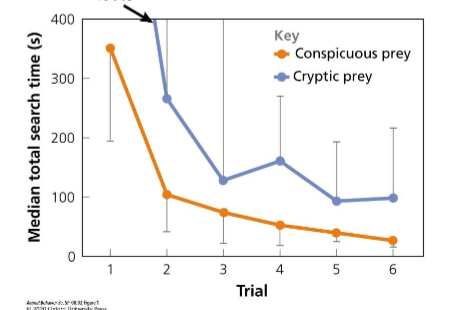
P: 1) trout will find noncryptic prey faster than they will find cryptic prey. 2) trout will find cryptic prey faster w experience
methods of cryptic prey reducing predator efficiency
established two test aquaria, identical except for the colour of the aquarium bottom: one was brown plastic covered w brown grains, and the other was green plastic covered w green grains.
placed a single prey in on of the different locations on the aquarium bottom. the maggot was cryptic on the brown background and conspicuous on the green background
recorded the amt of time until the test fish found the food item
tested 42 young trout, half w cryptic prey and half w conspicuous prey

results and conclusion of cryptic prey reducing predator efficiency
R: individuals found noncryptic prey faster than cryptic prey. search times to find prey decreased w experience
C: background colour matching can benefit prey by reducing predator hunting efficiency. predator search efficiency for cryptic prey can increase over time
OFT
optimal foraging theory. many models of it assume that fitness while feeding increases w energy intake rate. two well-known models: 1) diet model 2) patch-use model
optimal behaviour
behaviour that maximizes fitness
optimal diet model
predicts the food types an animal should include in its diet. it assumes: foragers maximize fitness by maximizing energy intake rates (higher survival), food items are encountered one at a time in proportion to their abundance, and food items can be ranked by their profitability.
Profitability=energy (J)/handling time (s)
Handling time= time to manipulate item prior to consumption
largest profitability is best

possible forager diets
extreme specialist and extreme generalist

mean handling time

solving for the optimal diet

optimal diet model graphical solution
graphical solution for the optimal diet, w lines showing how mean search time per item (blue) and mean handling time per item (orange) vary w each diet. optimate diet minimizes mean search time per item plus mean handling time per item (grey)

research question, hypothesis, and prediction of diet choice in NW crows
RQ: why do NW crows reject some clams while foraging'
H: crows attempt to maximize energy intake rate according to optimal diet model
P: crows should eat all clams greater than 29 mm in size and reject all clams <29 mm in size
methods of diet choice in NW crows
recorded the size of clams that were eaten and the size of clams picked up but not eaten (rejected)
measured handling times of differently size clams
measured energy content of differently size clams
results of diet choice in NW crows
clams >30 mm were almost always eaten, clams <26 mm were almost always rejected. so their hypothesis is not rejected
