practical two
 Call Kai
 Learn
Learn Practice Test
 Spaced Repetition
 Match
Match Flashcards
 Knowt Play
1/314

There's no tags or description
Looks like no tags are added yet.
Name | Mastery | Learn | Test | Matching | Spaced | Call with Kai | Chat |
|---|
No analytics yet
Send a link to your students to track their progress
315 Terms
Axial skeleton
Includes the skull, auditory ossicles (ear bones), vertebral column, sternum, and rib cage.
Appendicular skeleton
Includes the upper limbs, lower limbs, pectoral girdle, and pelvic girdle.
Axial skeleton function
Forms bony walls that protect internal organs (skull-brain, ribs-lungs, heart, liver).
Appendicular skeleton function
Acts as levers that help the body move, with skeletal muscle muscles attached to bony projections.
206 bones
The skeletal system is made up of about this many bones.
Long bone
Longer than they are wide, with broad ends
Short bone
Length and width are about equal
Flat bone
A thin, flattened bone with parallel surfaces.
Irregular bone
A bone with a varied shape that does not fit the other bone-shape categories.
Long bone examples
Humerus, ulna, radius, metacarpals, femur, tibia, fibula, metatarsals, and phalanges.
Short bone examples
Carpals, tarsals, and sesamoid bones such as the patella.
Flat bone examples
Some skull bones, ribs, and sternum.
Irregular bone examples
Facial bones, vertebrae, and coxal (hip) bones.
Bone marking
A noticeable projection, surface, depression, or opening on a bone.
Tuberosity
A large, rounded projection that may be roughened.
Crest
A narrow, usually prominent ridge of bone.
Trochanter
A very large, blunt, irregularly shaped process found only on the femur.
Line
A narrow ridge of bone that is less prominent than a crest.
Tubercle
A small, rounded projection or process.
Epicondyle
A raised area on or above a condyle.
Spine
A sharp, slender, often pointed projection.
Process
Any bony prominence.
Ramus
An arm-like bar of bone.
Neck
The narrowed part of a bone that typically connects a head to the shaft.
Head
A bony expansion carried on a narrow neck.
Facet
A smooth, nearly flat articular surface.
Condyle
A rounded, knuckle-like articular projection.
Groove
A furrow or channel in a bone.
Fissure
A narrow, slit-like opening through a bone.
Foramen
A round or oval opening through a bone.
Notch
A V-shaped depression in the edge of a flat area.
Meatus
A canal-like passageway or opening into a canal.
Sinus
A cavity within a bone that contains air and is lined with mucous membrane.
Fossa
A broad, shallow depression or groove in a bone.
Cranial bones
The eight bones that form the bony wall of the skull.
Frontal bone
The cranial bone forming the forehead and most anterior part of the skull.

Occipital bone
The cranial bone forming the most posterior part of the skull.

Parietal bones
The paired cranial bones forming much of the sides and roof of the skull.

Temporal bones
The paired cranial bones located on the sides of the skull.

Sphenoid bone
A cranial bone that forms a large part of the floor of the cranial cavity and has a bat-like shape.

Ethmoid bone
A cranial bone that forms a small part of the skull wall and contains the crista galli.

Cranial vault (calvaria)
The skullcap; the upper part of the skull surrounding the brain.
Cranial base
The bottom or floor of the cranial cavity.
Suture
An immovable fibrous joint where two cranial bones meet.
Coronal suture
The suture connecting the frontal bone to the parietal bones.

Sagittal suture
The suture connecting the two parietal bones.

Squamous suture
The suture connecting a parietal bone with its corresponding temporal bone.

Lambdoid suture
The suture connecting the occipital bone with the two parietal bones.

Facial bones
The 14 bones that form the face.
Nasal bones
Paired bones forming the bridge of the nose.

Palatine bones
Paired bones that form part of the hard palate, or roof of the mouth.

Lacrimal bones
Paired bones located near the medial corners of the eyes.

Inferior nasal conchae
Paired bones forming the lateral-inferior walls of the nasal cavity.

Maxillae
Paired bones forming the upper jaw.

Zygomatic bones
Paired cheekbones of the skull.

Vomer
A single blade-shaped bone forming the posteroinferior part of the nasal septum.

Mandible
The lower jaw and the strongest bone of the skull.

Orbit
The bony cavity that contains the eye.
Nasal cavity
The space inside the nose through which air passes.

Oral cavity
The space inside the mouth.

Paranasal sinuses
Paired, air-filled cavities in certain skull bones surrounding the nasal cavity.

Zygomatic process
A projection of the temporal bone that contributes to the zygomatic arch.

Zygomatic arch of temporal bone
The bony arch on the side of the skull formed by the zygomatic and temporal bones.

External acoustic meatus
The opening in the temporal bone leading toward the ear canal.

Styloid process
A thin, pointed projection of the temporal bone.

Mastoid process
A rounded projection of the temporal bone located behind the ear.

Mandibular fossa
A depression in the temporal bone where the mandible articulates.

Mandibular condyle
The rounded end of the mandible that articulates with the temporal bone.
Alveolar process
The part of a jaw bone that contains the tooth sockets.

Mandibular notch
The depression between the coronoid and condylar processes of the mandible.

Condylar process
The process of the mandible that ends in the mandibular condyle.

Ramus of the mandible
The vertical part of the mandible extending upward from its body.

Mental foramen
An opening in the mandible.
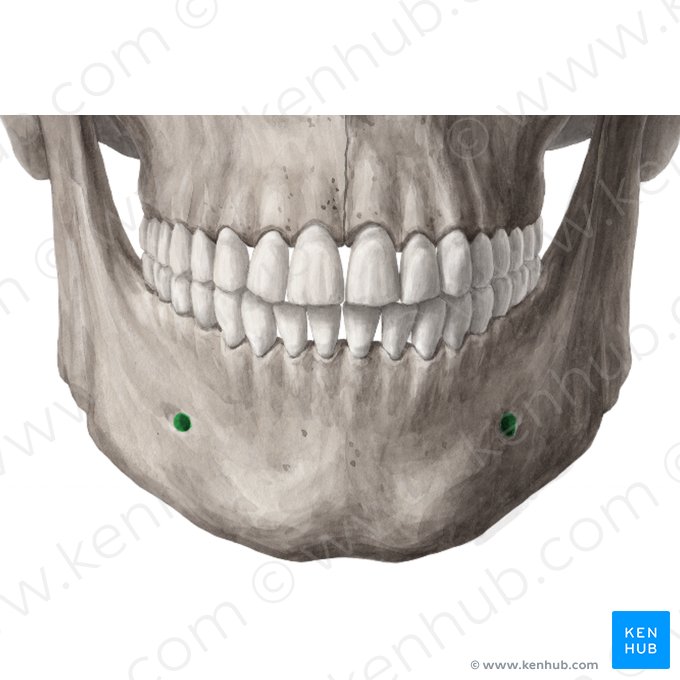
Body of mandible
The horizontal portion of the mandible that forms the lower jaw.

Coronoid process
A projection of the mandible located in front of the condylar process.

Crista galli
A projection of the ethmoid bone that helps anchor the brain meninges.

Sphenoid sinus
An air-filled sinus located deep within the skull in the sphenoid bone.

Horizontal plate of palatine bone
A part of the palatine bone that contributes to the hard palate.

Supraorbital foramen
An opening in the frontal bone above the orbit.

Optic canal
A passageway in the sphenoid bone associated with the orbit.

Glabella
The smooth area of the frontal bone between the eyebrows.

Superior orbital margin
The upper border of the orbit.
Occipital condyle
A rounded projection of the occipital bone that articulates with the first cervical vertebra.

External occipital protuberance
A prominent projection on the posterior surface of the occipital bone.

Foramen magnum
The large opening in the occipital bone through which the spinal cord passes.
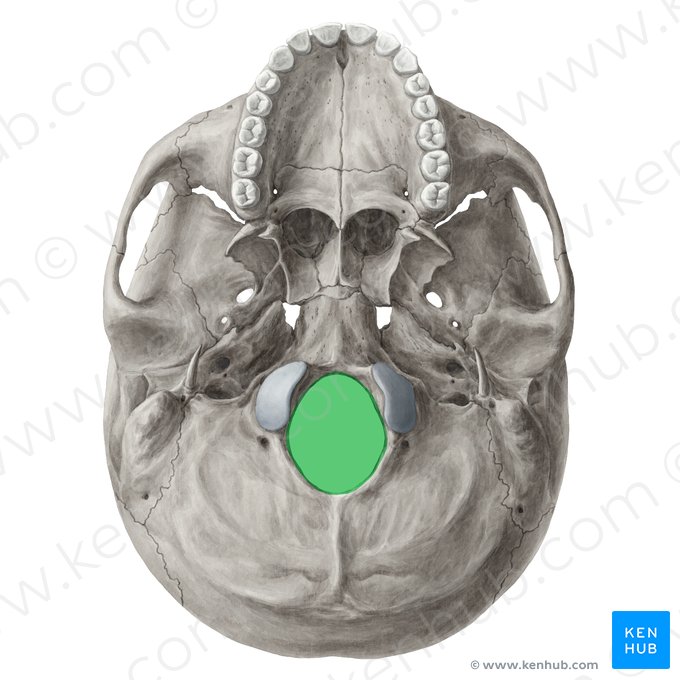
Jugular foramen
An opening in the skull located between the temporal and occipital bones.

Carotid canal
A passageway in the temporal bone associated with the carotid artery.

Foramen ovale
An opening in the sphenoid bone.

Internal acoustic meatus
An opening in the temporal bone on the internal surface of the skull.

Sella turcica
A depression in the sphenoid bone that includes the hypophyseal fossa.

Greater wing of sphenoid
A large wing-like part of the sphenoid bone.

Lesser wing of sphenoid
A smaller wing-like part of the sphenoid bone.

Body of sphenoid
The central part of the sphenoid bone.

Pterygoid plates
Projections extending from the sphenoid bone.

Hyoid bone
A U-shaped bone in the anterior neck between the mandible and larynx that does not directly articulate with another bone.

Greater horn of hyoid
The larger horn-like projection of the hyoid bone.

Lesser horn of hyoid
The smaller horn-like projection of the hyoid bone.
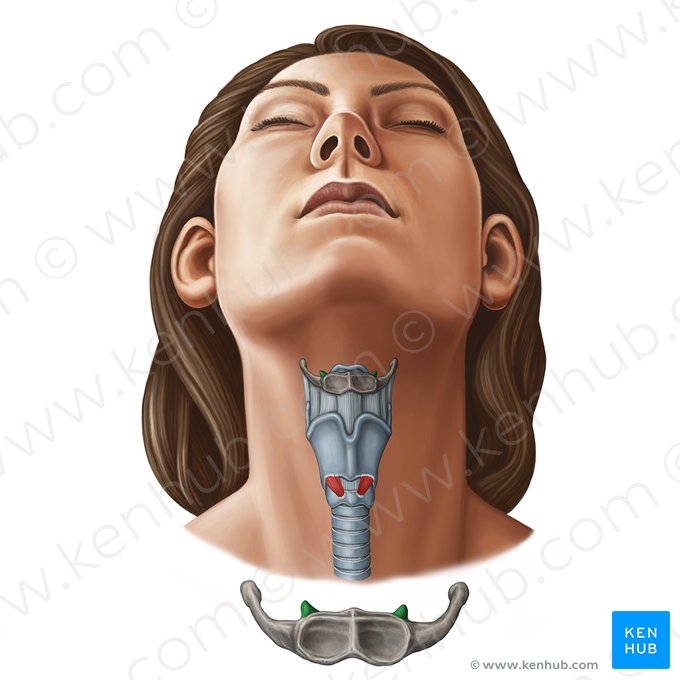
Body of hyoid
The central portion of the hyoid bone.

Frontal sinus
A paranasal sinus located within the frontal bone above the eyebrows.

Maxillary sinus
A paranasal sinus located in the maxilla below the eyes; it is the largest paranasal sinus.
