2A: Perception, Thinking, Problem Solving, Judgments, and Decision-Making
 Call Kai
 Learn
 Practice Test
 Spaced Repetition
 Match
 Flashcards
 Knowt Play
1/45

Earn XP
Description and Tags
STUDY UNIT 1 TOO AND HOW TO WRITE AAQ'S
46 Terms
Difference between sensation and perception
Sensation is the bottom-up process where your sensory organs and receptors detect physical energy from the environment (like light or sound waves) and convert it into neural signals.
Perception is the top-down process where your brain selects, organizes, and interprets those neural signals to give them meaning.
Sensation detects; perception interprets.
Selective attention (3)
Brain's ability to focus conscious awareness on one specific stimulus or task while filtering out other surrounding background information
Selective attention: Cocktail Party effect (1 of 3)
A form of selective auditory attention that lets you focus your attention on a single conversation in a noisy room while filtering out background chatter. Even though you ignore background noise, your brain keeps a low-level monitor active. If a personally meaningful stimulus, like hearing your name, is spoken across the room, it immediately captures your conscious focus.
Selective attention: Inattentional blindness (2 of 3)
Focusing conscious awareness on a particular stimulus or task while filtering out other competing stimuli in the environment, thereby failing to notice a fully visible, unexpected object or event because your attention is directed elsewhere.
Selective attention: Change blindness (3 of 3)
Failure to notice a visual change in an environment because your attention is focused elsewhere or interrupted
Bottom-up processing
The brain builds a complete representation of a stimulus starting from raw sensory input, without relying on prior knowledge, context, or expectation. The physical stimulus itself dictates the outcome rather than what you expect to see or hear.
Top-down processing
The brain uses prior knowledge, expectations, schemas, and context to interpret incoming sensory information, moving from general concepts or the "big picture" down to specific details.
Perceptual set
A mental predisposition or readiness to perceive stimuli in a particular way based on expectations, past experiences, culture, motivation, and context (example: outside on turf field listening to ringtone)
Sociocultural factors on perception
Sociocultural factors on perception refer to how a person's culture, social background, norms, values, and environment shape the way their brain organizes and interprets raw sensory information (top-down processing)
Gestalt Psychology principles (4)
The human brain naturally organizes individual pieces of sensory information into a unified, meaningful "whole" (from the German word Gestalt, meaning "form" or "shape"). The core philosophy states that "the whole is different from (or greater than) the sum of its parts".
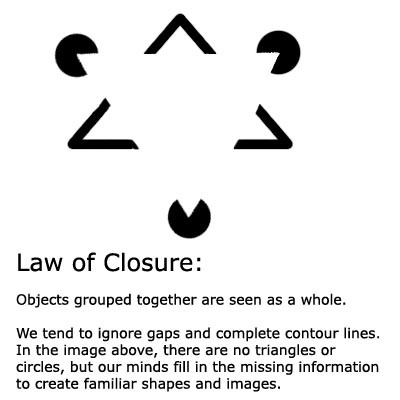
Gestalt Psychology principles: Closure (1 of 4)
Brain's natural tendency to fill in missing information, gaps, or visual breaks to perceive a complete, unified whole rather than a collection of separate fragments

Gestalt Psychology principles: Figure and Ground (2 of 4)
Brain automatically organizes the visual field into a main focus object (figure) and its surroundings (ground).

Gestalt Psychology principles: Proximity (3 of 4)
Brain tends to group objects that are physically close to each other into a single unit or collective group rather than seeing them as isolated individual items
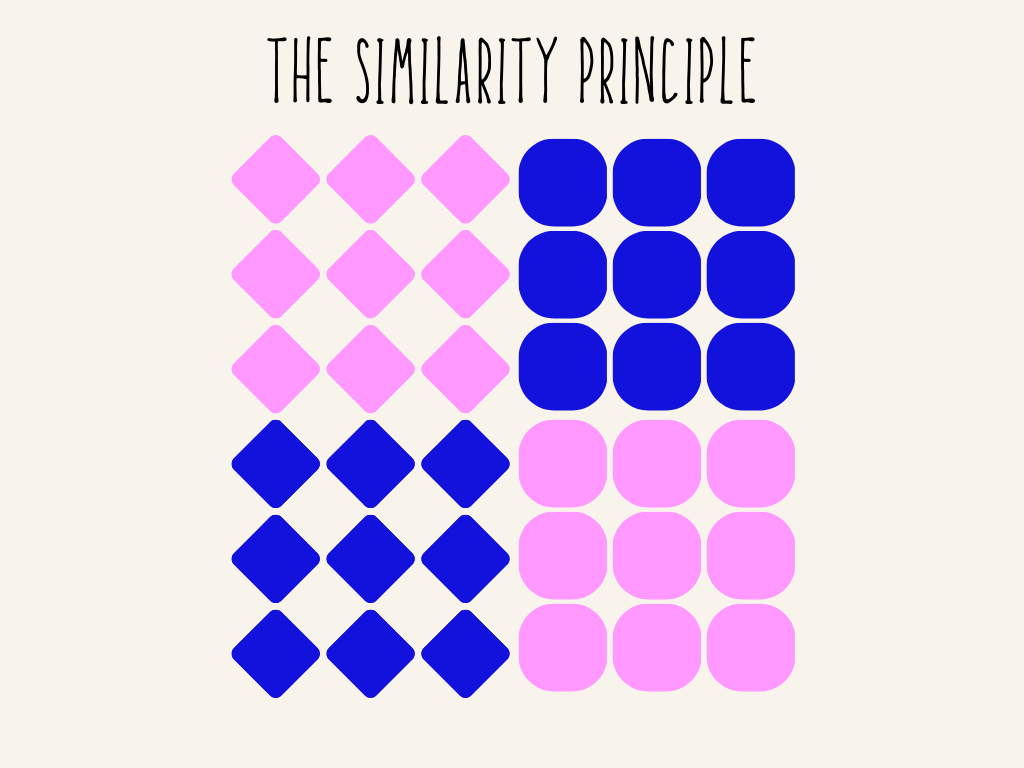
Gestalt Psychology principles: Similarity (4 of 4)
Brain naturally groups together objects that share visual characteristics—such as color, shape, size, texture, or orientation—and perceives them as a unified whole or pattern rather than as isolated items
Depth Perception
Ability to see the world in three dimensions (length, width, and depth) and judge the distances of objects, even though the images striking our retinas are flat and two-dimensional.
Binocular cues (2)
Aepth perception signals that require input from both eyes working together to help the brain judge distance, space, and three-dimensional (3D) relationships.
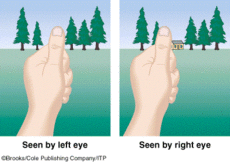
Binocular cues: Retinal disparity (1 of 2)
Brain computes distance by comparing the slightly different images projected onto the two retinas because the eyes are spaced a few inches apart.

Binocular cues: Convergence (2 of 2)
Binocular depth cue where the eyes turn inward toward each other to focus on a nearby object
Monocular cues (5)
Depth cues that can be processed by a single eye to judge distance, depth, and three-dimensional space from a two-dimensional retinal image.

Monocular cues: Relative clarity (1 of 5)
Monocular depth cue where the brain perceives sharper, clearer, and more detailed objects as closer, while hazier, blurrier, or fuzzier objects are perceived as farther away

Monocular cues: Relative size (2 of 5)
If two objects are assumed to be of similar real-world size, the one that casts a smaller retinal image on the eye is perceived as farther away.

Monocular cues: Texture gradient (3 of 5)
Monocular depth cue where a surface's texture appears coarse, sharp, and distinct up close, but gradually becomes finer, denser, smoother, and less distinct as distance increase.

Monocular cues: Linear perspective (4 of 5)
Monocular depth cue where parallel lines appear to converge (come together) as they recede into the distance toward a vanishing point on the horizon.

Monocular cues: Interposition (5 of 5)
Monocular depth cue where one object partially blocks or obscures another object, causing the brain to perceive the blocking object as closer and the blocked (occluded) object as farther away
Perceiving movement (3)
The process by which the brain gathers sensory information from the eyes to interpret when and how objects, or oneself, are moving through space.
Perceiving movement: Motion Parallax (1 of 3)
An observer who is in motion perceives objects that are closer to them as moving faster across their visual field than objects that are farther away. (example: When looking out the window of a moving car or train, nearby objects like a highway median, road signs, or close trees blur past you very quickly, while distant mountains, clouds, or the horizon seem to crawl or move along with you very slowly)
Perceiving movement: Phi Phenomenon (2 of 3)
An optical illusion where the human brain perceives pure, objectless motion between two or more stationary neighboring lights or objects that blink on and off in rapid succession
Perceiving movement: Stroboscopic effect (3 of 3)
A visual illusion in which the perception of continuous motion is generated by a rapid succession of individual, stationary (still) images.
Perceptual constancy
The brain's tendency to perceive familiar objects as having consistent, unchanging properties—such as size, shape, color, and brightness—even when the physical sensory input or image on the retina changes due to shifts in distance, viewing angle, or lighting. (example: the cow black and white pic)
Metacognition
“Thinking about thinking"—the awareness, monitoring, evaluation, and control of your own cognitive and learning processes.
Concept
A mental grouping or category of similar objects, events, ideas, or people (such as grouping dogs, chairs, or honesty) that helps us simplify and make sense of complex information.
Prototypes
A mental image or best example of a specific category (e.g., picturing a robin as your prototype for a "bird" rather than a penguin).
Schema (1)
A mental framework, blueprint, or organized pattern of thought that helps us interpret, categorize, and make sense of the world around us.
Schema: Assimilation/accommodation (1 of 1)
Assimilation: Interpreting and fitting new experiences into an existing schema without changing the schema itself.
Example: A toddler who has a schema for a "dog" sees a cat and calls it a "doggy" because it is a small, furry, four-legged animal.
Accommodation: Modifying an existing schema—or creating an entirely new schema—because new information does not fit what you already know.
Example: The toddler's parent explains that the animal is a cat and meows instead of barks; the toddler then adjusts their understanding to separate cats from dogs into distinct categories.
Algorithm
A methodical, step-by-step procedure or set of rules that guarantees a correct solution to a problem if followed accurately. Because it checks all options, it requires more time and mental effort, making it impractical for quick, everyday decisions.
Heuristics (representativeness, availability)
Mental shortcuts or rules of thumb that allow people to solve problems and make decisions quickly without doing exhaustive statistical analysis.
Representative: a mental shortcut (rule of thumb) used to judge the likelihood of an event, object, or person based on how closely it matches a prototype or stereotype in your mind.
Availability: a mental shortcut (heuristic) in AP Psychology where you judge the likelihood, frequency, or probability of an event based on how easily examples of it come to your mind.
Base-rate fallacy
A cognitive error where people ignore general statistical information (the "base rate" or prior probability) and instead focus too much on specific, individual, or dramatic details about a particular case.
Mental set
The tendency to approach a new problem using a problem-solving strategy or method that has been successful in the past, even when that approach may not be the best or most efficient fit for the current situation.
Priming
A phenomenon where exposure to one stimulus unconsciously influences how you respond to a subsequent, related stimulus. It operates through implicit memory (nondeclarative memory) and the activation of associative networks in the brain.
Framing
The way an issue, question, or piece of information is presented or structured, which can significantly influence people's decisions, judgments, and interpretations.
Sunk-cost fallacy
A cognitive bias where a person continues an endeavor, project, or relationship simply because they have already invested non-recoverable time, money, or effort into it—even when quitting or changing course is the more logical and beneficial choice.
Gambler’s fallacy
The mistaken cognitive belief that past random, independent events can influence or change the probability of future independent outcomes.
Overconfidence
The cognitive bias where a person's subjective confidence in their knowledge, judgments, or abilities is greater than their objective, actual accuracy.
Hindsight bias
The tendency to believe, after learning an outcome, that one would have foreseen or predicted it all along. It is commonly known as the "I-knew-it-all-along" phenomenon.
Divergent vs convergent thinking (1)
Convergent thinking and divergent thinking represent two opposing cognitive styles used to process information and solve problem.
Convergent thinking: A structured, logical cognitive process that narrows down multiple options or information sources to arrive at a single, correct, or best solution.
Divergent thinking: A spontaneous, free-flowing cognitive process that explores many different ideas, possibilities, or creative solutions to an open-ended problem.
Divergent vs convergent thinking: Functional fixedness (1 of 1)
A cognitive bias and barrier to problem-solving where you perceive an object solely by its usual or traditional purpose, making it hard to see alternative uses. (thinking outside of the box)