Campbell Biology flashcards
 Call Kai
 Learn
 Practice Test
 Spaced Repetition
 Match
 Flashcards
 Knowt Play
1/30

Earn XP
31 Terms
What is the equation for PH level?
The equation for pH level is given by pH=−log[H+], where [H+] represents the hydrogen ion concentration in moles per liter.
In any aqueous solution at 25 degrees, what is the product of H+ and OH-
The product of [H+] and [OH−] in any aqueous solution at 25 degrees Celsius is 1.0×10⁻¹⁴.
Measurements show that the pH of a particular lake is 4.0.
What is the hydrogen ion concentration of the lake?
(A) 4.0 M
(B) 10^-10 M
(C) 10^-4 M
(D) 10^4 M
The hydrogen ion concentration of the lake can be calculated using the pH equation. At pH 4.0, the concentration is [H+]=10−4 M. (C)
What is the hydroxide ion concentration of the lake described in
question 3?
(A) 10-^10 M
(B) 10^-4 M
(C) 10^-7 M
(D) 10.0 M
The hydroxide ion concentration can be calculated using the ion product of water. At a pH of 4.0, the hydroxide ion concentration is [OH−]=1.0×10⁻¹⁰ M. (A)
What is the specific heat of water?
One calorie to raise one gram of water by one degree Celsius?
A slice of pizza has 500 kcal. If we could burn the pizza and use
all the heat to warm a 50-L container of cold water, what would
be the approximate increase in the temperature of the water?
(Note: A liter of cold water weighs about 1 kg.)
(A) 50°C
(B) 5°C
(C) 100°C
(D) 10°C
The increase in temperature can be calculated using the specific heat capacity of water, which is approximately 4.18kJ/(kg°C). Burning 500 kcal converts to 2092kJ, leading to an approximate increase of 10°C in the temperature of the water.
What is the unit of calorie?
Calorie is how much heat it takes to raise 1g of water by one degree C
What is a kilocalorie?
Same as 1,000 cals, the heat needed to raise a kilogram of water by one degree C.
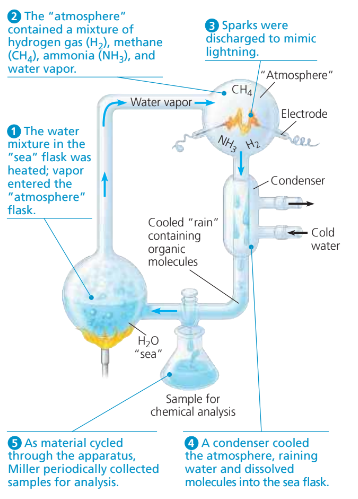
Stanley MIller
A scientist known for conducting the Miller-Urey experiment, which simulated early Earth conditions to demonstrate the abiotic synthesis of organic compounds, considered a key step in the origin of life. In 1953, Stanley Miller set up a closed system to mimic conditions thought at that time to have existed on the early Earth. A flask of water simulated the primeval sea. The water was heated so that some vaporized and moved into a second, higher flask containing the “atmosphere”—a mixture of gases. Sparks were discharged in the synthetic atmosphere to mimic lightning.
Avogadro’s number is…
6.022 x 10^23 (Which is the approximate number of elementary particles, atoms, ions, and molecules in a sample. So a mole of water and a mole of carbon may not weigh the same, but they have Avogadro’s exact number of elementary particles.)
Jeffery Bada
Discovered H2S in Stanley Millers’ original experiment. H2S made it so that the experiment replicated early life on Earth near a volcano.
Hydrocarbons
Molecules made up of solely carbon and hydrogen. Not important to life. Can be used for fatty acids in the body.
Isomers
A compound with the same atoms from the same element, but with different structures, and hence, different properties.
Structural Isomers…
Must have the same compound formula, but differ in the carbon skeleton.
What are Huckel’s four rules?
For an aromatic molecule, you must:
-Be cyclic/ a fully closed circle
-Planar, meaning have a flat ring because the p orbitals must be perpendicular to the rings
-Must be fully conjugated meaning every atom in the ring must have one hybridized p-orbital
-Must work with the 4n+2=# of elections in the pi ring
N must be an positive integer (e.g. 1, 2, 3, 4, 5, 6)

( OPOsubscript3²–)
Phosphate Group

(-SH)
Sulfhydryl group

-OH
Hydroxyl Group

-NH subscript 2
Amino group
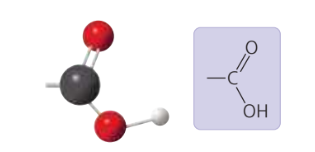
(-COOH )
Carboxyl group

c=o
Carbonyl group

-CHsubcript3
Methyl group
Alkanes
Hydrocarbons, very non-polar and don’t mix with water because of how non-polar they are. CnH2n+2, (By the way the n is number of atoms)
4 main important classes of monomers
Carbohydrates, Proteins, Nucleic acids, Lipids.
Condensation reaction
Monomer covalently bonded but loses a molecule in the process
Dehydration reaction
A condensation reaction w/ the loss of H2O
Hydrolysis
Polymers disassembled to monomers= hydrolysis, breaks bond w/ H2O
Why do enzymes help in the chemical reactions of building/breaking polymers? What does this have to do with the body?
Enzymes attack polymers that enter the body. Ex. you eat a fish. The polymers enter your body, and enzymes attack it, breaking it into monomers. Then, they travel via your bloodstream, and build themselves into new polymers.
Monosaccharides
Some multiple of CH2O, ex. Glucose is C6H12O6. They always have a carbonyl group.
Knowing maltose is the result of a dehydration reaction between two glucoses, what would the chem formula for maltose be? Hint, glucose is C6H12O6
C₁₂H₂₂O₁₁
All monosaccharides are some multiple of what?
CH2O