M7 Flashman- Protein regulation by small post-translational modifications
 Call Kai
 Learn
 Practice Test
 Spaced Repetition
 Match
 Flashcards
 Knowt Play
1/7

There's no tags or description
Looks like no tags are added yet.
8 Terms
what are the 3 types of small regulatory post-translational modification?
all small, covalent modifications
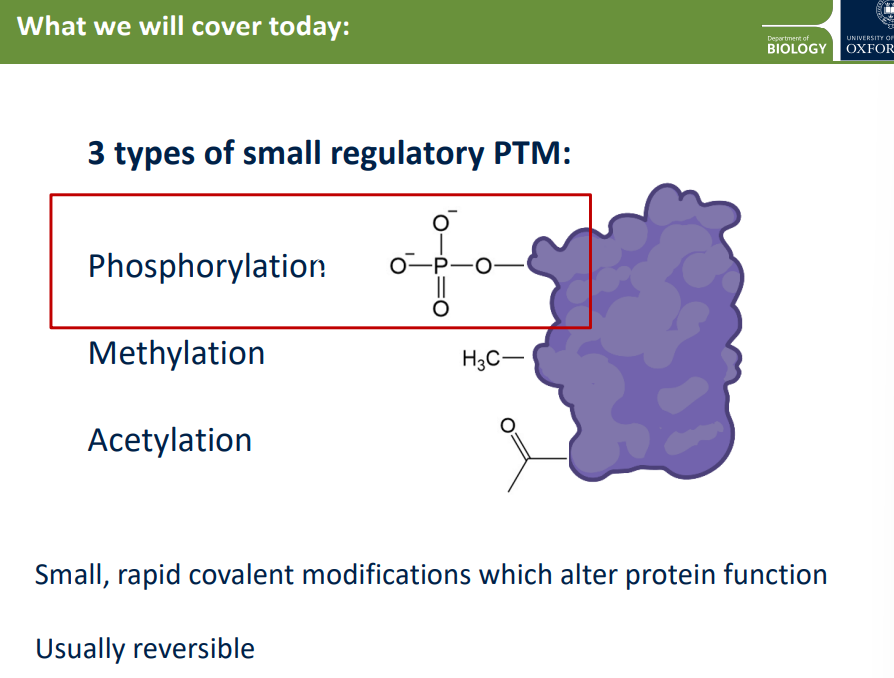
how do phosphorylation PTMs affect protein function?
phosphorylation is the addition of a negative PO42- group, so it causes a radical change in charge, altering the conformation/interactions
the phosphate addition comes from ATP, and is catalysed by target-specific kinases (eg. protein kinase A) → most kinases are themselves regulated by phosphorylation and regulatory subunits
the common targets are polar amino acids (OH group in side chain), particularly serine but also threonine/tyrosine → this forms O-phosphates
can also form N-, A-, and S- phosphates on basic, acidic and cysteine residues respectively→ this is not as common and harder to detect, due to being less stable bonds
hydrolysis of phosphates is catalysed by general/specific phosphatase enzymes
what is the role and function of protein kinase A?
protein kinase A (PKA) phosphorylates…
made up of the N lobe and the C lobe → ATP binds…
this has many functions depending on the cellular context, eg. promoting glycogen → glucose in the adrenaline-mediated fight or flight response
this requires PKA activation → adrenaline binds a G-coupled receptor, which converts GDP to GTP, binds to adenylate cyclase to convert ATP into cAMP, which binds to and removes the regulatory subunit of PKA, which can then be activated by PDK1 phosphorylation
conversely, PKA must be inactivated → phosphatase dephosphorylated PKA, and the cAMP is hydrolysed to permit regulatory subunit binding
how are kinase used to fight pathogens in plants?
tomato leaf spot disease bacteria is detected by flagellin recognition by receptor kinase on cell membrane
this has an internal kinase domain which gets activated
this triggers a cascade, resulting in CDK activation to trigger an oxidative burst, and TF phosphorylation to cause transcriptional reprogramming
bacteria have in turn adapted to this PTI by releasing effectors that inhibit/ubiquitinate/degrade/inactivate kinases in the ‘kinase battlefield’/arms race
how do methylation PTMs affect protein function?
catalysed by methyltransferase enzymes to cause covalent modification with methyl groups
these increase hydrophobicity
O-methylation is removed by hydrolysis, while N-methylation is removed by reduction → by different demethylase enzymes
the methyl groups come from S-adenosylmethionine (SAM)
this can occur on the side chains, N-, or C-termini, on acidic and basic residues
what is the role and function of SET9?
SET9 methylates a lysine in p53, a transcription factor that regulates the cell cycle, apoptosis and DNA repair (p53 is mutated in 50% of cancers)
how do acetylation PTMs affect protein function?
acetyl groups are added by acetyltransferases using acetyl CoA (→ CoA) this removes the positive charge on NH3+
this can either be general (at the N-terminus, very common and not removed) or regulatory (at lysine residues)
N- terminal acetylation has diverse functions in protein folding, interactions, subcellular localisation and protein stability/turnover
lysine acetylation is involved in regulating transcription and histone structure, as well as in maintaining tubulin stability and resistance to breaking
removed by deacetylases