RChT_Organic Chemistry
 Call Kai
 Learn
Learn Practice Test
 Spaced Repetition
 Match
Match Flashcards
 Knowt Play
1/49

There's no tags or description
Looks like no tags are added yet.
Name | Mastery | Learn | Test | Matching | Spaced | Call with Kai | Chat |
|---|
No analytics yet
Send a link to your students to track their progress
50 Terms
What is the bond angle and molecular geometry around a carbon atom with four single bonds?
A. 120º, tetrahedral
B. 109.5º, tetrahedral
C. 120º, planar
D. 109.5º, planar
B. 109.5º, tetrahedral
What is the hybridization of the central atom in NH3?
A. sp3
B. sp2
C. sp
D. not applicable
A. sp3
Which of the following compounds below has the shortest CN bond length?
A. ethanamine
B. acetamide
C. benzonitrile
D. benzyl amine
C. benzonitrile

What is the correct molecular formula for the hydrocarbon given below?
A. C7H8
B. C7H14
C. C8H14
D. C8H12
C. C8H14

What is the name for the alkane given below?
A. 2-isopropyI-3-butylpentane
B. 2-isopropyl-3-ethylheptane
C. 4-ethyl-2,3-dimethyloctane
D. 5-ethyl-6,7-dimethyloctane
C. 4-ethyl-2,3-dimethyloctane
How many constitutional isomers are possible for the molecular formula C5H12?
A. 1
B. 2
C. 3
D. 4
C. 3
Given the molecular formula C4H10O, it could possibly be a/an
A. phenol or ether
B. ether or ester
C. carboxylic acid or ester
D. alcohol or ether
D. alcohol or ether
Which of the following is TRUE for an optically active compound?
A. The molecular configuration is chiral.
B. The molecular configuration is achiral.
C. The compound is a racemic mixture of enantiomers.
D. The molecular configuration must have two or more stereogenic centers.
A. The molecular configuration is chiral.
Which of these may be separated by ordinary physical methods?
A. (R)-2-bromobutane and (S)-2-bromobutane
B. (R)-3-bromo-1-butene and (S)-3-bromo-1-butene
C. cis-2-bromo-2-butene and trans-2-bromo-2-butene
D. (2R,3S)-1,2-dibromobutane and (2S,3R)-1,2-dibromobutane
C. cis-2-bromo-2-butene and trans-2-bromo-2-butene
(R)-2-bromobutane and (S)-2-bromobutane: These are non-superimposable mirror images of each other, making them enantiomers.
(R)-3-bromo-1-butene and (S)-3-bromo-1-butene: These are also exact mirror images, meaning they are enantiomers.
(2R,3S)... and (2S,3R)... : Because every stereocenter is exactly inverted (R becomes S, and S becomes R), these represent enantiomers (or identical meso compounds, depending on the exact molecular symmetry).
cis-2-bromo-2-butene and trans-2-bromo-2-butene: These are diastereomers. They are not mirror images. The cis isomer has the bulky groups on the same side of the double bond, creating a polar molecule with a net dipole moment. The trans isomer has them on opposite sides, canceling out much of the polarity.
In this type of reaction, one sigma bond breaks and another forms at the same carbon atom.
A. addition
B. elimination
C. substitution
D. rearrangement
C. substitution
The hydrocarbon having the lowest boiling point is ____.
A. CH4
B. C2H4
C. C4H10
D. C6H6
A. CH4
Compared to ionic compounds of similar molar mass, hydrocarbons typically have
I. Higher water solubility
II. Higher melting points
A. I only
B. II only
C. both I and II
D. neither I nor II
D. neither I nor II
Alkanes react with halogens via
A. free radical substitution
B. electrophilic substitution
C. electrophilic addition
D. nucleophilic addition
A. free radical substitution
Alkenes and alkynes, because they contain 𝜋 bonds, undergo this type of reaction.
A. Electrophilic addition
B. Nucleophilic addition
C. Electrophilic substitution
D. Nucleophilic substitution
A. Electrophilic addition
Alkenes and alkynes have pi bonds, which create an exposed region of high electron density. This electron-rich area naturally attracts electrophiles (electron-poor species). When they react, the weak pi bond breaks to form new single bonds, adding the incoming atoms directly to the molecule rather than substituting existing ones.
Which of the following reactions can reduce an alkene yielding an alkane?
A. oxidation
B. bromination
C. hydrogenation
D. polymerization
C. hydrogenation
Which of the following is produced from addition of Cl2 to 1 butene?
A. CH3CH2CCl2CH3
B. CH3CH2CH2CHCl2
C. CH3CH2CHClCH2Cl
D. ClCH2CH2CH2CH2Cl
C. CH3CH2CHClCH2Cl

Which of the following reagents can perform the reaction below?
A. Br2, H2O
B. Br2, CH2Cl2
C. O3, (CH3)2S
D. KMnO4, H3O+
C. O3, (CH3)2S
All of the following reactions convert alkenes to alcohols EXCEPT
A. halohydrin formation
B. addition polymerization
C. hydroboration-oxidation
D. oxymercuration-demercuration
B. addition polymerization
Which of the following is produced when calcium carbide reacts with water?
A. methane
B. benzene
C. ethylene
D. acetylene
D. acetylene
All of the following hydrocarbons will readily react with bromine EXCEPT
A. hexane
B. ethylene
C. acetylene
D. cyclohexene
A. hexane
Among the ortho, meta and para isomers of xylene, which has the highest boiling point?
A. o-xylene
B. m-xylene
C. p-xylene
D. all have same bp
A. o-xylene
the two methyl groups are adjacent, creating an asymmetrical electron distribution that gives the molecule a small net dipole moment. This slight polarity creates stronger dipole-dipole interactions between the liquid molecules, requiring more thermal energy to boil
Aromatic compounds undergo substitution reactions instead of addition reactions because
A. the benzene ring is electron rich.
B. the hydrogens of benzene are relatively loosely bound.
C. the benzene ring is sterically crowded hence only substitution can occur.
D. the integrity of the benzene ring and the stable aromatic π system remains intact.
D. the integrity of the benzene ring and the stable aromatic π system remains intact.
Which of the following substituents is NOT an ortho, para director in an EAS reaction?
A. −Cl
B. −OH
C. −NO2
D. −CH3
C. −NO2
AlCl3 is a catalyst used in the alkylation and acylation of aromatic compounds. It is a/an
A. Arrhenius acid
B. Brønsted-Lowry acid
C. Lewis acid
D. Lewis base
C. Lewis acid
aluminum chloride (AlCl3) acts as an electron-pair acceptor during these reactions.
What is the product from the Friedel-Crafts alkylation of nitrobenzene?
A. ortho-nitrotoluene
B. meta-nitrotoluene
C. para-nitrotoluene
D. ortho-nitrotoluene and para-nitrotoluene
B. meta-nitrotoluene

Freon is an example of a/an
A. hydrocarbon
B. alkyl halide
C. alcohol
D. aldehyde
B. alkyl halide
What is the role of hydroxide ion in the reaction below? CH3CH2CH2CH2Br + OH-→ CH3CH2CH2CH2OH + Br
A. Lewis acid
B. Electrophile
C. Nucleophile
D. Oxidizing agent
C. Nucleophile

Which mechanism will the given reaction occur?
A. SN1
B. SN2
C. E1
D. E2
B. SN2
Which chloroalkane undergoes substitution with OH- exclusively by an SN1 mechanism?
A. (CH3)3CCl
B. (CH3)2CHCH2Cl
C. CH3CH2CHClCH3
D. CH3CH2CH2CH2Cl
A. (CH3)3CCl
Which reagent would be best for achieving an E2 elimination of 3-chloropentane?
A. NaI
B. NaHCO3
C. NaOC2H5
D. NaCH3COO
C. NaOC2H5
NaI is sodium iodide. The iodide ion is an excellent nucleophile but a very weak base, meaning it strongly favors SN2 substitution rather than elimination.
NaHCO3 is sodium bicarbonate (commonly known as baking soda). It is a weak base and is not strong enough to drive an E2 reaction.
NaOC2H5 is sodium ethoxide. The ethoxide ion is a strong base and a strong nucleophile, making it the classic textbook reagent for promoting E2 eliminations.
NaCH3COO is sodium acetate. The acetate ion is heavily resonance-stabilized, making it a weak base that is insufficient for E2.
Among the following group of compounds, which will have the highest boiling point?
A. alkenes
B. alkynes
C. alcohols
D. haloalkanes
C. alcohols
Alkenes and Alkynes: Nonpolar compounds that rely entirely on weak London dispersion forces (lowest boiling points).
Haloalkanes: Polar compounds held together by stronger dipole-dipole interactions.
Alcohols: Possess a hydroxyl (-OH) group, allowing them to form strong intermolecular hydrogen bonds. This is the strongest intermolecular force among the choices, requiring the most thermal energy to separate the molecules in the liquid phase.
An industrial source of alcohol.
A. coal
B. fats
C. sugar
D. ether
C. sugar
Which of the following will react faster with HBr?
A. 1-butanol
B. 2-butanol
C. 2-methyl-1-propanol
D. 2-methyl-2-propanol
D. 2-methyl-2-propanol
fastest because it is a tertiary (3*) alcohol, which allows the reaction to proceed via an SN1 mechanism by forming a highly stable tertiary carbocation intermediate.
Dehydration of an alcohol yields a/an ______.
A. alkene
B. alkyne
C. aldehyde
D. ketone
A. alkene

What is produced when a primary alcohol reacts with the reagent given below?
A. ketone
B. acetaldehyde
C. carboxylic acid
D. carbon dioxide
B. acetaldehyde
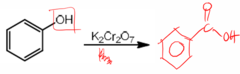
What is the product of the reaction of benzyl alcohol with KMnO4/H3O+?
A. benzoic acid
B. benzaldehyde
C. benzyl chloride
D. benzophenone
A. benzoic acid
Which of the following will be oxidized by Tollens reagent (ammoniacal AgNO3)?
A. ethanol
B. 2-butanol
C. tert-butanol
D. phenol
D. phenol
phenol’s can cause false positive for tollens test even if it is for aldehydes only
Which of the following can react with NaOH?
A. phenol
B. ethanol
C. ethylene
D. diethyl ether
A. phenol
Which of the following reactions is specific for phenols?
A. reaction with FeCl3
B. reaction with KMnO4
C. reaction with Jones reagent
D. reaction with Lucas reagent
A. reaction with FeCl3
FeCl3 used for colorimetric test used specifically to detect the presence of phenols and enols.
Ethers undergo which of the following reactions?
A. oxidation
B. substitution
C. rearrrangement
D. acid-base reaction
B. substitution
Which of the following is arranged in order of increasing boiling point?
A. 2-methylbutane < n-pentane < butanone < butanol
B. n-pentane < 2-methylbutane < butanone < butanol
C. 2-methylbutane < n-pentane < butanol < butanone
D. n-pentane < 2-methylbutane < butanol < butanone
A. 2-methylbutane < n-pentane < butanone < butanol
Methanal is used as
A. fuel
B. antiseptic
C. preservative
D. refrigerant
C. preservative
The simplest ketone is
A. acetone
B. lactone
C. cyclohexanone
D. ethyl methyl ketone
A. acetone

Carbonyl compounds undergo this type of reaction.
A. Electrophilic addition
B. Nucleophilic addition
C. Electrophilic substitution
D. Nucleophilic substitution
B. Nucleophilic addition
example of carbonyl compounds are aldehydes and ketones
Ketones react with LiAlH4 to form
A. phenols
B. primary alcohols
C. secondary alcohols
D. tertiary alcohols
C. secondary alcohols
Which of the following will have the highest boiling point?
A. butane (58 g/mol)
B. propanal (58 g/mol)
C. 1-butanol (60 g/mol)
D. acetic acid (60 g/mol)
D. acetic acid (60 g/mol)
Butane: Relies only on weak London dispersion forces (lowest boiling point).
Propanal: Polar, allowing for stronger dipole-dipole interactions.
1-butanol (60 g/mol): wrong this is 1-propanol
Acetic acid: Carboxylic acids can form highly stable, double-hydrogen-bonded dimers. This allows two acetic acid molecules to tightly lock together in the liquid phase, requiring the most thermal energy to separate.
Carboxylic acids are more acidic than alcohols because
A. of the increased polarity of the O-H bond due to the carbonyl group.
B. of the stability of the carboxylate anion formed upon ionization.
C. of the higher Ka value.
D. All of the above.
D. All of the above.
What is formed when an alcohol reacts with a carboxylic acid in the presence of an acid catalyst?
A. anhydride
B. acid chloride
C. ester
D. ether
C. ester

