BIO EXAM: Second Lecture!
 Call Kai
 Learn
Learn Practice Test
 Spaced Repetition
 Match
Match Flashcards
 Knowt Play
1/36

There's no tags or description
Looks like no tags are added yet.
Name | Mastery | Learn | Test | Matching | Spaced | Call with Kai | Chat |
|---|
No analytics yet
Send a link to your students to track their progress
37 Terms
Mattias Schleiden- German botanist
All plants are aggregates of fully individualized, independent,
separate beings, namely the cells themselves
Theodor Schwann, German physiologist
All animal tissues also consist of individual cells
Cell Theory 1
All organisms are composed of one or more cells, and the
life processes of metabolism and heredity occur within
these cells
Cell Theory 2
Cells are the smallest living things, the basic units of
organization of all organisms
Cell Theory 3
Cells arise only from pre-existing cells
Is the statement? “although life likely evolved spontaneously in the environment
of early earth” True?
All cells today represent a continuous line of descent from the
first living cells
Why are most cells relatively small?
Diffusion of substances in and out of cells
Rate of diffusion is affected by
Surface area available, Temperature, Concentration gradient, Distance

IMPORTANT: Why all cells are inevitably small?
Surface area grows by the square, and volume grows by the cube. Surface Area-to-Volume ratio actually decreases.

Surface Area-to-Volume ratio actually decreases.
Is it better to have an organism made of many small cells or an organism composed of fewer, larger cells(Think of wrinkles in the brain)
Organism made of small cells
As a cell’s size increases: Does the volume increase more rapidly or the surface
The volume increases much more rapidly
How do some cells overcome being too large
Some cells overcome limitation by being long and narrow
– like neurons
What cell plays a key role in controlling cell function
Membrane
Resolution
minimum distance two points can be apart and still be distinguished as two separate points
Most cells are less than what size in diameter
50 μm
Objects must be what length apart for naked eye to resolve them
as two objects rather than one
100 μm
Light microscopes
Resolve structures that are 200 nm apart
Electron microscopes
Resolve structures that are 0.2 nm apart
TEM
(Transmission electron microscopes) transmit
electrons through the material
SEM
(Scanning electron microscopes) beam electrons
onto the specimen surface

Is this SEM or TEM
TEM

Is this SEM or TEM
SEM

SEM image of poly grains

Drosophila’s image of eye

SEM image of blood cells

TEM image of Golgi complex

TEM image of mitochondria
Basic Structural Similarities of All cells
(Prokaryote and Eukaryote)
Nucleoid or nucleus where DNA is located, cytoplasm, ribosomes, and plasma membrane
Cytoplasm
Semifluid matrix of organelles and cytosol
Ribosomes
Synthesize proteins
Plasma membrane
Phospholipid bilayer

Cell

Mitochondria

Golgi apparatus

Endoplasmic reticulum
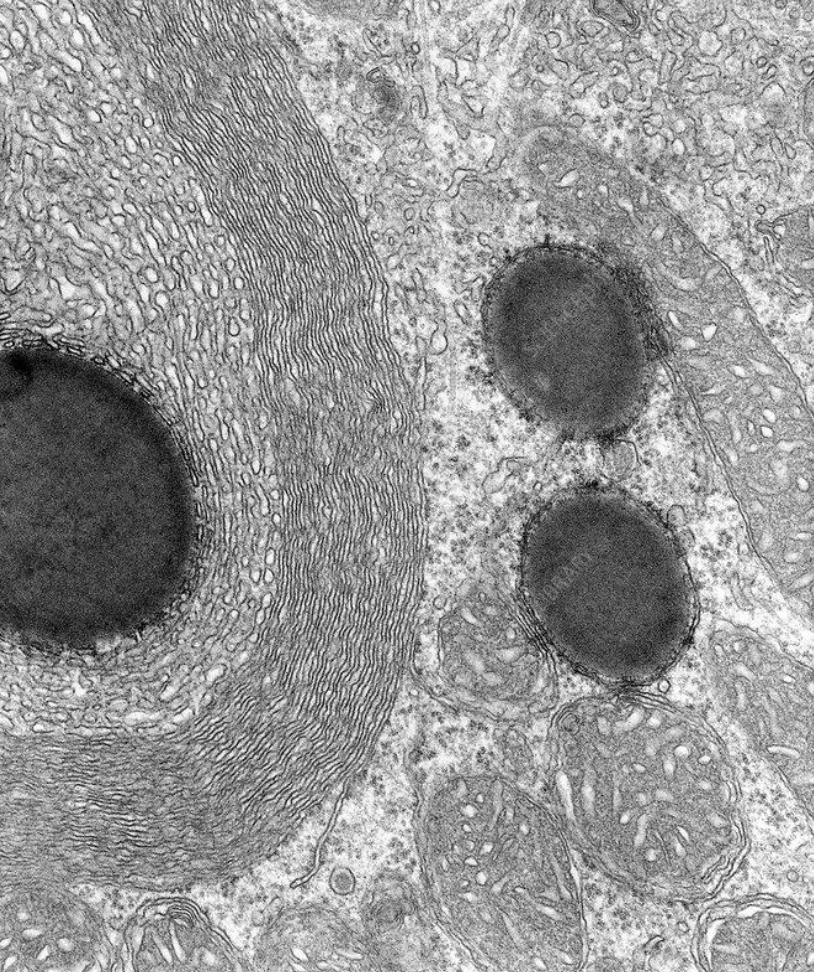
Smooth ER: thin lines inside a cell that is
synthesising steroid hormones & Nearby lipid droplets (dark
circles) supply the cholesterol needed for the biosynthesis of steroids