Quiz 2: The Product Life Cycle, Segementation and Target Markets
 Call Kai
 Learn
 Practice Test
 Spaced Repetition
 Match
 Flashcards
 Knowt Play
1/74

There's no tags or description
Looks like no tags are added yet.
75 Terms
What is the product life cycle?
Stages that a product goes through , starting with it’s launch to eventual decline.
What are the 4 stages of the product life cycle?
Intro, Growth, Maturity and Decline
What are the characteristics of the introduction stage in the PLC?
Few competitors; marketing objective: awareness; focus is on new product; use skimming or prenetration strategy; limited distro; minimal profits
What are the characteristics of the growth stage in the PLC?
More competitors; product differentiation; intro of more featrures; prices are slowly reduced; distribution is increased; emphasized points of differentiation vs competitors; increased profits that reach max.
What are the characteristics of the marturity stage in the PLC?
Many competitors; brand loyalty; full product line and innovation; price discounts frequently; full distro; pricing and sales promo; maximized profits that level off
What are the characteristics of the decline stage in the PLC?
Reduced competition - some leave market; product rationalization; retaining only best sellers or discontinue; very low prices; distro is reduced; minimal promo; decreasing and minimal profits
During the introduction stage of the PLC, what are profits low?
Typically due to slow sales growth, high product dev costs and high levels of marketing needed to launch a new product.
What is Price Skimming?
a marketing strategy where the initial launching price of a product is high.
Why do maketors employ the strategy of Price Skimming?
To recover research and development costs for launching a new product.
What is penetration pricing?
When a company uses low prices to enter a market.
Why would a company use penetration pricing?
Encourages rapid acceptance of an innovation or combat competitors.
What are the alternate product life cycles?
High learning, low learning, fashion products and fad products
What is a high learning and low learning product?
High learning: extended intro period due to significant efforts required to educate customers on use and benefits; Low learning: short intro stage as benefits are self evident
What are the characteristics of the PLC for fashion products?
Cyclical life cycles; goes from intro to decline within a 2-3 year period then resurfaces years later
What are the characteristics of the PLC for fad products?
Short lifecycle; rapid growth followed by rapid decline; no maturity stage
How do companies extend the PLC
Modifying the product; line extensions; modifying the market; repositioning a product or introducing a new product.
How do companies modify the product to extend the PLC
Product improvements and line extensions
How do companies modify the product market to extend the PLC?
Finding new customers; increasing product’s use and creating a new use case
Repositioning a product
A way to extend the PLC once a product reaches its maturity stage which often includes an injection of newness to give the product renewed competitive advantage.
Introducing a new product
Adding a new product to a line to bring a mature product back to the growth or early maturity stage.
What are the types of new products?
Minor innovation; continuous innovation and radical innovation
What are the characteristics of new products?
Minor: requires no new learning by consumers; goals: wide distro and consumer awareness; continuous innovation: changes consumers’ normal routine but ddoes not require new learning, goals: differentiation; radical innovation: requires new learning and consumption patters; goals: educate consumers via adverts, product trials and personal selling, PR
What are the types of consumers?
Innovators, Early adopters, early majority, late majority and laggards
What is the adoption curve?
The sequential diffusion and acceptance of an innovation into the market by consumers.
Why do new products and services fail?
Insignificant point of difference; incomplete new concept definition; insufficent market attractiveness; poor execution of the marketing mix; poor timing
Steps in the new product dev process
New product dev strategy, idea generation, screening and eval, business analysis, development, test marketing and commercialization
What are the purposes of the first stage in the new product development process?
New product dev strategy: identify new product dev focus that meets company objectives
What are the purposes of the second stage in the new product development process?
Idea generation: brainstorm
What are the purposes of the third stage in the new product development process?
Screening and Eval: evaluate product ideas and dev concepts
What are the purposes of the fourth stage in the new product development process?
Business analysis: identify the product’s features and marketing strategy; products key features and marketing mix; production, legal and profitabillity; market share projections, price points, costs, etc
What are the purposes of the fifth stage in the new product development process?
Development: create prototype to test internaly and externally
What are the purposes of the sixth stage in the new product development process?
Test marketing: Test the product and marketing strategy in the marketplace on a limited scale
What are the purposes of the eighth stage in the new product development process?
Commercialization: implement all areas of the marketing mix, regional rollout
What is segment marketing?
Marketing a wide rangle of different products to meet the needs of a org’s varied target markets. Involves aggregating prospective buyers into groups that have common needs and respond similarly to marketing programs.
What are the two types of market segments?
consumer and business
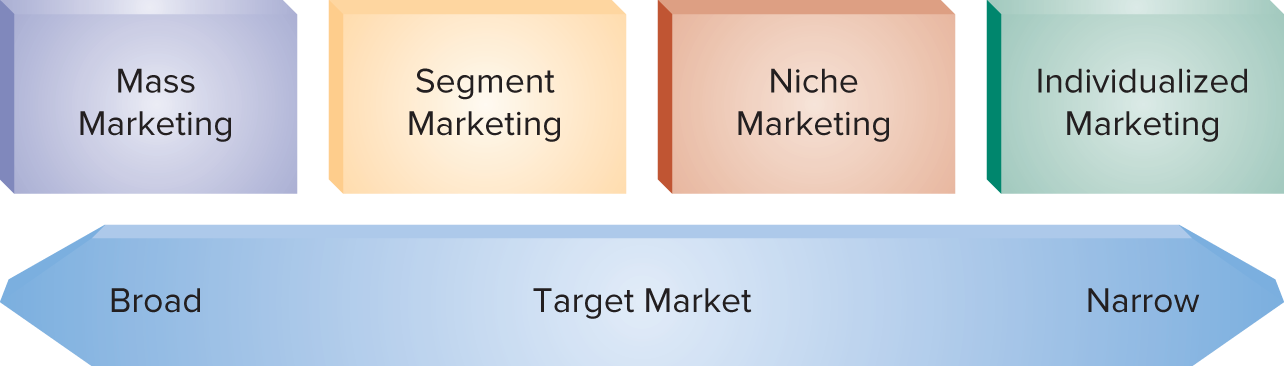
What are the four forms of market segmentation
Mass marketing, segment marketing, niche marketing, individualized marketing
What is a target market?
Group or segment of existing or potential consumers to which marketers direct their marketing efforts
What is a target market profile?
A description of the target market that contains specific info about the target group in 4 areas: geographics, psychographics, behaviouristics and demographics
What are geographics?
Where the target market lives
What are demographics?
Gender, marital status, income, occupation education - what is the basic census type info on the target market as a whole
What are psychographics?
Prevailing attitudes, beliefs, values, habits and approaches to life of the target market
What are behaviouristics?
How the target market engages and interacts with the product
What is a persona?
Character descriptions of a brand’s typical customers. Fictional character narratives to capture tarket consumer
What does a well defined persona include?
Gender, age, interests, hobbies, education, goals, jobs, influencers, media usage, technology preferences, fears, concerns, drivers, delights and interactions with a brand. “Day in the life of”.
What are the steps in market segmentation?
Indentify consumer needs and characteristics in each market; cluster common customer variables to create meaningful segments; estimate size and feasibility; identify the segments to be targeted; take actions w/ marketing programs; monitor and evaluate success
What is product positioning?
The impression of a branded product you want to establish in consumers’ minds relative to their needs and also in contrast to the competition
What are the 3 factors of product positioning?
(1) imagine (2) product attibute (3) price
What is a positioning statement?
Formalized statement that identifies the image a branded product represents
What are the characteristics of positioning statements?
(1) the target market and need (2) the branded product name (3) the category in which the product competes (4) the brand’s unique attributes and benefits
What is repositioning?
Strategy when brands need a refresh due to changing attitudes and perspectives.A resource-intensive process requiring changes to at least one element of the marketing mix.
What are four unique elements to services?
Intagibility, niconsistency, inseparability and inventory
What are positioning maps?
Visual representations of how products or product groups are positioned within a category to consumers/customers.

What are the 3 steps to effective product positioning?
(1) Identify the important attirbutes for a product or brand idea (2) Discover how target customers rate competing product or brands with respect to these attributes (3) disocer where the company’s product or brand is on these attributes in the minds of potential customers
What is a product mix?
Combination of product lines managed by a company.
What is the product mix width?
Refers to the number of different product lines offered by the company.
What is the product line length?
Refers to the number of products or brands in the product line.
What is the product line depth?
Refers to the number of different versions of each product sold within its product lines
What are the 3 basic factors of product positioning?
Image; Product Attribute; Price
What is the positioning process?
(1) Determine competitor positioning (2) Select a defined positioning via positioning statement (3)Gather customer feedback and monitor marketplace perceptions

What is a positioning map?
Visual representation of how competitive products in a specific product category or market relate to each other
What are the characteristics of an effective positioning statement?
(1) Identify the target market and need (2) the branded product name (3) the category in which the product competes and (4) the brand’s unique attritbutes and benefits
When is repositioning used?
(1) A brand proactively changes a product (2) A product still offers value to the company and is still popular but sales are slowing
What should a good brand name possess?
(1) Suggest the product benefits (2) should be memorable distinctive and positive (3) fit the company or product image (4) Should have the ability to be legally protected (5) the name should be simple