ECO-212 Midterm Exam #2
 Call Kai
 Learn
 Practice Test
 Spaced Repetition
 Match
 Flashcards
 Knowt Play
1/183

There's no tags or description
Looks like no tags are added yet.
184 Terms
Economists normally assume that the goal of a firm is to
a. maximize profit
b. sell as much of their product as possible
c. minimize cost
d. sell their product at the highest price possible
a. maximize profit
XYZ corporation produced 300 units of output but sold only 275 of the units it produced. The average cost of production for each unit of output produced was $100. Each of the 275 units were sold for a price of $95. Total revenue for the XYZ corporation would be:
a. 27,500
b. 30,000
c. 28,500
d. 26,125
d. 26,125
Profit is defined as
a. Marginal revenue minus marginal cost
b. total revenue minus total (opportunity) cost
c. average revenue minus average total cost
d. net revenue minus depreciation
total revenue minus total (opportunity) cost
An example of an implicit cost of production would be
a. the cost of a delivery truck in a business that rarely makes deliveries
b. the cost of raw materials for producing bread in a bakery
c. the income an entrepreneur could have earned working for someone else
d. all of the above
the income an entrepreneur could have earned working for someone else
Foregone interest from investing your own personal savings into a business is an example of
a. an explicit cost
b. a foregone tax liability
c. an accounting cost
d. an implicit cost
an implicit cost
Economic profit is equal to
a. total revenue minus the accounting cost of producing goods and services
b. total revenue minus the explicit cost of producing goods and services
c. total revenue minus the total opportunity cost of producing goods and services
d. total average revenue minus the total average cost of producing the last unit of a good or service
total revenue minus the total opportunity cost of producing goods and services
Accounting profit is equal to
a. marginal revenue minus marginal cost
b. total revenue minus the explicit cost of producing goods and services
c. total revenue minus the total opportunity cost of producing goods and services
d. total average revenue minus the total average cost of producing the last unit of a good or service
total revenue minus the explicit cost of producing goods and services
Firms can have
(i) accounting profits and economic losses
(ii) accounting profits and economic profits
(iii) accounting losses and economic losses
(iv) accounting losses and economic profits
a. i and iv
b. ii and iii
c. i, ii, iii, and iv
d. only i, ii, and iii
e. all of the above
only (i), (ii), and (iii)
The production function describes
a. the relationship between quantity of inputs and quantity of output
b. the most cost effective method of combining various inputs in the production process
c. how inputs are most profitably used in production
d. the relationship between a firm's revenue and level of production
the relationship between quantity of inputs and quantity of output
The principle that rational people think at the margin
(i) is important to understanding how firms decide how many
workers to hire
(ii) is of little use to firms who are trying to maximize profit
(iii) provides the behavioral foundation for analyzing how firms make
optimal decisions
a. ii and iii
b. i and iii
c. i and ii
d. all of the above
(i) and (iii) only
The marginal product of labor (MPL) can be defined as
a. change in quantity of labor / change in total output
b. change in quantity of labor / change in total cost
c. change in profit / change in quantity of labor
d. change in total output / change in quantity of labor
d. change in total output / change in quantity of labor
Diminishing marginal product of labor occurs when
a. adding another unit of labor increases output, but not by as large a margin as the previously employed labor
b. adding another unit of labor decreases output
c. adding another unit of labor increases output, but by more than the margin of previously employed labor
d. none of the above
adding another unit of labor increases output, but not by as large a margin as the previously employed labor
________ do not vary with the amount of output a firm produces.
a. total costs
b. variable costs
c. fixed costs
d. none of the above
Fixed costs
Categorizing a factor of production, such as a large piece of machinery, as a fixed cost or a variable cost often depends on
a. if it is being categorized for accounting or for economic decision making purposes
b. the cost of the factor of production
c. the time horizon being considered
d. all of the above
the time horizon being considered
The cost to produce one additional unit is called
a. fixed cost
b. marginal cost
c. average cost
d. variable cost
marginal cost
If XYZ company chooses not to produce anything this month, its ________ will be zero for the month.
a. marginal cost
b. average cost
c. opportunity cost
d. total cost
marginal cost
As the quantity produced increases,
a. average fixed cost decreases
b. total fixed cost increases
c. total variable cost decreases
d. none of the above
average fixed cost decreases
Average total cost (ATC) equals
a. (fixed costs + variable costs) / quantity produced
b. (fixed costs + variable costs) / change in quantity produced
c. change in total costs / quantity produced
d. change in total costs / change in quantity produced
(fixed costs + variable costs) / quantity produced

Bill's Bones is an archaeology company and retail outlet that "mines" and sells common fossils directly to the public. The structure of his firm's costs are as follows.
The most efficient or optimal scale of production for Bill's Bones occurs at
a. Q = 100
b. Q = 150
c. Q = 175
d. Q = 120
Q = 150

Bill's Bones is an archaeology company and retail outlet that "mines" and sells common fossils directly to the public. The structure of his firm's costs are as follows.
Over what output range would marginal cost (MC) be above average variable cost (AVC) but below average total cost (ATC)?
a. 120 to 150
b. 120 to 175
c. 100 to 120
d. it is impossible to tell from the information provided
120 to 150
Diseconomies of scale occur when
a. average total cost increases as output increases
b. average fixed cost declines as output increases
c. average total cost declines as output increases
d. average fixed cost increases as output increases
average total cost increases as output increases
Typically, the marginal cost curve ________ as output increases.
a. briefly increases then decreases
b. always decreases
c. always increases
d. briefly decreases then increases
e. none of the above
briefly decreases then increases
Which of the following cost functions always has a negative slope?
a. average fixed cost (AFC)
b. average variable cost (AVC)
c. marginal cost (MC)
d. average total cost (ATC)
Average fixed cost (AFC)
The efficient scale of a firm occurs when
a. the firm is experiencing neither economies nor diseconomies of scale
b. the firm is experiencing constant returns to scale
c. average total cost is minimized
d. marginal cost equal average total cost
e. all of the above
All of the above
When marginal cost (MC) is less than average total cost (ATC),
a. average total cost is greater than average variable cost
b. average total cost must be decreasing
c. the firm is experiencing economies of scale
d. all of the above
all of the above

Use the graph below to answer the following questions.
Decreasing (diminishing) returns to scale occur when output is at
a. Decreasing returns to scale are observed over the entire output range
b. Q = 400
c. Q = 120
d. Q = 320
Q = 400
A perfectly competitive market is characterized by which of the following attributes:
(i) many buyers and many sellers
(ii) barriers to entry
(iii) goods offered for sale are largely the same
(iv) price takers
a. i, iii, and iv
b. i, ii, and iv
c. i only
d. all of the above
(i), (iii) and (iv)
Use the table below to answer the following question:
Quantity Price
1 $13
2 $13
3 $13
4 $13
5 $13
6 $13
7 $13
8 $13
9 $13
Over what range of output is marginal revenue (MR) declining?
a. 3 to 7
b. 7 to 9
c. 1 to 6
d. None, marginal revenue is constant over the whole range of output
None. Marginal revenue is constant over the whole range of output.
For a firm in a perfectly competitive market, __________________ equals the price of the good.
a. marginal revenue
b. average revenue
c. demand price
d. all of the above
all of the above
If marginal cost exceeds marginal revenue
a. the firm may be at the profit maximizing level of output
b. a profit maximizing firm should always increase the level of production.
c. the firm may still be generating economic profit, but will not be maximizing profit.
d. the firm must be incurring economic losses.
the firm may still be generating economic profit, but will not be maximizing profit.
To the best of their ability, a profit maximizing producer always chooses to produce the level of output where
a. average revenue is greater than marginal cost.
b. average variable cost exceeds marginal cost.
c. marginal revenue equals marginal cost.
d. average total cost is less than average revenue.
marginal revenue equals marginal cost.

For the perfectly competitive firm depicted in the graph,
a. average revenue is equal to $5.00
b. marginal revenue is equal to $3.50
c. accounting profits are zero
d. economic profits are zero
e. there is not enough information to determine MR, AR or profitability
average revenue is equal to $5.00
Firms in a perfectly competitive market are said to be price takers because
a. firms have no incentive to charge less than the going market price
b. each firm can sell as much as it wants at the going market price
c. if a firm were to charge more than the going market price, it would sell none of its goods
d. All of the above
All of the above
Which of the following industries is generally assumed to be most closely associated with a perfectly competitive market?
a. airline companies
b. agriculture
c. retail stores
d. telephone companies
Agriculture
If you were to buy a product from a perfectly competitive firm, the price you would pay for the product would be
a. equal to the average revenue of the firm
b. equal to the marginal revenue of the firm
c. close to the marginal cost of producing the product
d. all of the above
All of the above
If a perfectly competitive firm receives $500 in total revenue and has a marginal revenue of $10, what is the average revenue, and how many units were sold?
a. $5 and 100
b. $10 and 50
c. $10 and 100
d. Cannot be determined from the information given
$10 and 50
When price is greater than marginal cost for a perfectly competitive firm
a. there are profit opportunities to be exploited by increasing production and output.
b. the firm should decrease output to maximize profit.
c. marginal cost must be rising.
d. the firm is likely to be minimizing its losses.
there are profit opportunities to be exploited by increasing production and output.
The supply curve for an individual firm in a perfectly competitive market
a. is determined by forces external to the firm.
b. is reflected in its marginal cost curve above average variable cost in the short run
c. is reflected in its marginal cost curve above average total cost in the long run.
d. is likely to slope downward.
e. both b and c
both b and c
Firms maximize profits when marginal cost equals
a. average cost
b. supply
c. marginal revenue
d. all of the above
marginal revenue
When a firm in a perfectly competitive market shuts down production,
a. costs of all remaining firms in the market must fall.
b. the market supply curve shifts left.
c. market supply increases.
d. the market supply curve shifts right.
the market supply curve shifts left.
When new firms enter a market in pursuit of economic profit,
a. all firms will see their share of market production increase
b. no firms in the industry will earn economic profit in the short run, all else equal.
c. the market demand curve will rise.
d. economic profit of existing firms in the market will begin to fall, all else equal.
economic profit of existing firms in the market will begin to fall, all else equal.
The entry and exit decisions of firms are signaled by
a. high or low demand for a firm’s product
b. high capital cost
c. economic profits and economic losses
d. low capital costs
economic profits and economic losses
The fundamental source of monopoly market power arises from
a. perfectly inelastic demand
b. perfectly elastic demand
c. availability of “free” natural resources
d. barriers to entry
barriers to entry

Which of the average total cost curves shown in the graphs below would be consistent with a natural monopolist?
a. panel d
b. panel a
c. panel c
d. panel b
Panel c
A firm in a market characterized by significant barriers to entry, products which have no close substitutes, and no competitors, is said to be
a. a monopoly
b. an oligopoly
c. competitive
d. monopolistically competitive
e. none of the above
a monopoly.
The goal of a(n) ________ is to maximize profit.
a. oligopoly
b. monopoly
c. monopolistically competitive firm
d. perfectly competitive firm
e. all of the above
all of the above
An industry is a(n) ________ when a single firm can supply a good or service to an entire market at a lower cost than two or more firms could.
a. government-created monopoly
b. resource monopoly
c. natural monopoly
d. efficient monopoly
natural monopoly
In order to sell more of its product a monopolist
a. must sell in international markets
b. must sell to the government
c. must lower its price on all units it sells
d. must use its market power to forced
must lower its price on all units it sells.
When a monopolist faces a downward sloping market demand curve, its
a. average revenue is less than the price of its product.
b. marginal revenue is always less than the price of the units it sells.
c. marginal revenue is greater than the price of the units it sells.
d. average revenue is always less than marginal revenue.
marginal revenue is always less than the price of the units it sells.
A profit maximizing monopolist will produce the number of units that coincides with the level of output at which
a. average revenue is just equal to marginal cost.
b. total economic revenue is just equal to opportunity cost.
c. marginal revenue is just equal to marginal cost.
d. average revenue is just equal to average total cost.
marginal revenue is just equal to marginal cost.
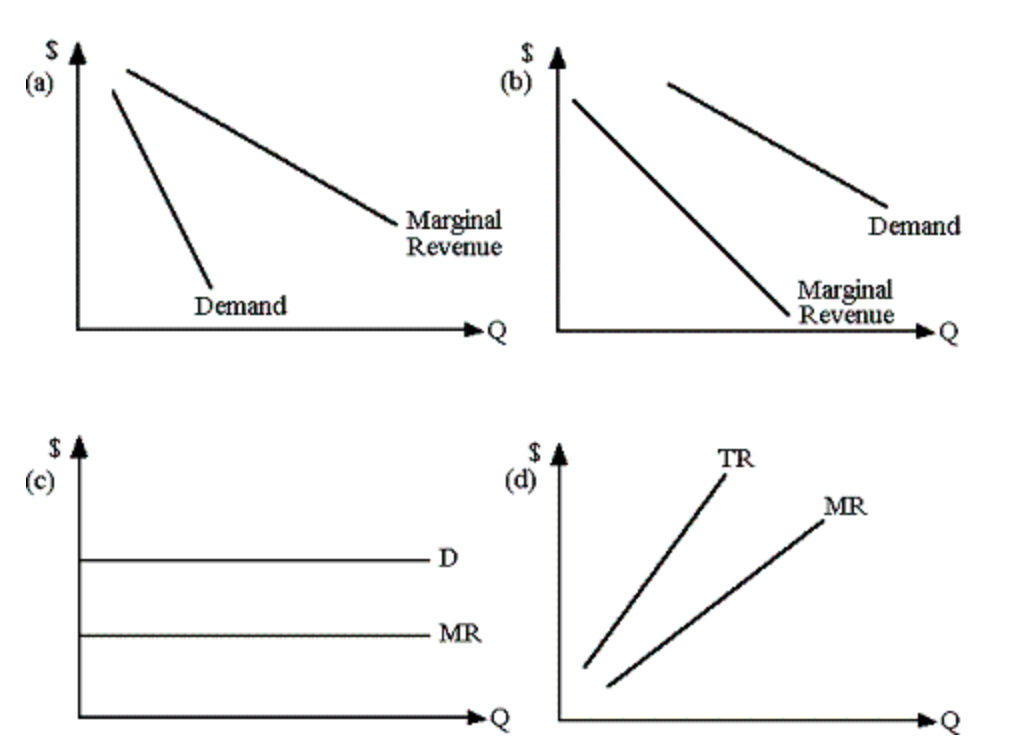
Which of the graphs shown below best depicts the demand side of the market for a typical monopolist?
a. panel a
b. panel b
c. panel c
d. panel d
Panel b

A profit maximizing monopolist will choose to produce approximately _________ units of output.
a. Q1
b. Q3
c. Q0
d. Q2
Q1
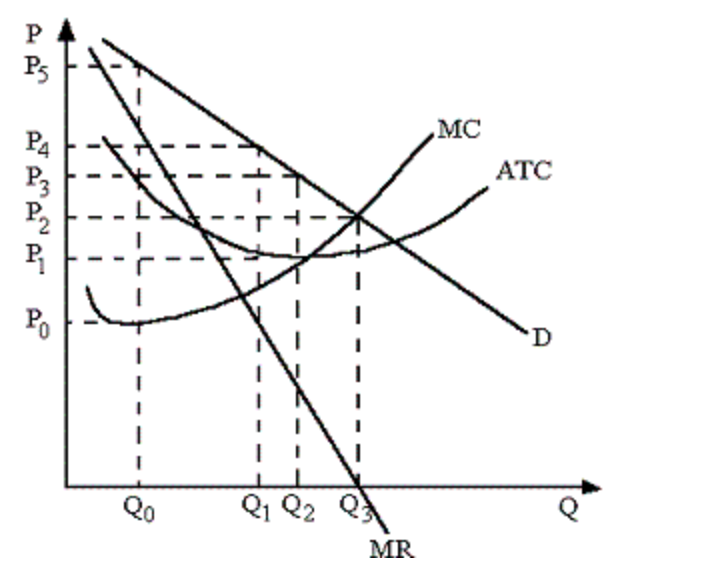
A profit maximizing monopolist will have economic profits roughly equal to
a. (P5 - P2) * Q0
b. (P3 - P1) * Q2
c. (P5 - P0) * Q0
d. (P4 - P1) * Q1
(P4 - P1) * Q1
If this monopolist decided to produce (and sell) Q2 units of output
a. it would continue to make an economic profit, but would not be operating at a level consistent with profit maximization
b. revenue would be less than if it sold Q0 units of output
c. it would have losses of indeterminate size
d. it could not stay in business in the long run
it would continue to make an economic profit, but would not be operating at a level consistent with profit maximization
As a monopolist increases the quantity of output it sells, the price consumers are willing to pay for the good __________ .
a. decreases due to the law of decreasing marginal benefit
b. increases due to the law of increasing marginal benefit
c. is unaffected
d. not enough information
decreases due to the law of decreasing marginal benefit
For a competitive firm, marginal revenue ________ the price of its good, and for a monopolist, marginal revenue ________ the price of its good.
a. is less than, equal
b. is greater than, is less than
c. equals, is greater than
d. equal, is less than
equals, is less than

A profit maximizing monopolist will cause a deadweight loss equal to
a. A + B + C + D + F
b. F
c. E
d. A + B + F
F
The real economic problem with monopolies is their ability
a. to profiteer at the expense of consumers
b. to buy political favors with their excessive profits
c. to price their product at a level that forces consumers to pay more than they are willing or able
d. to restrict output below the socially efficient level of production
e. all of the above
to restrict output below the socially efficient level of production
Under conditions of monopoly, the socially efficient level of production occurs where the marginal cost curve intersects the ________ curve.
a. demand
b. average cost
c. supply
d. marginal revenue
demand
Because P > MC, monopoly pricing prevents some mutually beneficial trades from taking place. These unrealized mutually beneficial trades are ________ to society.
a. a sunk cost
b. not considered a cost
c. a deadweight loss or excess burden
d. of little concern
a deadweight loss or excess burden
If a monopolist sells 100 units at $8 per unit and realizes an average cost of $6 per unit, what is the monopolist's profit?
a. $200
b. $800
c. $600
d. None of the above
200
What is the deadweight loss due to monopoly pricing under the following conditions:
The price charged for goods produced is $16.
The intersection of the marginal revenue and marginal cost curves occurs where output is 10 units and price is $8.
The socially efficient level of production is 12 units.
a. $48
b. $16
c. $24
d. $8
e. None of the above
$8
One problem with government regulation of natural monopolies is that
a. a benevolent government is likely to be interested in generating profits for political gain
b. a government regulated outcome may increase the profitability of the monopoly
c. regulated industries typically have rising average costs or diseconomies of scale
d. the government typically has poor information about the socially optimal level of production
the government typically has poor information about the socially optimal level of production
If a regulated natural monopoly is unable to generate profits at the "marginal-cost pricing" regulated level of production
a. the regulated monopolist should try to minimize losses in the long run
b. it may be necessary for the government to subsidize the natural monopolist, which requires raising taxes or cutting public spending elsewhere
c. the regulated monopolist should always exit the industry
d. the government should always purchase the monopoly and run it in the public sector
it may be necessary for the government to subsidize the natural monopolist, which requires raising taxes or cutting public spending elsewhere
One problem with regulating a natural monopolist on the basis of its average cost is
a. a monopolist's costs, by definition, are higher than costs of perfectly competitive firms
b. that it does not provide an incentive for the monopolist to reduce or minimize its costs, possibly encouraging the monopolist to overstate costs or become less efficient
c. a monopolist is still able to generate excessive economic profits
d. regulators are unable to control prices and/or production output, possibly encouraging the monopolist to overstate costs or become less efficient
that it does not provide an incentive for the monopolist to reduce or minimize its costs, possibly encouraging the monopolist to overstate costs or become less efficient

Which of the graphs shown below best describes the situation of a regulated natural monopolist with marginal-cost pricing regulation?
a. Panel b
b. Panel a
c. Panel d
d. Panel c
Panel d
A perfectly price discriminating monopolist is able to
a. maximize profit and produce a level of output consistent with optimal social well-being
b. produce a level of output consistent with optimal social well-being, but not maximize profit
c. exercise illegal preferences over the gender of its employees
d. maximize profit, but not produce a level of output consistent with optimal social well-being
maximize profit and produce a level of output consistent with optimal social well-being
If a monopolist is able to price discriminate
a. consumer surplus is increased at a point closer to the socially efficient level of output
b. consumer surplus and deadweight losses are transformed into producer surplus and monopoly profits at a point closer to the socially efficient level of output
c. the price effect dominates the output effect on monopoly revenue at a point farther from the socially efficient level of output
d. deadweight loss is increased at a point closer to the socially efficient level of output
consumer surplus and deadweight losses are transformed into producer surplus and monopoly profits at a point closer to the socially efficient level of output

A monopolist who is able to engage in perfect price discrimination will have profit equal to
a. C + D + F
b. A + B + C + D + E
c. A + C
d. B + D + E
A + B + C + D + E
Price discrimination requires the firm to
a. differentiate between different units of their product
b. engage in arbitrage among buyers of their product
c. separate customers according to their willingness to pay
d. prevent arbitrage among buyers of their product
e. both c and d
both c and d
Markets which are characterized by only a few sellers with large market shares that sell similar or nearly identical (homogeneous) products are typically referred to as
a. monopoly markets
b. competitive markets
c. aggressive markets
d. oligopoly markets
oligopoly markets
In general, market structures that fall somewhere in between Monopoly and Perfect Competition are called
a. oligopoly markets
b. incomplete markets
c. monopolistically competitive markets exclusively
d. imperfectly competitive markets
imperfectly competitive markets
Monopolistic competition is characterized by which of the following attributes:
(i) Many sellers
(ii) Product Differentiation
(iii) Barriers to entry
(iv) Natural monopolies
a. i and iii
b. ii and iv
c. i and ii
d. all of the above
(i) and (ii) only
In a monopolistically competitive market structure, because each good sold in the market is _________________ each firm is considered a _________________.
a. slightly different, price taker
b. the same, price setter or price maker
c. slightly different, price setter or price maker
d. the same, price taker
slightly different, price setter or price maker
In a monopolistically competitive industry, price is likely to be _________________ marginal cost since each firm is a _________________.
a. always a fraction of, price setter or price maker
b. below, price setter or price maker
c. equal to, price taker
d. above, price setter or price maker
above, price setter or price maker
When many sellers are involved in selling their products in a market, the market structure could be which of the following:
(i) perfect competition
(ii) monopolistic competition
(iii) monopoly
(iv) oligopoly
a. ii
b. i, ii, and iv
c. i
d. i and ii
e. all of the above
both (i) and (ii)
When freedom of entry is one of the attributes of a market structure, economic profits are
a. sacrificed to excess capacity
b. negative for all firms
c. always positive
d. eventually driven to zero
eventually driven to zero
A monopolistically competitive firm differs from a perfectly competitive firm because a monopolistically competitive firm
a. is characterized by profit maximization
b. faces a horizontal demand curve at the market clearing price due to product homogeneity
c. faces a downward sloping demand curve for its product due to product differentiation
d. has no barriers to entry
c. faces a downward sloping demand curve for its product due to product differentiation

Which of the graphs shown above would be consistent with a monopolistically competitive firm that is making economic profits?
a. panel a
b. panel d
c. panel c
d. panel b
Panel a

Which of the graphs shown above would be consistent with a monopolistically competitive firm that is making economic losses?
a. panel c
b. panel a
c. panel b
d. panel d
Panel b

The graphs below depict the effect on incumbent firms of entry and exit in a monopolistically competitive market.
If firms in a monopolistically competitive market are earning economic profits, which of the graphs shown would reflect the change in demand for incumbent firms as the market adjusts to its new equilibrium?
a. Panel d
b. Panel b
c. Panel a
d. Panel c
Panel a
In monopolistically competitive markets, economic losses ____________, and __________________ shifts the demand curve of incumbent firms to the ___________________.
a. signal some incumbent firms to exit, exit, right
b. signal some incumbent firms to exit, exit, left
c. signal new firms to enter, entry, right
d. signal new firms to enter, entry, left
signal some incumbent firms to exit, exit, right
As new firms enter a monopolistically competitive market, economic profits of existing firms ____________ and product diversity in the market _________________.
a. rise, increases
b. rise, decreases
c. decline, decreases
d. decline, increases
decline, increases
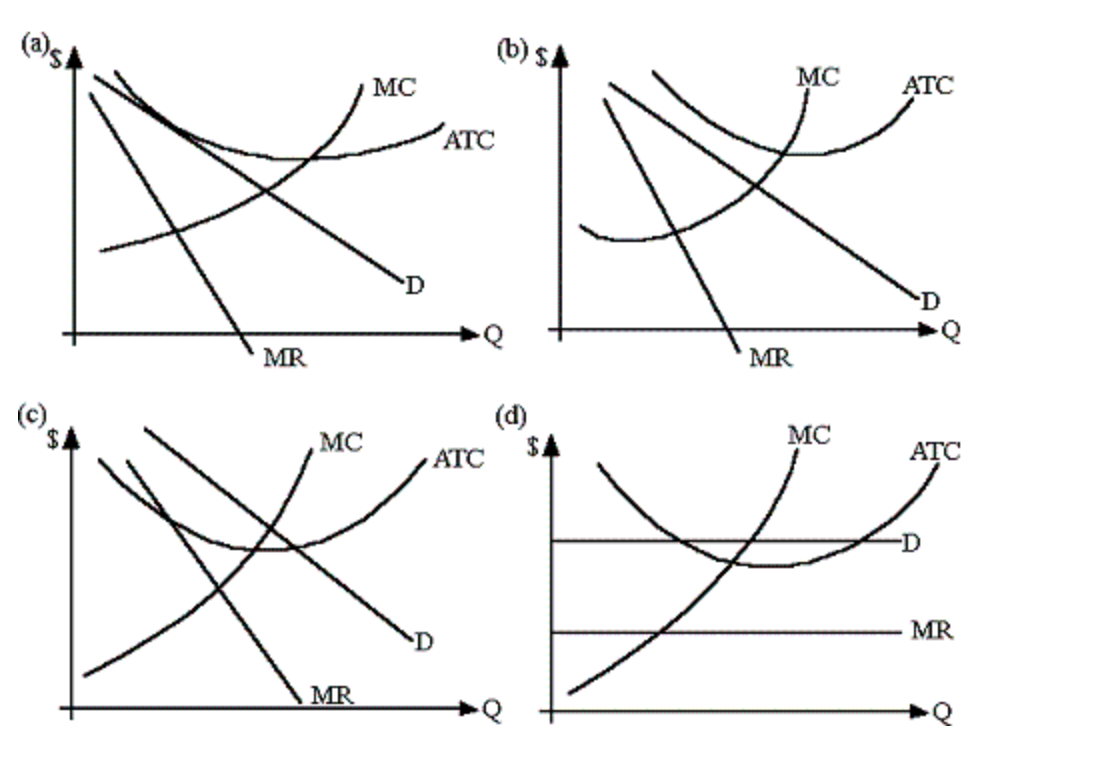
Which of the panels shown reflects a long run equilibrium in a monopolistically competitive market?
a. Panel d
b. Panel a
c. Panel c
d. Panel b
Panel a

Panel b in the set of images shown above is consistent with
a. a perfectly competitive firm that is incurring economic losses
b. a monopolistically competitive firm in both a short-run and a long-run equilibrium
c. a monopolistically competitive firm in a long-run equilibrium, but not a short-run equilibrium
d. a monopolistically competitive firm in short-run equilibrium, but not a long-run equilibrium
a monopolistically competitive firm in short-run equilibrium, but not a long-run equilibrium
For a monopolistically competitive firm in long-run equilibrium ___________________ like in a monopoly market, and ________________________ like in a competitive market.
a. price exceeds marginal cost, price equals average total cost
b. price equals average total cost, price exceeds marginal cost
c. marginal revenue equals marginal cost, average revenue exceeds average total cost
d. average revenue exceed average total cost, marginal revenue exceeds average revenue
price exceeds marginal cost, price equals average total cost
If regulators were to require that monopolistically competitive firms set price equal to marginal cost in the long run, then
a. all monopolistically competitive firms would experience economic losses
b. firms would also operate at maximum efficient scale
c. the most efficient firms are not likely to be affected
d. new firms would be likely to enter the market
all monopolistically competitive firms would experience economic losses
Advertising that conveys information about the prices of different goods being offered for sale
a. is likely to enhance the ability of markets to allocate scarce resources more efficiently
b. is psychological rather than informational
c. increases brand loyalty and product differentiation
d. all of the above
is likely to enhance the ability of markets to allocate scarce resources more efficiently
When advertising encourages customers to become more informed about all firms in the market, then
a. the market power of individual firms is strengthened
b. each firm is likely to have less market power and prices are likely to be lower
c. firms are able to foster stronger brand loyalty
d. demand curves for specific brands in the market are likely to become less elastic
each firm is likely to have less market power and prices are likely to be lower
Firms that have large advertising budgets, such as those firms that advertise during the Super Bowl, are likely to be providing consumers with
a. a good example of wasted resources
b. a potential signal about product quality
c. a glimpse of ostentatious capitalism
d. information about product price
a potential signal about product quality
When compared to perfect competition, the theoretical disadvantages of monopolistic competition are __________ and __________, whereas the practicalbenefit that consumers get in return is __________.
a. product variety, excess capacity, marginal cost pricing
b. deadweight losses, product variety, excess capacity
c. product variety, deadweight losses, average cost pricing
d. excess capacity, deadweight losses, product variety
excess capacity, deadweight losses, product variety
In markets characterized by oligopoly,
a. there is often tension between cooperation with rivals and pursuit of self interest
b. collusive agreements will always prevail
c. collective profits are lower under cartel arrangements
d. pursuit of self interest by profit maximizing firms always maximizes collective profits in the market
there is often tension between cooperation with rivals and pursuit of self interest
When a profit maximizing oligopolist makes a production decision
a. it should ensure that the output effect is dominant
b. it generally must consider the behavior of competing rival firms
c. it should ensure that the price effect is dominant
d. it must always assume that competing firms will maintain their current levels of production
it generally must consider the behavior of competing rival firms
There are two types of markets in which firms face some competition yet are still able to have some control over the prices of their products. The names given these market structures are
a. duopoly and imperfect competition
b. imperfect competition and monopolistic competition
c. monopolistic competition and oligopoly/duopoly
d. oligopoly and duopoly only
monopolistic competition and oligopoly/duopoly
An agreement among firms over production output and price is called _______. This group of firms that are acting in unison is called a ________.
a. conspiracy, union
b. conspiracy, cartel
c. collusion, cartel
d. collusion, union
collusion, cartel
An oligopolist is part of a cartel that is collectively producing at the monopoly level of output. The oligopolist, being self-interested will
a. lower production below the agreed-upon level and drive up prices further
b. do nothing thus allowing the cartel to realize monopoly profits
c. increase production beyond the agreed-upon level to undercut rivals within the cartel
d. None of the above
increase production beyond the agreed-upon level to undercut rivals within the cartel
________ is the study of how people behave in strategic situations.
a. game theory
b. welfare economics
c. statistics
d. econometrics
Game theory
The prisoners' dilemma is an important game to study because
a. most games present zero-sum alternatives
b. it identifies the fundamental difficulty in maintaining cooperative agreements
c. strategic decisions faced by prisoners are always identical to those faced by firms engaged in illegal collusive agreements
d. all of the above
it identifies the fundamental difficulty in maintaining cooperative agreements
Given the following prisoners' dilemma table, if Bonnie and Clyde make the appropriate self-interested decision independent of the other, how much time would each end up spending in jail?
|
| Bonnie's Decision |
|
|
| Confess: | Remain Silent: |
Clyde's Decision | Confess: | 8 years for each | Bonnie gets 20 years, Clyde goes free |
| Remain Silent: | Bonnie goes free, Clyde gets 20 years | 1 year for each |
a. Bonnie goes free, Clyde gets 20 years
b. 1 year for each
c. 8 years each
d. Bonnie gets 20 years, Clyde goes free
8 years each
In game theory, a strategy is called a ________ if it is the best strategy for a player to follow regardless of the strategies pursued by other players.
a. known probability
b. dominant strategy
c. perfect strategy
d. none of the above
dominant strategy