dental science - unit 5
 Call Kai
 Learn
Learn Practice Test
 Spaced Repetition
 Match
Match Flashcards
 Knowt Play
1/19

Earn XP
Description and Tags
The Tooth: Functions, Tissues and Structural Landmarks
Name | Mastery | Learn | Test | Matching | Spaced | Call with Kai | Chat |
|---|
No analytics yet
Send a link to your students to track their progress
20 Terms

Name the various tooth surfaces, and where is it located?
Incisal - The biting edge of an anterior tooth
Palatal - The inner side of an upper jaw tooth that faces the palate
Labial - The surface towards the lips
Buccal - The surface towards the cheeks
Lingual - The surface that faces the tongue
Mesial - The surface that is closest to the midline of the face (side of tooth)
Distal - The surface that is away from the midline of the face (side of tooth)
Occlusal - The chewing surface of posterior teeth
Proximal - Tooth surfaces that are next to each other

Name and identify the division of specific surfaces on a tooth.
For dividing a tooth surface into thirds:
Mesial third
Middle third
Distal third
And horizontally:
Cervical third – closest to the gum
Middle third
Incisal/occlusal third – closest to the biting/chewing edge.
Subgingival
Apical - very tip of a tooth’s root
Middle
Cervical - closest to gums

Identify the parts of a tooth
crown - top of tooth covered in enamel
root - in the jaw covered in cementum
cementoenamel junction - where enamel meets the cementum
apex - at the terminal end of root(s)
alveolar bone - where the tooth (root) is anchored
bifurcation - where two roots meet

Describe the enamel tissue, their location within the tooth, their chemical composition, and their functions
Smooth cap covering and protecting underlying tissues of the tooth
Most densely mineralized tissue of the body
composed of millions of tiny enamel rods to form framework of enamel
96% inorganic (mineral) 4% organic matter and water
Ameloblasts - cells that produce enamel
Function: shields inner tissues from damage, decay, and temperature sensitivity

Describe the dentin tissue, their location within the tooth, their chemical composition, and their functions.
Directly underneath enamel of the crown and cementum of root
Odontoblasts - cells that produce dentin
Has dentinal tubules or odontoblastic tubules that run from outside surface of tooth to the pulp (inside)
Function: structure support, pulp protection

Describe the cementum tissue, their location within the tooth, their chemical composition, and their functions.
covers the root and is like bone tissue - very thin layer
50% inorganic and 50% organic matter and water
Cementoblasts - cells that produce cementum
Function: anchors the tooth within the jawbone

Describe the pulp tissue, their location within the tooth, their chemical composition, and their functions.
located at the center of the tooth for entire length of tooth
Soft and made up of blood vessels, cellular substances, and nerves
Function: regenerate dentin and to provide nutrients to a tooth
Pulp cavity - entire hollow space inside a tooth containing pulp (nerves and blood vessels)
What are the components of the pulp?
Pulp chamber - surrounded by dentin. Large, main central cavity located inside the visible crown of the tooth
Pulp horns - small, pointed extension of pulp chamber that stick upward toward chewing edges
Pulp canal - narrow channel that runs down through the root of the tooth
Apical foramen - small opening at the apex of the tooth. Channel for blood, lymph vessels and nerves to gain access to the interior area of tooth


Define the teeth landmark terminology: Lobe
A section of a developing tooth that helps form the crown.

Define the teeth landmark terminology: Developmental grooves
Small lines or grooves on a tooth that mark where two lobes meet.

Define the teeth landmark terminology: tubercle
a small elevated area of enamel on the lingual surface and sometimes the labial or occlusal surface

Define the teeth landmark terminology: fossa
wide, shallow depression on the lingual surfaces of anterior teeth
Lingual fossae are found upon the lingual surface of incisors
On canines, there are two lingual fossae
Triangular fossae are found on molars and premolars on occlusal surfaces
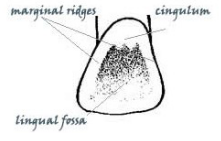
Define the teeth landmark terminology: cingulum
a buldge of enamel found on the cervical third of the lingual surface of an anterior tooth
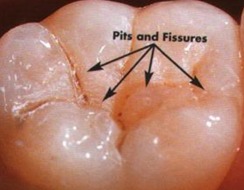
Define the teeth landmark terminology: pit
Small depressions or holes on a tooth, usually where grooves meet or cross.

Define the teeth landmark terminology: cusp
major elevation on the masticatory surfaces of canines and posterior teeth

Define the teeth landmark terminology: ridge
A raised line or edge on the surface of a tooth.
4 ridges on each cusp:
Buccal/labial – toward the cheek/lip
Lingual – toward the tongue
Mesial – toward the middle of the mouth
Distal – away from the middle of the mouth

Define the teeth landmark terminology: concavity
is a depression in a surface
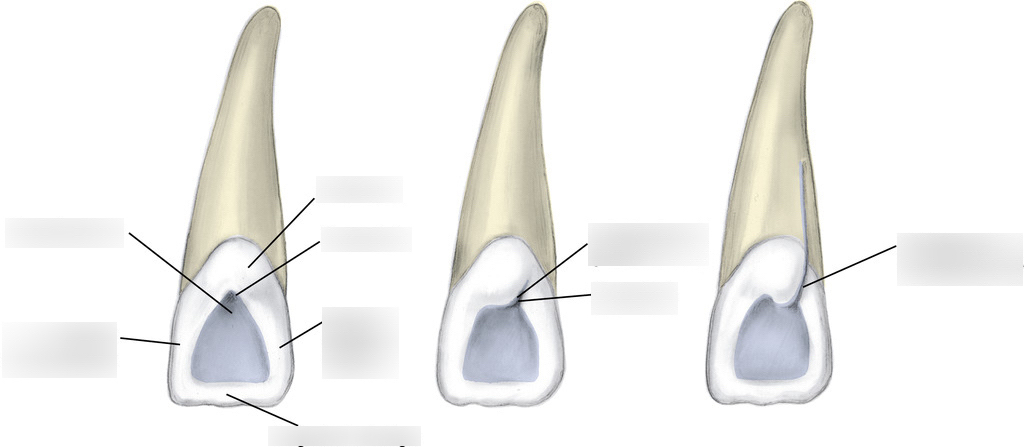
Define the teeth landmark terminology: lingual groove
the developmental line or lingual groove that separates the 3 labial lobes from the cingulum (anterior tooth) or cusp(s) for a posterior toot
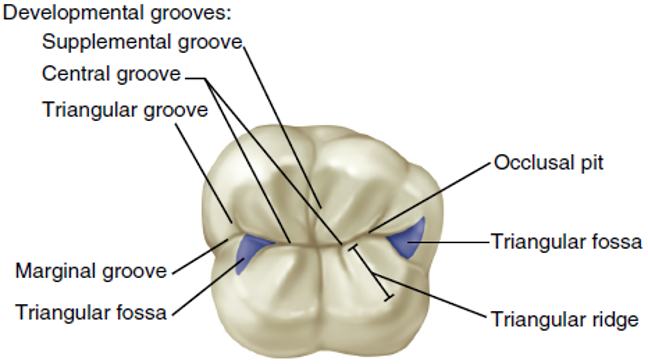
Define the teeth landmark terminology: triangular groove
Developmental groove that separates a marginal ridge from the triangular ridge of a cusp
Define the teeth landmark terminology: transverse groove
A groove that runs across the chewing surface of a tooth.