70026 Attributable Risk & Strategies for Prevention
 Call Kai
 Learn
Learn Practice Test
 Spaced Repetition
 Match
Match Flashcards
 Knowt Play
1/37

There's no tags or description
Looks like no tags are added yet.
Name | Mastery | Learn | Test | Matching | Spaced | Call with Kai | Chat |
|---|
No analytics yet
Send a link to your students to track their progress
38 Terms
What is Attributable Risk?
The public health impact of an exposure on an exposed group.
What is the main question answered by Attributable Risk (AR)?
How much additional absolute risk is associated with exposure among exposed individuals?
What are the assumptions of when dealing with attributable risk?
There is a causal relationship between exposure and outcome.
There are no other sources of bias.
There is equal distribution of all factors among exposed and unexposed.
What is background incidence?
The incidence of disease in the unexposed group.
What constitutes for incidence in an exposed group?
Background incidence + incidence due to exposure.
What is the relationship between NNT and Attributable Risk?
Inverse of each other.
Why is NNT significant?
Can be used to test effectiveness of health interventions and treatments.
What is NNT?
Number needed to treat.
What is ARP?
Attributable Risk Percent. A proportion of disease among the exposed which can be attributed to exposure
When is AR and ARP used?
Both AR and ARP are appropriate to use when considering the effect of an exposure among the exposed group.
What is Population Attributable Risk?
The excess risk of disease in the total study population that Is attributable ot the exposure.
What is Population Attributable Risk Percent?
The proportion of the disease in the population that could be prevented by eliminating the exposure.
What is background incidence?
Incidence of disease in an unexposed group.
How would you calculate AR?
AR = incidence among the exposed - incidence among the unexposed

How can AR be applied in public health?
Assess the potential benefit of protecting exposed groups, e.g. reducing air pollution exposure in highly polluted areas.
Is Attributable Risk an absolute or relative measure of risk?
AR is an absolute measure of risk.
Is Attributable Risk an absolute or relative measure, and how is it expressed?
An absolute measure of risk difference, expressed in percentage points (e.g. 15 percentage points), not as a percentage increase.
What is required to interpret Attributable Risk causally?
Comparable exposed and unexposed groups, with appropriate control of confounding, so that the observed risk difference can reasonably be attributed to the exposure.
What is Attributable Risk Percent?
A proportion of disease among exposed which can be attributed to exposure.
What is the main question answered by Attributable Risk Percent? (ARP)?
What proportion of disease among exposed individuals is attributable to exposure?
How is Attributable Risk Percent (ARP) calculated?
100 * ( incidence among the exposed - incidence among the unexposed) / incidence among the exposed

How can Attributable Risk Percent (ARP) help improve public health?
Can help evaluate targeted interventions for high-risk groups.
Which Measures of Risk are absolute, and which are relative?
Absolute: Attributable Risk, Population Attributable Risk
Relative: Attributable Risk Percent, Population Attributable Risk Percent
Which Measures of Risk relate to exposed groups, and which pertain to the whole population.
Exposed Individuals: Attributable Risk, Attributable Risk Percent
Population: Population Attributable Risk, Population Attributable Risk Percent
What is Population Attributable Risk (ARP)?
The excess risk of disease in the total study population that Is attributable to the exposure.
What is the main question Population Attributable Risk answers?
How much additional absolute risk exists in the whole population?
What is Population Attributable Risk Percent (PAR)?
The proportion of the disease in the population that could be prevented by eliminating the exposure.
What is the main question Population Attributable Risk Percent (PARP) answers?
What proportion of population disease is attributable to exposure?
How do you calculate Population Attributable Risk (PAR)?
incidence in the total population - incidence among the unexposed
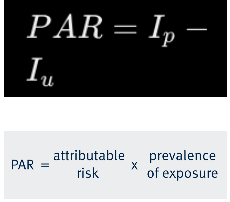
How do you calculate Population Attributable Risk Percent (PARP)?
100 * (incidence in the total population - incidence among the unexposed) / incidence in the total population
How can Population Attributable Risk (PAR) improve public health?
Helps policymakers assess the potential population benefit.
How can Population Attributable Risk Percent (PARP) be applied to improve public health ?
Useful for prioritising public health policies and comparing prevention opportunities.
Why might the actual public health benefit of eliminating an exposure differ from the benefit estimated by AR%, PAR or PAR%?
Estimates rely on causal assumptions. The actual benefit also depends on whether the exposure can be eliminated, how effective the intervention is, and whether other factors affect disease risk.
What does it mean that attributable measures depend on a causal relationship?
Exposure must genuinely contribute to causing the disease, not merely be associated with it. Only then can the excess risk be interpreted as attributable to the exposure and potentially preventable by eliminating it, assuming the relevant causal conditions hold.
What are the key considerations when interpreting AR?
An absolute measure of risk difference.
Requires comparable groups and appropriate control of confounding for causal interpretation.
Express in percentage points, not as a percentage increase.
What are key considerations when interpreting ARP?
A relative proportion among the exposed, not the whole population.
Depends on a causal relationship and assumes the exposure can be eliminated without other changes affecting risk.
What are key considerations when interpreting PAR?
Influenced by both exposure prevalence and the exposure–disease association.
A high PAR indicates a larger absolute population burden, assuming the comparison is valid and causal.
What are key considerations when interpreting PARP?
Depends on exposure prevalence, causal validity and the feasibility of removing the exposure.
A large PAR% does not necessarily mean an intervention is affordable, feasible or the most cost-effective option.