organic structures & mechanisms - SEMESTER 1
 Call Kai
 Learn
 Practice Test
 Spaced Repetition
 Match
 Flashcards
 Knowt Play
1/96

There's no tags or description
Looks like no tags are added yet.
97 Terms
Name the 4 types of structural isomers
Chain, position, functional group, tautomers
What is a chain isomer?
Has the same molecular formulae but branches differently
What is a position isomer?
Where the molecular formulae is the same but the functional group moves position in the chain
What is a functional group isomer?
Where the molecular formulae is the same but the functional group changes
What is a tautomer?
Has the same molecular formulae but a different sequence of atoms due to the position of the atomic nuclei
What do stereoisomers require?
3d structure
C=C
What is an enantiomer?
Molecules with the same molecular formulae but a different arrangement in space with a chiral centre.
What is a Z isomer?
Where the branches with the greatest priority are on the same side of the line of symmetry
What is an E isomer?
Where the branches with the highest priority are on opposite sides of the line of symmetry
What is a cis isomer?
Where the branches are identical on the same side of the line of symmetry
What is a trans isomer?
Where the branches are identical on the opposite sides of the line of symmetry
What is an R optical isomer?
Where the branches of a molecule are clockwise in order of priority
What is an S optical isomer?
Where the branches of a molecule are anticlockwise in order of priority
Where should the smallest priority atom face when working out R or S optical isomerism?
Facing away from you
Why does a racemic look optically inactive?
The two enantiomers cancel eachother out.
What is a diastereoisomer?
A stereoisomer that are not enantiomers and don’t have to be optically active
What is a stereoisomer?
Compounds whose structure differs in the arrangement of its atoms in space
What is an enantiomer?
2 stereoisomers that are non-identical mirror images that are chiral objects and are non superimpossible
How many stereoisomers do diastereoisomers make?
4 stereoisomers
What is a Meso compound?
Has sterogenic centres but also has a plane of symmetry
What direction are R stereoisomers?
Clockwise
Wha direction are S stereoisomers?
Anticlockwise
How is a dihedral angle formed and how can they be viewe?
between the two planes formed by the four groups, easier to view as a Newman projection
What are the two types of structures in a pane for Newman projections?
Eclipsed or staggered
Give 3 features of the eclipsed structure in a Newman projection
higher energy
0 degree bonds
Strain
Give 3 properties of staggered formations for newman projections
distributed evenly
60 degree bonds
More stable
What is torsional strain?
A twisting force due to repulsion between bonding electrons
What is steric repulsion?
Repulsion between electrons
What is an eclipsed molecule?
Where 2 methyl groups overlap completely, so hydrogens get really close and repel eachother causing steric repulsion
What is ‘gauche’ structure?
where no groups overlap, but not all bond angles are equal

Name this shape and state the strain it has
Anti clinal, torsional

Name this shape and state the strain it has
Syn-clinal, steric

Name this shape and state the strain it has
Anti periplanar, no strain
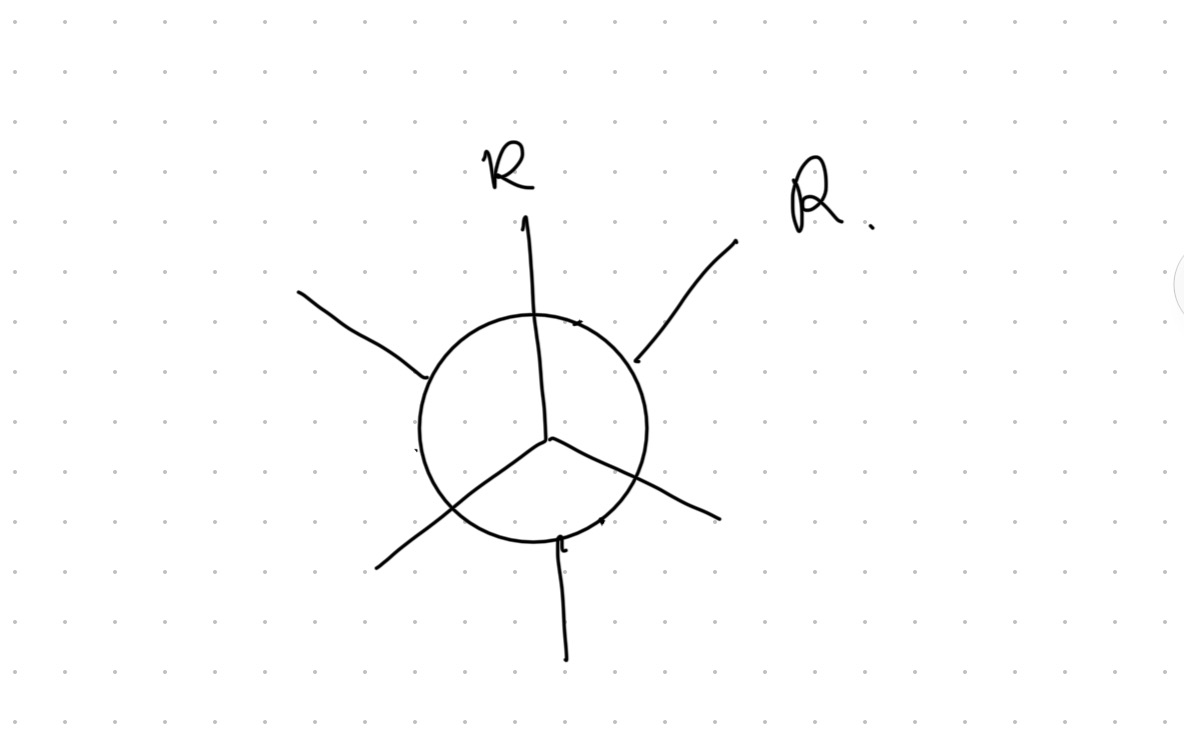
Name this shape and state the strain it has
Syn-clinal, steric

Name this shape and state the strain it has
Anti-clinal, torsional

Name this shape and state the strain it has
Syn periplanar, torsional and steric
Which shape is the most favourable in the newmans projections?
Anti periplanar
Which shape is the least favourable in the newmans projection?
Syn periplanar
Which type of strain is most favoured?
Steric
What are atropisomers?
Separable enantiomers without chiral centres
On a Fischer projection, what direction do horizontal and vertical lines go in a plane?
Horizontal - go back into the plane
Vertical - come out of the plane
What strain does cyclopropane experience?
Torsional strain
What strain does cylcobutane have?
Torsional and angle
What type of bond do bigger groups prefer on cyclohexane?
Equatorial bonds
How should bonds been drawn in cyclohexane in the chair confirmation?
Parallel to the adjacent bond
Define ‘functional group level’
The number of bonds to heteroatom from given carbon atoms
What is an alcohol group tracked to a benzene called?
Phenol

Diether

Thiol

Cyclic ether

Epoxide

Peroxide

Amide

Hydrate

Hemiacetal

Acetal

Imine

Oxime

Ester

Anhydride

Amide
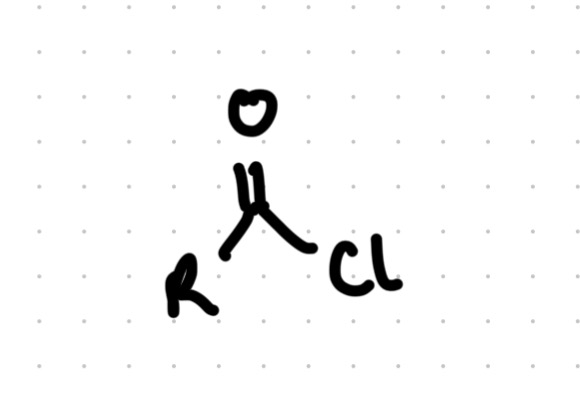
Acid chloride
What type of groups are the most oxidised?
Largest functional group
What is oxidation in terms of function group level?
Where the functional group level increases
What is reduction in terms of function group level?
When function group level decreases

Ether

Carbonate

Carbamate

Urea
What is an inductive effect?
The way electronegative atoms polarise electron density in the single bond framework of a molecule
When does negative inductive effect happen?
When the side group is more electronegative than carbon, so the electron is pulled from carbon conductively
Define reactivity
The movement of electron density to where it is needed to break weak bonds and form stronger ones
What is heterocyclic bond cleavage?
Where the bond breaks unevenly and a single curly arrow is used
What is homolytic bond cleavage?
Where a bond breaks evenly and a fish hook arrow is used, free radicals form
State the process of how reactants turn to products theoretically
Reactants, gain enough energy to overcome activation energy
Form reactive intermediates (charged molecules)
Products form
How does a smaller energy barrier effect a reaction?
Makes the reaction faster and forms more stable intermediates
What type of inductive effect is most stable?
Positive inductive effect
What is a mesmeric effect?
The movement of electron density in the double bond pi system of a molecule by resonance
What is a negative mesomeric effect?
Where electrons are withdrawn from a negative charge
What is a positive mesomeric effect?
Where electrons are added by resonance
Which is more influential, mesomeric effect or inductive effect?
Mesomeric effect
What is a pi bond?
Overlapping p orbitals
How can the order of curly arrow move to be found?
1) from a negative charge/ lone pair/ double bond/ single bond
2) to a positive charge/ partial positive charge
3) finish by balancing number of bonds
4) Ensure charge is conserved
What is a nucleophile and what does it usually attack?
An electron donor, attacks a C+
What is a base and what does it usually attack?
Proton acceptor, attacks a H+
What is an electrophile and what does it usually react with?
An electron acceptor, reacts with a nucleophile
What is an acid and what does it usuallly react with?
A proton acceptor, reacts with a base
What type of molecules can more readily donate electrons?
Less electronegative molecules
If a molecule has more resonance, is it a good or a bad nucleophile?
Bad nucleophile
What type of alcohol is the best type of nucleophile?
A primary alcohol
What is chemoselectivity?
When several different sites could react but one does so prefferentially
Which type of group generates the most stable conjugate base and why?
The most acidic group because the negative charge should form on the most electronegative atom
What molecules are the most able to donate lone pairs of electrons?
the most basic molecules
If a molecule is very electronegative, is it good at giving away its electrons?
No
What does acidic dehydration of an alcohol produce?
an ether
What does Sn2 stand for?
Bimolecular nucleophilic substitution
What does Sn1 stand for?
Unimolecular nucleophilic substitution