BIOL1190: Lab 8 - Respiratory System
 Call Kai
 Learn
 Practice Test
 Spaced Repetition
 Match
 Flashcards
 Knowt Play
1/110

There's no tags or description
Looks like no tags are added yet.
111 Terms
what does the respiratory system provide?
a passageway for air into and out of the body
what is the respiratory system the site of?
gas diffusion into and out of the blood stream
what else does the respiratory have a role in?
- homeostasis of blood pH
- filters inspired air
- contains the receptors for smell
what does the upper respiratory system consists of?
- the nose
- the pharynx
what does the lower respiratory system consists of?
- the larynx
- the trachea
- the bronchi
- the lungs
what are the bones forming the floor of the nasal cavity?
- palatine process of the maxilla
- horizontal plate of the palatine bone
what are the bones that form the roof of the nasal cavity?
- cribriform plate of the ethmoid bone
- nasal bone
- sphenoid bone
- frontal bone
what is the mucous membrane lining the anterior nasal cavity?
non-keratinized stratified squamous epithelium
whaat does the olfactory epithelium cover?
the superior portion of the nasal cavity
what lines the inferior nasal cavity?
pseudostratified ciliated columnar epithelium
what bones form the three passageways called the meatus?
the superior, middle, and inferior nasal conchae
what is the function of the nasal conchae and nasal meatus and the epithelia covering them during inhalation?
- as inhaled air whirls around the conchae and meatus, it is warmed by blood in the capillaries (epithelia)
- increase surface area in the internal nose (nasal conchae and meatus)
what is the function of the nasal conchae and nasal meatus and the epithelia covering them during exhalation?
prevents dehydration by trapping water droplets
what is the function of the nostrils (external nares)?
opening for air to pass into the nasal cavity
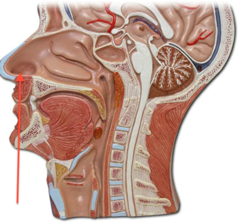
what is the function of the nasal cavity?
- warm, moisten, and filter incoming air
- detect olfactory stimuli
- modify speech vibrations as they pass through the large, hollow resonating chambers

what is the function of the nasal septum?
- covered with a mucous membrane (helps warm, moisten, and filter air)
- separates the nasal cavity into left and right sides

what are the four paranasal sinuses?
- ethmoidal cells
- maxillary
- sphenoid
- frontal

what are the functions of the paranasal sinuses?
- allow the skull to increase in size without a change in the mass of the bone
- increases the surface area of the nasal mucosa, thus increasing the production of mucus to help moisten and cleansed inhaled air
- serves as a resonating chambers within the skull that intensify and prolong sounds
what is the function of the choanae (internal nares)?
two openings that permit communication between the nasal cavity and the pharynx

what is the function of the pharynx?
- passageway for air and food
- provides a resonating chamber for speech and sounds
- houses the tonsils, which participate in immunological reactions against foreign invaders

what is the function of the nasopharynx?
lined with ciliated pseudostratified columnar epithelium which secretes mucus (by goblet cells) that traps dust, microbes, and foreign particles and cilia sweep away mucus for elimination from the body
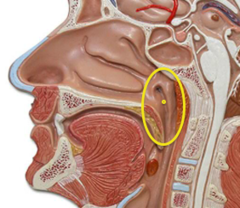
what is the function of the oropharynx?
lined with non-keratinized stratified squamous epithelium which protects against abrasion (like sharp or rough foods)
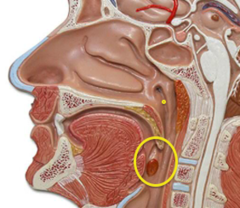
what is the function of the laryngopharynx?
lined with non-keratinized stratified squamous epithelium which protects against abrasion (like sharp or rough foods)

what is the function of the fauces?
opening that acts as a passageway from the mouth into the pharynx

what is the function of the tonsils?
- strategically positioned to participate in immune responses against inhaled or ingested foreign substances
- help protect the lungs from pathogens

what are the three tonsils?
- lingual
- palatine
- pharyngeal

what is the larynx?
- connects the laryngopharynx to the trachea and contains the vocal cords
- superior portion (above vocal cords) is lined by non-keratinized stratified squamous epithelium
- inferior portion (below vocal cords) is lined by ciliated pseudostratified columnar epithelium

what is the thyroid cartilage?
- also known as Adam's apple
- consists of two fused plates of hyaline cartilage that form the anterior wall of the larynx and give it a triangular shape
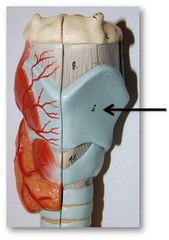
what is the cricoid cartilage?
forms the inferior wall of the larynx

what is the function of the hyoid bone?
supports the tongue

what is the function of the epiglottis?
its unattached portion is free to move up and down to cover the glottis during swallowing which prevents aspiration of food and liquids into the lungs

what is the glottis?
- consists of a pair of folds of mucous membrane in the larynx (the vocal folds) and the space between them (the rima glottidis)
- closes during swallowing to help prevent aspiration, working together with the epiglottis

what is the rima glottidis?
- space between vocal folds in the larynx
- closes during swallowing to help prevent aspiration, working together with the epiglottis

what is the trachea?
mucosa lining is lined by ciliated pseudostratified columnar epithelium

what is the function of the tracheal cartilages?
'C' shapred rings of hyaline cartilage supporting the trachea, preventing it from collapsing, particularly during inhalation

what is the function of the vestibular folds (false vocal cords)?
when the vestibular folds are bought together, they function in holding the breath against pressure in the thoracic cavity, such as might occur when a person strains to life a heavy object

what is the function of the vocal folds (true vocal cords)?
- attached to skeletal muscles, and during speech, the muscles contract to keep the vocal cords tight
- as air passes through the vocal cords, they vibrate and sound is produced
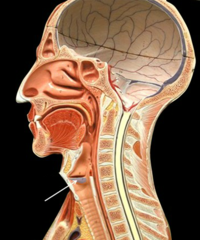
what is the bronchi?
the inferior end of the trachea branches into the left and right primary bronchi at the carina

what happens at the diametre of the bronchi tree?
the structure decreases (from primary bronchus to terminal bronchiole)
what happens to the epithelium as the diametre of the tree structure decreases?
the epithelium changes from ciliated pseudostratified columnar epithelium to ciliated columnar, simple columnar, ciliated cuboidal, to cuboidal
what happens to the cartilage as the diametre of the tree structure decreases?
changes from rings to plates, and eventually the distal bronchioles have no cartilage support
what happens to the bronchioles as the amount of cartilage decreases?
the amount of smooth muscles surrounding the bronchioles increases
what are the lungs surrounded by?
the parietal and visceral pleurae
what is the visceral pleura?
- covers the lungs themselves
- secretes pleural fluid
what is the parietal pleura?
- lines the walls of the thoracic cavity
- secretes pleural fleuid
what does the pleural cavity between the pleural membranes contain?
a friction reducing serous fluid that reduces friction between the membranes
what is the hilum?
the bronchi, pulmonary arteries, pulmonary veins, lymphatic vessels, and nerves enter and exit the lungs in this region

what is the lining of the respiratory bronchioles and smaller structures?
simple squamous epithelium
where does diffusion of oxygen and carbon dioxide take place?
across the respiratory membrane
what does the respiratory membrane consists of?
the alveolar wall, the basement membrane of the alveolar wall, and the basement membrane of the capillary, and the endothelium of the capillary
what is the function of the carina?
- the point where the trachea divide into the right and left main bronchi
- one of the most sensitive areas of the entire larynx and the trachea for triggering a cough reflex

what is the function of the main/primary bronchus?
conducts air from the trachea to the secondary bronchi

what is the function of the lobar/secondary bronchi?
conducts air from the primary bronchi to the lobes of the lungs

what are the functions of the terminal bronchiole?
- contains exocrine bronchiolar cells, which may protect against harmful effects of inhaled toxins and carcinogens, and function as stem cells which gives rise to various cells of the epithelium
- conducts air from the bronchioles to the respiratory bronchioles

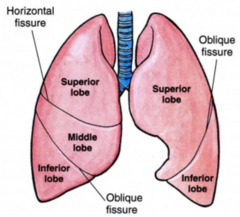
what are the lobes of the lung?
superior, middle, inferior
what is the function of the cartilage rings and plates?
help keep the airways open and prevent collapse during inhalation and exhalation

what is the function of the smooth muscle in the respiratory system?
regulate the diameter of the airways
what is the function of respiratory bronchioles?
- contains exocrine bronchiolar cells, which may protect against harmful effects of inhaled toxins and carcinogens, and function as stem cells which gives rise to various cells of the epithelium
- conducts air from the terminal bronchioles to the alveolar ducts
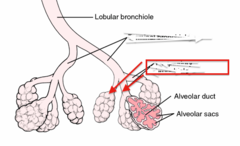
what are the functions of the alveolar duct?
- conduct air from the respiratory bronchioles to the alveolar sacs
- product surfactant to maintain patency
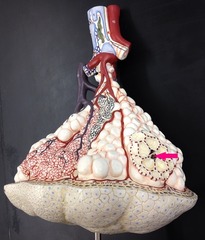
what is the function of the alveolar sac?
hold clusters of alveoli and each saccule contains about 20-30 pulmonary alveoli

what is the function of the alveoli?
main site of gas exchange in the lungs

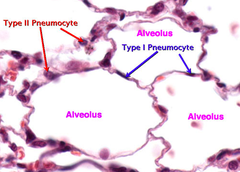
what are type 1 alveolar cells?
simple squamous epithelium lining the alveoli are the main site of gas exchange
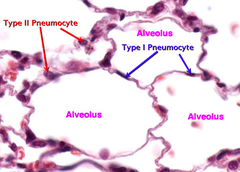
what are type 2 alveolar cells?
secrete alveolar fluid and surfactant
what is the function of the pulmonary arteriole?
carries deoxygenated blood from the pulmonary arteries to the pulmonary capillaries

what is the function of the pulmonary venule?
carries oxygenated blood from the pulmonary capillaries to the pulmonary veins

what is the function of the pulmonary capillary?
facilitate gas exchange between the air in the alveoli and the blood
what is emphysema?
destruction of the walls of the pulmonary alveoli, producing abnormally large air spaces that remain filled with air during exhalation

what is cellular respiration?
the process where cells require a constant, abundant supply of oxygen for cellular functions, and release carbon dioxide as a waste product
what is pulmonary ventilation?
the movement of air into and out of the lungs, ensuring that the gases in the alveoli are continuously refreshed
what is inhalation?
an active process involving contraction of the diaphragm ad the external intercostal muscles
what is exhalation?
usually a passive process, involving relaxation of the diaphragm and external intercostal muscles
what is the function of the diaphragm?
- contraction: causes it to flatten and increase vertical dimension of the thoracic cavity: resulting in inhalation
- relaxation: causes it to move superiorly and decreases vertical dimension of the thoracic cavity resulting in exhalation

what is the function of the external intercostals?
- contraction: elevates ribs and increases anteroposterior and lateral dimensions of thoracic cavity, resulting in inhalation
- relaxation: depresses ribs and decreases anteroposterior and lateral dimensions of thoracic cavity, resulting in exhalation

what is the function of the sternocleidomastoid?
elevate sternum during forced inhalation
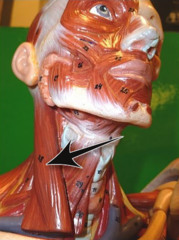
what is the function of the pectoralis minor?
elevates ribs 3-5 during forced inhalation when scapula is fixed

what is the function of the rectus abdominis?
compresses the abdomen to aid in forced exhalation

what is the function of the internal intercostals?
contraction draws adjacent ribs together to further decrease anteroposterior and lateral dimensions of thoracic cavity during forced exhalation

what is external respiration?
involves the movement of gas across the respiratory membrane
how does external respiration work?
air in the alveoli loses oxygen and gains carbon dioxide, while blood in the pulmonary capillaries gains oxygen and loses carbon dioxide
how does oxygen and carbon dioxide move?
according to the laws of diffusion, down their respective concentration gradient
what is internal respiration?
occurs throughout the body
how does internal respiration work?
oxygen diffuses out of the systemic capillaries into the interstitial fluid and into the tissue cells, and carbon dioxide diffuses from the tissue cells through the interstitial fluid into the systemic capillaries
what is the procedure that demonstrates quiet vs. forced breathing?
putting a measuring tape around a subject's chest and determine the increase/decrease of the circumference of the chest during quiet and forced breathing
what is the procedure that demonstrates respiratory rate?
having the subject sit down and count their respiratory cycle and then having the subject sit up and count their respiratroy cycle
why is there a different between respiratory rate when standing up compared to sitting down?
the respiratory rate is often slightly higher when standing compared to sitting due to increased muscular effort to maintain posture and greater oxygen demand when standing
what can influence an individual's respiratory volume?
- age
- sex
- size
- physical condition
what is a spirometre?
an instrument used to measure lung volumes and capcities to assess the health of the respiratory system
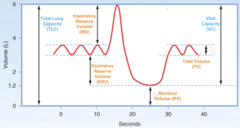
what is tidal volume (TV)?
the amount of air inhaled or exhaled during a single breath
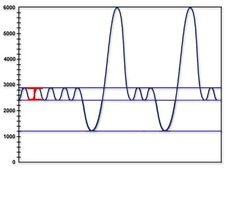
what is dead space?
the air that remains in the areas not lined by simple squamous epithelium and is unavailable for gas exchange
what 4 areas of the respiratory system contribute to dead space?
- nasal cavity
- pharynx
- larynx
- trachea
what is inspiratory reserve volume (IRV)?
the amount of air that can be inhaled in excess of a normal inhalation

what is expiratory reserve volume (ERV)?
the amount of air that can be forcefully expelled in excess of a normal exhalation
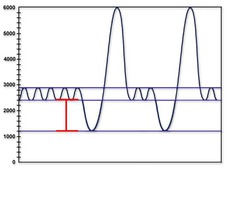
what is residual volume?
the amount of air remaining in the alveoli and airways after a forceful exhalation

what is vital capacity (VC)?
the total exchangeable air of the lungs, or the sum of TV + IRV + ERV, and will be measured as the maximum amount of air that can be exhaled after a maximal inhalation

what is total lung capacity?
the sum of vital capacity and residual volume

what are the numbers you need to memorize in lab?
in a male with a total lung capacity of 6000 mL, the tidal volume is 500 mL, vital capacity is 4800 mL, and the expiratory reserve volume is 1200 mL
why are tests involving forced exhalations (ERV and VC) important?
important in the detection of obstructive disorders such as asthma, bronchitis, and emphysema
what conditions is ERV reduced?
in conditions in which the elasticity of the lungs is reduced by a chronic obstructive pulmonary disease (COPD) like emphysema
what happens due to decreased elastic recoil?
energy must be used to deflate the lungs with every exhalation
what causes restricted airways?
excess mucous production and narrowed airways