Econ 4001.02 Test #2
 Call Kai
 Learn
 Practice Test
 Spaced Repetition
 Match
 Flashcards
 Knowt Play
1/53

There's no tags or description
Looks like no tags are added yet.
54 Terms
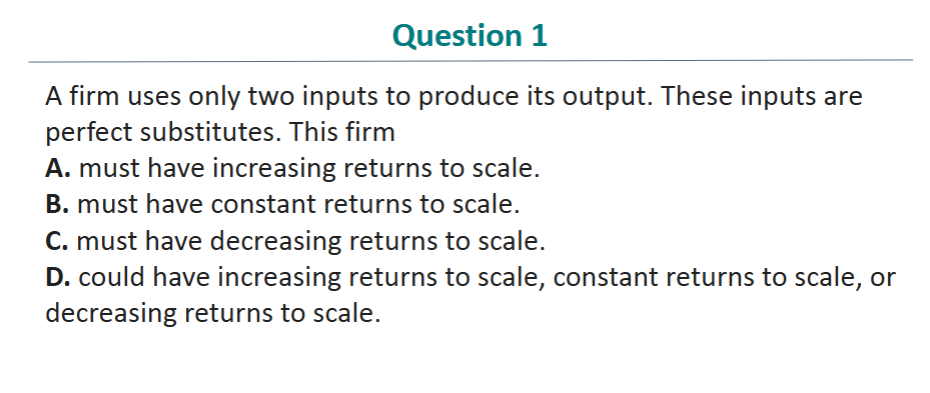
D, fk(x,x) - K could be positive (increasing) negative (decreasing) or 1 (constant)

D) For returns to scale Cobbs Douglas: a+b. For marginal product, take partial derivative of x, look at sign where (+) means increasing
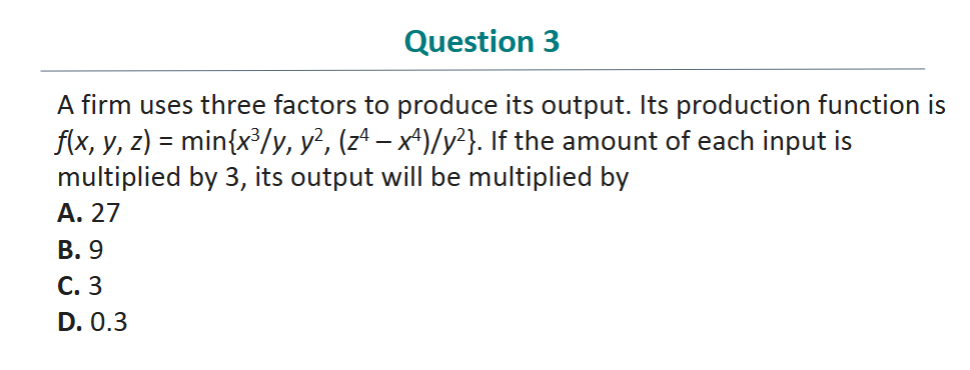
B) For this question, only need to solve for first value, plug in the multiplier and simplify

A)
B - thats what moving along an isoquant does
C - MPx or MPy are dependent on q
D - Slope of isoquant changes

C)
Factors out to k^bc. Compare that value to 1

D)
(p)(MP) = w (equilibrium, if higher the firm would hire more and vice versa)
Find MP of q
Use equation above
Substitute

C

Dumb Question

MP x P = w
Find MP, multiply by price of output and substitute

C)
Find MRTS (Use cobbs douglas trick)
Set equal to price ratio
Cross multiply

D)
Identify that these are perfect substitutes
Find MP of each
plug into MP x P = w, solve for x
Larger number = more output, plug that # into original function
DONT plug into both

B)
Set MRTS = to w1/w2
“3 Times” = 3x/x etc.
Cross multiply

C)
Find MC of each
set them equal to eachother and solve for y1
y1 + y2 = # of units
plug in y2 for y1, solve

B)
Recognize Cobbs-Douglass formula
Z^ ½ and (x + y)^ ½ both receive same amount

B)
Recognize the minimum - choose lower number
Add corresponding numbers

B)
Find MRTS
Set MRTS = Price ratio
Cross multiply, find relationship between M and L
Use initial function, put M in terms of L and set equal to total value produced
Find the value of L
Find M with new value of L
Plug into TC Functions (wL x L) + (wM x M)

A
Plug 4 in for M (states machines cannot change) to solve for L
Plug into TC function (wL x L) + (wM x M)

C)
Take integral ( + C is fixed cost)
plug in

D)
A - MC rises before even intersecting
B - MC rises afterwards as well
C - MC > ATC after minimum points (where it begins to rise)

A)
MC = P

B)
+ x is fixed cost
Divide q from VC to find AVC
Plug in 10

C)
Set P = ATC
Divide out TC by q to find ATC
Plug in values and solve for Q

C)
Set MRTS = Price Ratio
x1 in terms of x2
Plug back into production function (can split up #x2 to (#^) (x^)
Solve for y, put in terms of x2
Plug that value back into x1 = 36x2 (x2 part replaced) to find relationship between y and x1
Using the two relationships (x2 and y, x1 and y) plug back into production function and add
Take derivative of TC

B)
Short-run constraint, plug in value fo X2
Solve for X1
Plug into SRTC Function and simplify to find TC
Take derivative for MC
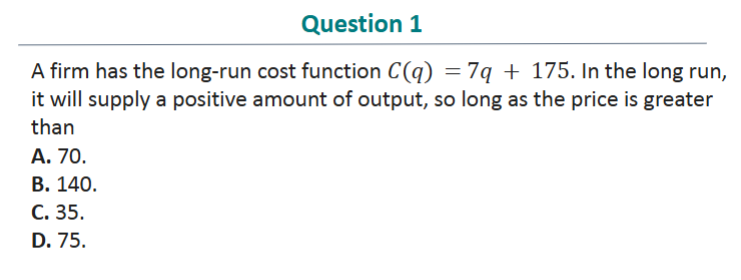
Question was flawed: makes more sense if it is 7q² + 175q

Find MC
Use to find supply curve (y=p/4)
Find AC, then take derivative and set = 0
Use that y value to plug back into AC

Short-run, operates if P > AVC

D)
Calculate the cost per cup for wages
add number to Pc

C)
Find MC of firm 1, plug in q
Set this value = MC of firm 2 and solve

A)
Realize its Compliments, x1 = 5x2
Set each = y (output values) and solve for x =
C = w1x1 + w2x2
Plug in values to solve in terms of y for cost
Find MC
Remember P = MC
Solve for y in terms of p

Find AVC of each (divide q from VC)
Find Derivative, set = 0
Plug Q back into AVC function to find AVC
Compare that AVC to value given for Market Price of sunglasses

C)
Find TC (given $ x [p x kilometer])
Find profit, (given $ - found value)
Multiply profit by total number of jars

B)
Find AC (divide q)
Find MC (take derivative)
Set AC = MC, find quantity for each firm
Find P = MC (already solved MC), plug in above value for Q
Plug value of P into Q function
Divide Qd/# of firms (found above)

A

D)
Invert Supply Curve
Take integral of p =

B)
Find MC of each term
Set equal to p, form: y = xP
Multiply by # of firms by value
Add the two together

B)
Set supply = demand

B)
Set supply = demand
Set supply (+ tax) = demand
Find difference

Set supply = demand
Set supply = demand (+ tax)
Find difference
Plug in values to DWL formula (½)(t)(Change in Q)
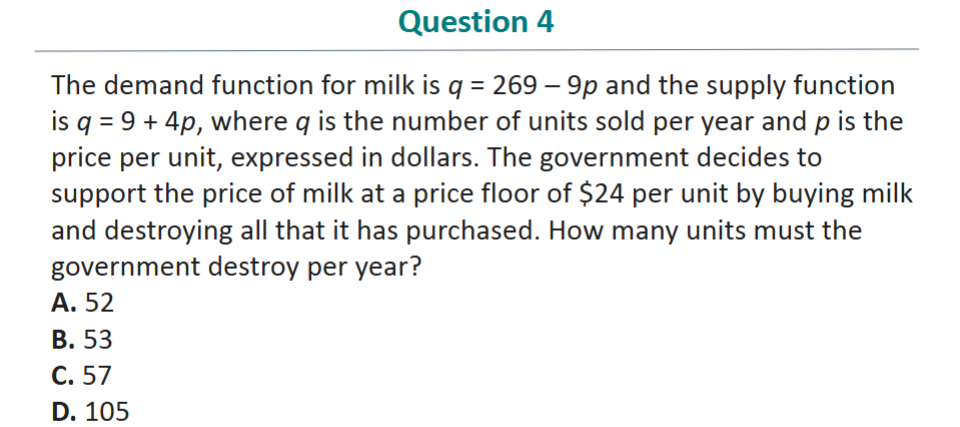
A)
Price floor = Insufficient Demand and too much supply
Plug in p, subtract

B)
DWL = ½ (2t) (Qt)
Here, doing anything to t also impacts Q, therefore impact is larger
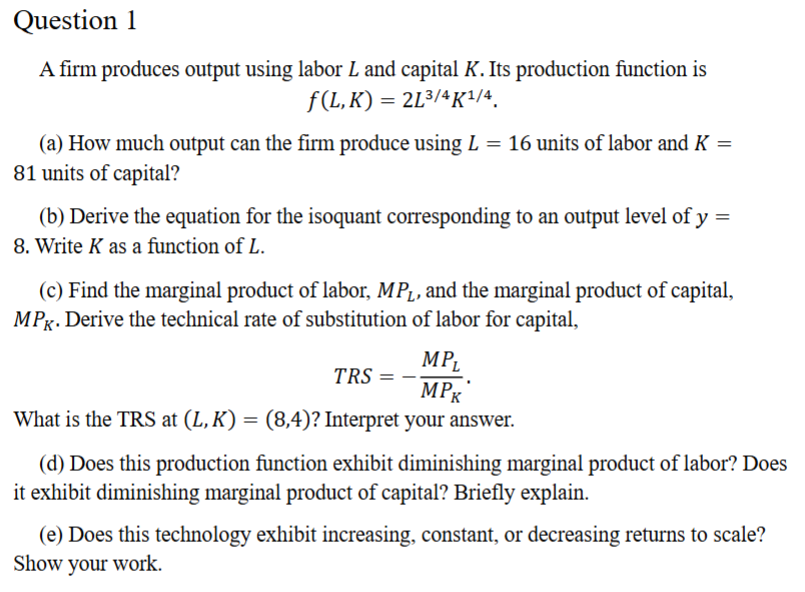
a)
Just plug in
b)
Set function = 8
Simplify, put in terms of K
c)
Cobbs Douglas Trick
means that firm can substitute 2 units of labor for 3 units of output and remain at the same level
d)
L = decreasing, derivative has a negative exponent
K = decreasing negative exponent
e)
Cobbs-Douglass, when exponents = 1, constant returns to scale

a)
Short run profit function; py - wL - rK
Plug in values, y = min{} (plug in K value as well)
b)
Plug in prices and values into previous equation
Answer: 12
c)
Compare prices of L, anything below 7 leads to a loss per worker added, the firm would not hire any

PERFECT SUBSTITUTES
a)
Plug in values for L and K
b)
Produce 100 with the cheaper option, (divide 100 by coeffecient)
c)
Compare new costs per unit
They are equal, any amount works

pt.1
a)
Find TRS and set equal to Price Ratio (w/r)
b)
Plug in L=… to initial function and isolate for K
Plug in K=… to initial function and isolate for L
c) fade

pt. 2
d)
Find quantity of labor and capital using the firms long run conditional demand functions for L and K
Multiply those values by the prices to get C
Add together
e)
Keep K constant this time and solve for L (using conditional demand function for L)
Multiply those values by the prices to get C
Add together

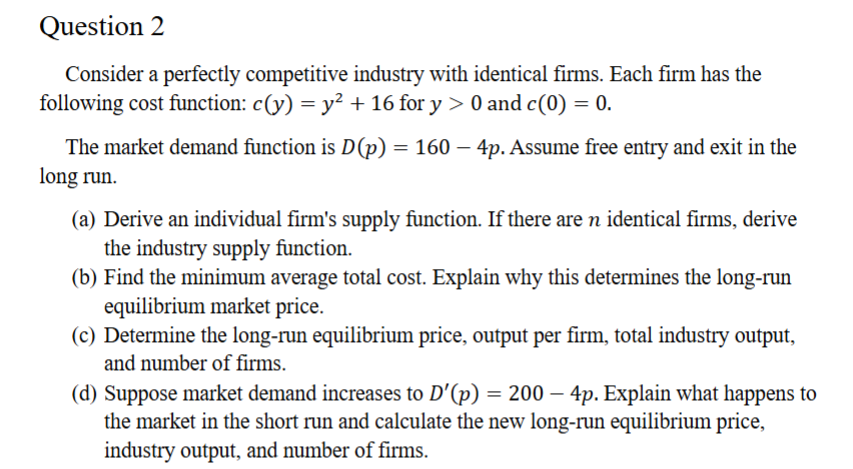


Set equal to output level
Use exponent so that one variable is itself
Divide out

B

C
A + B both act as if its a preference curve. Instead, with production functions, multiplication actually changes the technology involved (bc more had to be produced from somewhere)
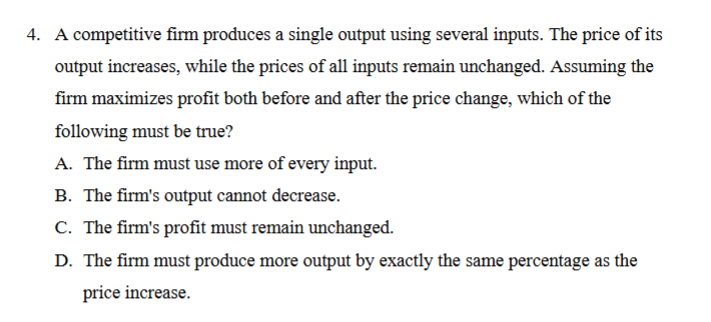
B
P = MC, so the firm will increase MC to get to new P, meaning output is increasing
A - “every” isnt necessarily true
C - Higher P = Higher profits
D - This is not true, the MRTS varies

Prices “between” 7 and 10 (aka not 7 or 10)
This means S3 will produce and S2 will not. S1 also produces
Add S3 and S1