Exam 4 - Organizing Species, Protists, Plants
 Call Kai
 Learn
Learn Practice Test
 Spaced Repetition
 Match
Match Flashcards
 Knowt Play
1/53

There's no tags or description
Looks like no tags are added yet.
Name | Mastery | Learn | Test | Matching | Spaced | Call with Kai | Chat |
|---|
No analytics yet
Send a link to your students to track their progress
54 Terms
What is taxonomy?
A field of biology concerned with identifying, naming, and classifying species.
What is phylogenetics?
The scientific study of evolutionary relationships among lineages and species.

Phylogenetic tree
Hypothetical evolutionary history showing the relationships between phylogenies
Outgroup
Species/lineage not closely related to any other member of the group understudy
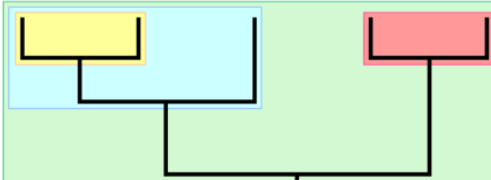
Sister groups
Two lineages that emerge from the same mode
Derived character
A trait shared by all members of clade that evolved in that clade’s common ancestor
Monophyletic group
A group including an ancestral derived character with all of its descendants

Polyphyletic group
A set of organisms that are grouped together based on similar traits, but do not include their most recent common ancestor.
Ex: Elephants, rhinoceroses, hippopotamuses, and tapirs and are group together in a single category because they share specific traits such as
Thick skin
Large heavy bodies
Herbivorous diets
What is the assumption of parsimony?
The simplest explanation that fits the evidence is the best one
What are derived traits?
Traits different from those of the group’s ancestor
The best phylogeny is the one that requires the ______ ______ _______
Fewest evolutionary changes
Homologous structures indicate _____ ______
Evolutionary relationships
Ex: Shared bone structure across reptiles, birds, and mammals
Analogous structures indicate fulfilling a similar __________ ____
Environmental niche
Ex: Appear via either convergence or reversal
Convergence
Developing similar structures due to pressures from environmental niche
Reversal
Loss of structure due to pressures from environmental niche
All organisms use the same:
Energy molecule
Nucleotides
Cell cycle
Phospholipid cell membranes
Oxygen for respiration
20 amino acids
All organisms are descended from a _____ _____?
Common ancestor
What is a cladogram?
Represents a hypothesis of relationships among organisms
What are some of the eukaryotic traits?
Multiple linear chromosomes inside a nucleus
Membrane-bound organelles
Mitochondria or mitochondria-derived organelles
What is the endosymbiont hypothesis?
Mitochondria and chloroplasts evolved from bacteria
What are some of the general protist traits?
Variety of organization strategies
Unicellular
Some are colonial (living as a collection of independent cells)
Multicellular
Most have typical eukaryotic organelles
List some more of the general protist traits
Most have a protective layer on their cell surface
Variety of locomotive strategies
Swimming with flagella
Swimming using cilia
Crawling around using pseudopods
Some don’t move at all
List some more of the general protist traits
Majority are free-living and aquatic
Some live in moist soil
Some live on or inside other organisms
List some more of the general protist traits
Most reproduce asexually when conditions are favorable then switch to sexual reproduction
Variety of lifecycles
Some are haploid
Some are diploid
Multicellular algae alternates between haploid and diploid forms
What are excavates? (Protist)
Unwalled cells with 1+ flagella
Have an “excavation” groove for feeding

What does the SAR supergroup stand for?
S: Stramenopiles
A: Alveolates
R: Rhizaria
What are characteristics of stramenopiles?
Have short anterior flagellum with hairlike extensions
Most are photosynthetic
What are the characteristics of the diatom lineage within stramenopiles?
They are photosynthetic with silica shell
What are the characteristics of brown algae and what group do they belong in?
Multicellular and photosynthetic
Stramenopiles
What are the characteristics of water molds and what group do they belong in?
Heterotrophic parasites with cellulose cell walls
Stramenopiles
What are the characteristics of alveolates?
Have sacs beneath their plasma membrane (may be empty or contain cellulose)
What are the characteristics of ciliates and what group do they belong in?
Heterotrophs covered in cilia
Have two nuclei (macro & micro)
Alvelolates
What are the characteristics of dinoflagellates lineage and what group do they belong in?
Have two flagella
Alveolates
What are the characteristics of apicomplexans lineage and what group do they belong in?
Parasites with a secretory vesicle complex on their cell apex
What are the characteristics of Rhizaria?
Nearly all are single-celled, marine heterotrophs with a protective shell
What are the characteristics of foraminifera lineage and what group do they belong in?
Shell is made of calcium carbonate
Most settle on bottom of the ocean among sediments
Rhizaria
What are the characteristics of radiolaria lineage and what group do they belong in?
Shell is made of silica
All live suspended in ocean water column (planktonic)
Rhizaria
What are the characteristics of Archaeplastids?
Have cellulose cell walls and chloroplasts with two membranes
What are the characteristics of radiolaria lineage and what group do they belong in?
Chloroplasts have chlorophyll a and red accessory pigments
Archaeplastids
What are the characteristics of green algae lineages and what group do they belong in?
Chloroplasts have both chlorophyll a and chlorophyll b
Land plants evolved from within these lineages
Archaeplastids
What are the characteristics of amoebozans?
Heterotrophs that moves using cytoplasm extensions (pseudopods)
Amoebas lineage
Single-celled
Most are predators, some are parasites
What are the characteristics of amoebas lineage and what group do they belong in?
Single-celled’
Most are predators, some are parasites
Amoebozoans
What are the characteristics of slime molds lineage and what group do they belong in?
Live as an aggregation of individual cells (cellular) or as a multinucleated mass (plasmodial)
Amoebozoans
What are the characteristics of opisthokonts?
Heterotrophs
Choanoflagellates lineage
Most are single-celled with a flagellum surrounded by a “collar” or threadlike projections
Animals evolved from within this lineage
What are the general plant traits?
All are multicellular
All have cell walls made of cellulose
All have chloroplasts with two membranes
All store sugars as starch
All form and develop their embryos within a chamber composed of maternal tissues (embryophytes)