Unit 1: Motion in 1-D and 2-D Test Review
 Multiple Choice & FRQ
 Call Kai
1/29

Earn XP
30 Terms
If one object has a greater speed than a second object, does the first necessarily have a greater acceleration? Explain, use an example.
No, because acceleration is the rate of change of velocity over time while speed is how fast an object is moving at a specific time. An object can have a low speed with a high acceleration or an acceleration of 0 with a high speed. If a car is traveling at a pace of 50 mph without changing direction or speed, its acceleration is 0. A car can go from rest and accelerate to 20 mph, causing it to have a greater acceleration.
Can the velocity of an object be negative when its acceleration is positive? What about vice versa? Explain, use an example.
Yes, a car can move left or backwards (negative direction) but can still have a positive acceleration if it is going in the positive direction (forward or right). An example would be a car rolling down the driveway (making its velocity negative as it is traveling in the negative direction), but it can have a positive acceleration when the driver presses the gas to move forward or hits the breaks. It slows down and stops. A car can have a positive direction if the car is moving forward but a negative acceleration when the driver brakes as the deceleration is backward.
Can an object be increasing its speed as its acceleration decreases? Explain, use an example.
Yes, but the acceleration must stay positive and the object’s speed will increase. The object’s rate in which its speed is increasing becomes smaller during a negative acceleration.
Can an object have zero velocity and a nonzero acceleration at the same time? Explain, use an example.
Yes, it means the object is changing its direction while being stopped for a quick instant. As long as its in the process of going from negative velocity to positive velocity, or vice versa. An example would be throwing a ball upwards. The entire time, gravity will pull it downwards. When it reaches max height, the velocity is 0 and acceleration is -9.8m/s/s even if it’s not moving at that exact second.
Two cannonballs, A and B are fired from the ground with identical initial speeds, but with 𝚹A larger than 𝚹B. Which cannonball reaches a higher elevation? Which stays in the air longer? Which travels farther? Explain.
Two vectors have a length of V1=3.5 km and V2= 4.0 km. What are the maximum and minimum magnitudes of their vector sum?
In which of the following cases does a car have a negative velocity and a positive acceleration? A car is traveling in the…
-x direction at a constant 20 m/s
-x direction increasing in speed
+x direction increasing in speed
-x direction decreasing in speed
+x direction decreasing in speed
A ball is thrown straight up, What are the velocity and acceleration of the ball at the highest point in its path?
v = 0 , a = 0
v = 0 , a = 9.8 m/s/s up
v = 0 , a = 9.8 m/s/s down
v = 9.8 m/s/s up , a = 0
You drop a rock off a bridge. When the rock has fallen 4m, you drop a second rock. As the two rocks continue to fall, what happens to their velocities?
Both increase at the same rate
The velocity of the first rock increases faster than the velocity of the second rock
The velocity of the second rock increases faster than the velocity of the first rock
Both velocities stay constant
A ball is dropped from the top of a tall building. At the same instant, a second ball is thrown upward from the ground level. When the two balls pass one another, one on the way up and one on the way down, compare the magnitudes of their acceleration:
The acceleration of the dropped ball is greater
The acceleration of the ball thrown upward is greater
The acceleration of both balls is the same
The acceleration changes during the motion so you cannot predict the exact value when the two balls pass each other
The accelerations are in opposite directions
The magnitude of a component vector must be
Less than or equal to the magnitude of the vector
Equal to the magnitude of the vector
Greater than or equal to the magnitude of the vector
Less than, equal to, or greater than the magnitude of the vector
One ball is dropped vertically from a window. At the same instant, a second ball is thrown horizontally from the same window. Which has greater speed at ground level?
The dropped ball
The thrown ball
Neither, they both have the same speed on impact
It depends on how hard the ball was thrown
A car is driven 225 km west and then 98 km southwest (45°). What is the displacement of the car from the point of origin (magnitude and direction)? Hint: Draw a diagram.
235.4 km
245.4 km
302.3 km Total displacement of 294.3 km west and 69.3 km south
323 km
The summit of a mountain is 2450 m above base camp. The horizontal distance between camp and the summit is 4580 m. What is the actual distance (in a straight line) between the base camp and the summit?
7030 m
6108.3 m
5305 m
5194.1 m
A tiger leaps horizontally from a 7.5 m high rock with a speed of 3.0 m/s. How far from the base of the rock will she land?
1.24 m
1.53 m
3.67 m
4.59 m
A rescue plane wants to drop supplies to isolated mountain climbers on a rocky ridge 235 m below. If the plane is traveling horizontally with a speed of 250 km/hr (69.4m/s), how far in advance of the recipients (horizontal distance) must the goods be dropped?
6.93 m
36.08 m
475.78 m
1731.3 m
If you are driving at 95 km/h along a straight road and you look to the side for 2.0 s, how far do you travel during this inattentive period?
52.8 m
95 m
190 m
209.6 m
You are driving home from school steadily at 95 km/hr for 180 km. It then begins to rain and you slow to 65 km/hr. You arrive home after driving 4.5 hr. How far is your hometown from school?
349 km
404 km
440 km
472.5 km
A car traveling 95 km/hr is 210 m behind a truck traveling 75 km/hr. How long will it take the car to reach the truck?
1.2 hr
37.8 sec
2.8 min
10.5 days
At highway speeds, a particular automobile is capable of an acceleration of about 1.8 m/s/s. At this rate, how long would it take for the car to accelerate from 65 m/s to 120 m/s?
30.6 s
99 s
102.8 s
333 s
The best rebounders in basketball have a vertical leap of 120 cm. (a) What is their initial launch speed off the ground? (b) How long are they in the air?
A bowling ball traveling with a constant speed hits the pins at the end of a bowling lane 16.5 m long. The bowler hears the sound of the ball hitting the pins 2.80 s after the ball is released from his hands. What is the speed of the ball, assuming the speed of sound is 340 m/s?
Calculate (a) how long it took King Kong to fall straight down from the top of the Empire State Building (380 m high), and (b) his velocity just before landing.
A projectile is fired with an initial speed of 36.6 m/s at an angle of 42.2° above the horizontal on a long flat firing range. Determine (a) the maximum height reached by the projectile, (b) the total time in the air, and (c) the total horizontal distance covered.
An object starts from rest and falls under the influence of gravity. Draw graphs of (a) its speed and (b) the distance it has fallen, as a function of time from t = 0 to t = 5.00 s. Ignore air resistance.

Answer each of the following questions for each position vs. time graph.
Which object is traveling the fastest?
Which object starts furthest away for x = 0?
Which objects are accelerating?
Which objects are not moving?
Which objects move in a positive direction?

Answer each of the following questions for each position vs. time graph.
Which object is traveling the fastest?
Which object starts furthest away for x = 0?
Which objects are accelerating?
Which objects are not moving?
Which objects move in a positive direction?
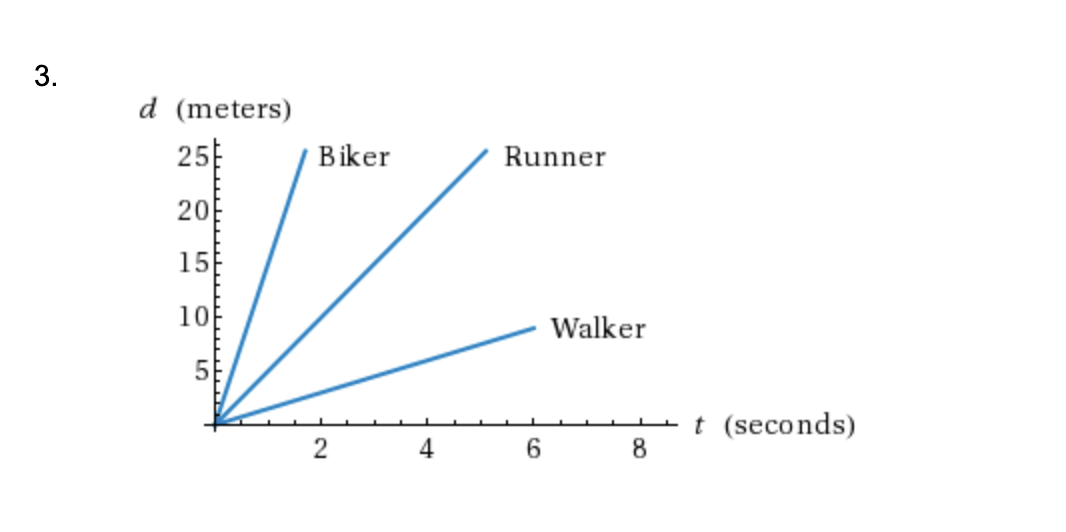
Answer each of the following questions for each position vs. time graph.
Which object is traveling the fastest?
Which object starts furthest away for x = 0?
Which objects are accelerating?
Which objects are not moving?
Which objects move in a positive direction?

Answer each of the following questions for each position vs. time graph.
Which object is traveling the fastest?
Which object starts furthest away for x = 0?
Which objects are accelerating?
Which objects are not moving?
Which objects move in a positive direction?

Answer each of the following questions for each position vs. time graph.
Which object is traveling the fastest?
Which object starts furthest away for x = 0?
Which objects are accelerating?
Which objects are not moving?
Which objects move in a positive direction?