Biology unit test 1
 Call Kai
 Learn
Learn Practice Test
 Spaced Repetition
 Match
Match Flashcards
 Knowt Play
1/300

There's no tags or description
Looks like no tags are added yet.
Name | Mastery | Learn | Test | Matching | Spaced | Call with Kai | Chat |
|---|
No analytics yet
Send a link to your students to track their progress
301 Terms
What are independent and dependent variables? (Which thing is changed, and which result is measured?)
Independent: factor changed/predictor, on x-axis. Dependent: measured result, on y-axis.
What is a correlational study? (How do researchers check whether two things are related?)
Checks whether two or more numerical variables are related.
Does correlation prove that one variable causes another? (If two things change together, does one definitely cause the other?)
No.
Does science already explain everything perfectly?
No. explanations can improve when new evidence appears.
Are scientific methods completely free from bias or error? (Can research still be unfair or contain mistakes?)
No. careful methods help reduce both.
What is animal physiology? (What does studying how animal bodies work mean?)
The study of how animal bodies work.

What is homeostasis? (What does keeping conditions steady inside the body mean?)
Keeping conditions inside the body stable.
How do breathing, circulation, and digestion work together?
Digestion supplies nutrients. lungs supply oxygen. blood carries both to cells.
What is breathing?
Moving air into and out of the lungs.
What is cellular respiration and its word equation? (How do cells get usable energy, and what goes in and comes out?)
Cells release usable energy: glucose + oxygen -> carbon dioxide + water + energy.
Where does most aerobic cellular respiration happen? (Where inside a cell does most energy release using oxygen happen?)
In the mitochondria inside cells.
What are metabolic needs? (What does the amount of energy an animal needs mean?)
How much energy an organism needs to stay alive and work.
What three factors affect respiratory system complexity? (What affects how simple or complicated an animal's breathing system is?)
Metabolic needs, body size, and environment.
What is gas exchange? (What does exchanging oxygen and carbon dioxide mean?)
Oxygen and carbon dioxide moving between an organism and its surroundings.
What is diffusion? (How do particles spread from where there are more to where there are fewer?)
Particles moving from a higher concentration to a lower concentration.
What is a concentration gradient? (What does a difference in the amount of a substance mean?)
A difference in concentration between two places.
What makes a gas exchange surface efficient? (What helps oxygen and carbon dioxide cross a surface quickly?)
A large, thin, moist surface and a concentration gradient.
Why must gas exchange surfaces be moist, thin, and large? (Why do these surfaces need to be wet, thin, and have lots of area?)
Moist: gases dissolve. Thin: short diffusion distance. Large: more gas crosses at once.
How do earthworms breathe?
Oxygen diffuses through moist skin into blood. carbon dioxide diffuses out.
What does the clitellum do?
Thick earthworm band that helps form the egg cocoon.
What do the setae do?
Small earthworm bristles that grip surfaces during movement.
What breathing system do insects use?
A tracheal system of branching air tubes.
What do the spiracles do? (What is the job of the insect's small breathing openings?)
Small insect body openings that let air enter and leave.
What do the tracheae do? (What is the job of the insect's branching air tubes?)
Branching air tubes that carry air through an insect.
What do the tracheoles do? (What is the job of the insect's smallest air tubes?)
Tiny air tubes delivering oxygen close to insect cells.
What do the insect air sacs do?
Enlarged air spaces helping move and store air.
Where are dorsal, lateral, and ventral tracheal tubes? (Where are the air tubes on the back, sides, and underside?)
Dorsal = back. lateral = sides. ventral = underside.
What does the ovipositor do?
Structure used by a female insect to lay eggs.
What is the path of air in an insect?
Spiracles -> tracheae -> tracheoles -> cells.
Do insects need blood to carry oxygen?
No. their air tubes deliver oxygen directly to cells.
What limits how large insects can grow?
Their air tube system must get enough oxygen to all cells.
Why could some prehistoric insects grow much larger?
Higher atmospheric oxygen helped their air tubes supply larger bodies.
How do fish exchange gases?
Gills take oxygen from water into blood and release carbon dioxide into water.

What do the gill filaments do?
Feathery structures providing a large surface for gas exchange.

What does the gill arch do?
Supports the gill filaments.

What do the gill rakers do?
Help filter particles near the gills.
Why do gill filaments contain many blood vessels?
Blood carries oxygen away and brings carbon dioxide to the gills.
What is concurrent flow? (What does flowing together in the same direction mean?)
Two fluids moving in the same direction.
What is countercurrent flow in fish gills? (How do water and blood move compared with each other?)
Water and blood flow in opposite directions.
Why is countercurrent flow useful in fish gills? (Why does flowing in opposite directions help fish take in oxygen?)
Water stays richer in oxygen than nearby blood, so oxygen keeps entering blood.
What happens if blood flows through gills but fresh water stops?
Oxygen uptake drops because the oxygen gradient gets smaller.

What does the carapace do?
Hard covering protecting the crayfish body and gills.

What does the rostrum do?
Pointed extension between the eyes that helps protect the head.

What do the antennae and antennules do?
Feelers that sense the surroundings.

What does the cheliped do?
Claw-bearing leg used to grab food and defend the crayfish.

What do the swimmerets do?
Small abdominal appendages used in swimming and reproduction.

What do the telson and uropods do?
Form the tail fan used to steer and move backward.

How do crayfish exchange gases?
Through gills under their body covering.
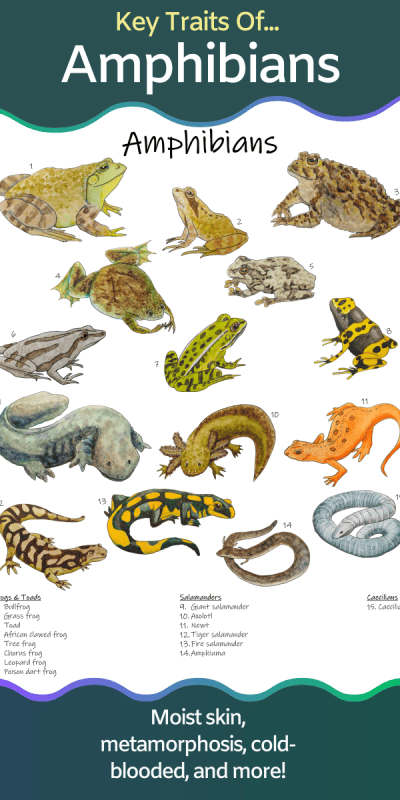
What are amphibians?
Animals such as frogs, toads, and salamanders.
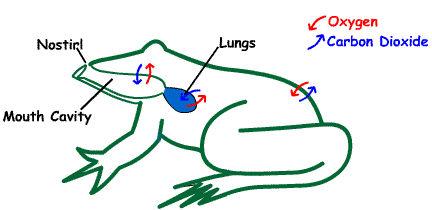
How do adult frogs exchange gases?
Through moist skin, lungs, and the mouth lining.
How do tadpoles usually exchange gases?
Through gills.
Why can frogs exchange gases in wet mud?
Gases diffuse through their moist skin into nearby blood vessels.
Why are frog lungs less efficient than mammal lungs? (Why do frog lungs exchange gases less effectively?)
They have a smaller gas exchange surface area.
How do bird air sacs help breathing?
They keep fresh air moving through the lungs during inhaling and exhaling.
Which direction does air mainly move through bird lungs?
One direction.
How many breathing cycles move one batch of air through a bird's system?
Two complete cycles: two inhales and two exhales.
What type of exchange do bird lungs use? (How is blood flow arranged compared with airflow?)
Crosscurrent exchange. blood flow crosses the airflow.
What do the lungs do?
Exchange oxygen and carbon dioxide between air and blood.
What protects the lungs from damage and foreign matter? (What keeps lungs safe from injury, dust, and other unwanted material?)
Ribs protect them. nasal hairs filter particles. mucus traps dirt. warmed, moist air protects tissue.
What does the nasal cavity do?
Filters, warms, and moistens incoming air.
What are cilia in the airways?
Tiny moving hairs that sweep mucus toward the throat.
What does the mouth/oral cavity do?
Another opening for air to enter and leave.
What does the pharynx do? (What is the job of the shared throat passage?)
Throat passage shared by air and food.
What does the epiglottis do? (What does the flap near the airway do when you swallow?)
Flap helping stop food entering the airway during swallowing.
What does the larynx do? (What is the job of the voice box?)
Voice box containing the vocal cords.
What does the glottis do?
Opening between the vocal cords where air passes.
What do the vocal cords do?
Vibrate as outgoing air passes, making sound.
How do vocal cords make sound?
Air moving out of the lungs makes them vibrate.
What does the trachea do?
Windpipe carrying air toward the bronchi.
What keeps the trachea from collapsing?
Rings of cartilage.
What do the bronchi do?
Two main air tubes carrying air into the lungs.
What do the bronchioles do?
Small branches carrying air toward the alveoli.
What do the alveoli do?
Tiny grape-like air sacs where air and blood exchange gases.
What do the pulmonary capillaries do? (What is the job of the tiny blood vessels around the lung air sacs?)
Tiny vessels around alveoli where blood gains oxygen and loses carbon dioxide.
What does the pleural membrane do? (What is the job of the thin covering around the lungs?)
Covers lungs and lines the chest wall. its fluid reduces friction.
What does pleural fluid do?
Reduces friction as the lungs move during breathing.
What does the thoracic cavity do? (What does the chest space contain?)
Chest space containing the heart and lungs.
What do the intercostal muscles do? (What is the job of the muscles between the ribs?)
Muscles between ribs that move the rib cage during breathing.
What does the diaphragm do?
Muscle below lungs. moving down draws air in, relaxing upward helps air leave.
What is the path of inhaled air?
Nose or mouth -> pharynx -> larynx -> trachea -> bronchi -> bronchioles -> alveoli.
What is the path of exhaled air?
Alveoli -> bronchioles -> bronchi -> trachea -> larynx -> pharynx -> nose or mouth.
What happens during inhalation? (What happens when you breathe in?)
Diaphragm contracts downward. ribs move up/out. chest volume increases. pressure drops. air enters.
What happens during normal exhalation? (What happens when you breathe out normally?)
Diaphragm relaxes upward. ribs move down/in. chest volume decreases. pressure rises. air leaves.
How do pressure and volume relate during breathing? (How does changing chest space affect air pressure?)
More volume means lower pressure. less volume means higher pressure.
How does gas exchange happen between alveoli and blood? (How do oxygen and carbon dioxide move between air sacs and blood?)
Gas exchange: oxygen diffuses from alveoli into blood. carbon dioxide diffuses from blood into alveoli.
How does blood change as it passes through lung capillaries?
Arrives oxygen-poor/CO2-rich. leaves oxygen-rich/CO2-poor.
Why does oxygen enter blood at the alveoli?
It diffuses from higher oxygen concentration in alveolar air to lower concentration in arriving blood.
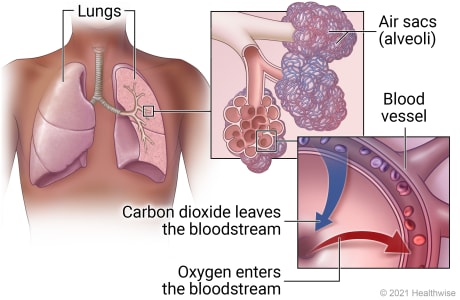
Why does carbon dioxide enter alveoli from blood?
It diffuses from higher concentration in arriving blood to lower concentration in alveolar air.
What makes alveoli good at gas exchange?
Large surface area, moist thin walls, and many capillaries.
What is hemoglobin?
An iron-containing red blood cell protein. oxygen binds to its iron.
What is oxyhemoglobin? (What is hemoglobin called when oxygen is attached?)
Hemoglobin with oxygen attached: hemoglobin + oxygen
How many oxygen molecules can one hemoglobin molecule carry? (How many oxygen molecules fit on one oxygen-carrying protein?)
Four.
Why does hemoglobin release oxygen near body cells?
Those cells have a lower oxygen level.
Where does oxygen go after leaving blood at body tissues?
Through capillary walls into cells, then to mitochondria.
What does deoxygenated mean? (What does having less oxygen mean?)
Having relatively little oxygen.
How is most carbon dioxide carried in blood?
As bicarbonate ions.
How does carbon dioxide become bicarbonate? (How is carbon dioxide changed into the form mostly carried in blood?)
CO2 + H2O
What happens to bicarbonate at the lungs?
It is changed back into carbon dioxide, which is breathed out.
What are obstructive and restrictive respiratory diseases? (What is the difference between blocked airflow and limited lung expansion?)
Obstructive: reduced airflow, especially out. Restrictive: reduced lung expansion.
What is emphysema?
An obstructive lung disease that damages alveoli and reduces lung elasticity.