PHYSICS
 Call Kai
 Learn
 Practice Test
 Spaced Repetition
 Match
 Flashcards
 Knowt Play
1/11

Earn XP
Description and Tags
Level 1-- Operation Projectile Precision. How can we predict motion?
12 Terms

THE AVERAGE VELOCITY of an object is=
the total displacement DIVIDED by the total time of an object’s movement

AVERAGE VELOCITY=
initial velocity + final velocity DIVIDED BY 2

CHANGE IN VELOCITY=
final velocity SUBTRACTED by the initial velocity

ACCELERATION=
change in velocity (final velocity SUBTRACTED by the initial velocity) DIVIDED by time

CHANGE IN DISPOSITION=
final disposition SUBTRACTED by the initial disposition
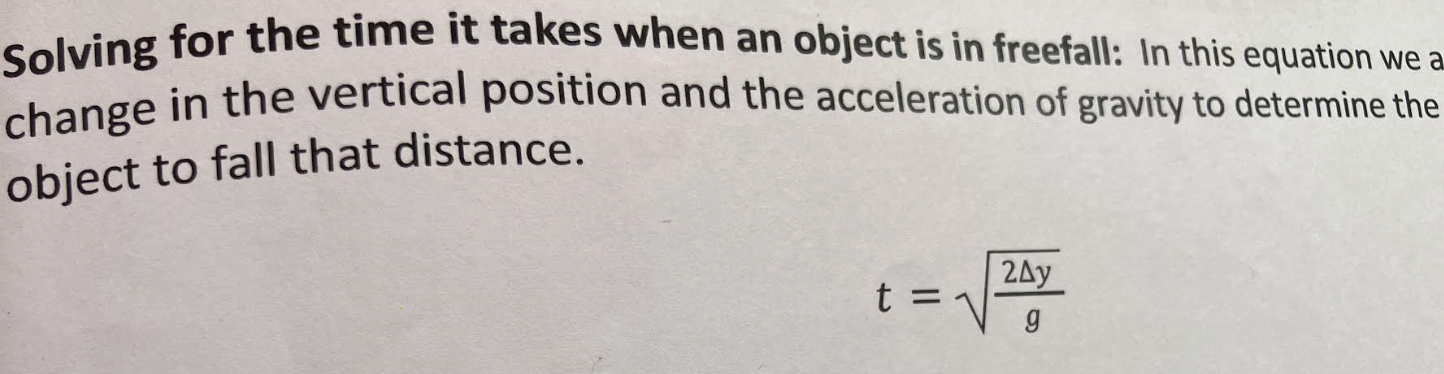
TIME=
the SQUAREROOT of 2 MULTIPLIED by the change of disposition DIVIDED by gravity

Definition of DISPLACEMENT (x)
a vector quantity that refers to an object’s overall change in horizontal position
Definition of DISPOSITION (y)
a vector quantity that refers to an object’s overall change in vertical position

Acceleration {think sudden bursts of speed!}
velocity’s rate of change
Newton’s First Law {N1L}
Objects in motion stay in motion and objects at rest stay at rest
Newton’s Second Law {N2L and think F= ma}
Mass tends to resist acceleration and force tends to support acceleration
Newton’s Third Law {N3L}
For every action, there is an equal in magnitude and opposite in direction reaction