Axis of Symmetry and Vertex, Vertex Form of a Quadratic Equation
 Call Kai
 Learn
 Practice Test
 Spaced Repetition
 Match
 Flashcards
1/40

Earn XP
Description and Tags
41 Terms
Axis of Symmetry
The line that splits a quadratic equation at the point of symmetry is called
a
In the expression ax² + bx + c, which value determines how the parabola opens?
Vertex
What is the point at which the parabola begins to change direction?
Minimum
If a quadratic equation opens upward, is the vertex a maximum or minimum?
x
Is the axis of symmetry the x value of the vertex or the y value of the vertex
x = 2
What is the axis of symmetry for the quadratic equation x² - 4x + 6 = 0?
(2, 2)
What is the vertex for the quadratic equation x² - 4x + 6 = 0?
Minimum
Is the vertex for the quadratic equation x² - 4x + 6 = 0 a max or a min?
x = 0
What is the axis of symmetry for the quadratic equation y = x² + 2?
(0, 2)
What is the vertex for the quadratic equation y = x² + 2?
Down
Will the graph for the quadratic equation f(x) = -2x² + 8x - 3 open up or down?
x = -2
What is the axis of symmetry in the graph shown?

(-2, -1)
What is the vertex in the graph shown?
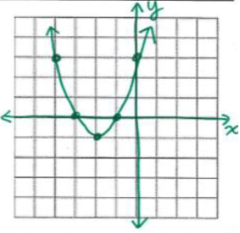
(0, 1)
What is the vertex in the graph shown?

x = -1
What is the axis of symmetry in the graph shown?
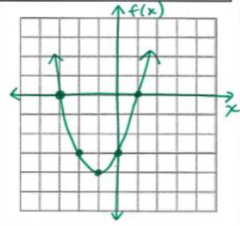
(-1, -4)
What is the vertex in the graph shown?

(0, -4)
What is the vertex in the graph shown?

(3,4)
What are the coordinates of the Vertex of
the function: f(x) = (x - 3)² + 4
(-5, -17)
What are the coordinates of the Vertex of
the function: f(x) = -2(x + 5)² - 17
(5, -17)
What are the coordinates of the Vertex of
the function: f(x) = 3(x - 5)² - 17
(-3, 4)
What are the coordinates of the Vertex of
the function: f(x) = (x + 3)² + 4
5
In the function f(x) = (x - 1)² + 5, the minimum value occurs when x is:
-8
In the function f(x) = (x + 4)² - 8, the minimum value occurs when x is:
-10
In the function f(x) = -(x + 3)² - 10, the maximum value occurs when x is:
13
In the function f(x) = -2(x - 6)² + 13, the maximum value occurs when x is:
f(x) = (x - 6)² - 29
Rewrite f(x) in vertex form by completing the square. f(x) = x² - 12x +7
f(x) = (x - 3)² - 4
Rewrite f(x) in vertex form by completing the square. f(x) = x² - 6x + 5
f(x) = (x - 6)² - 45
Rewrite f(x) in vertex form by completing the square. f(x) = x² - 12x - 9
f(x) = (x - 3)² - 20
Rewrite f(x) in vertex form by completing the square. f(x) = x² - 6x - 11
f(x) = (x + 5)² - 28
Rewrite f(x) in vertex form by completing the square. f(x) = x² +10x - 3
f(x) = -(x - 5)² + 33
Rewrite f(x) in vertex form by completing the square. f(x) = -x² +10x +8
f(x) = -(x + 7)² - 10
Rewrite f(x) in vertex form by completing the square. f(x) = -x² - 14x - 59
f(x) = 2(x - 4)² - 47
Rewrite f(x) in vertex form by completing the square. f(x) = 2x² - 16x - 15
f(x) = 3(x + 2)² - 1
Rewrite f(x) in vertex form by completing the square. f(x) = 3x² +12x + 11
f(x) = -3(x - 4)² + 7
Rewrite f(x) in vertex form by completing the square. f(x) = -3x² +24x - 41
f(x) = 2(x + 5)² - 37
Rewrite f(x) in vertex form by completing the square. f(x) = 2x² + 20x + 13
f(x) = (x - 1)² +6
Rewrite f(x) in vertex form by completing the square. f(x) = x² - 2x + 7
f(x) = (x + 2)² - 4
Rewrite f(x) in vertex form by completing the square. f(x) = x² + 4x
f(x) = (x + 3)² - 32
Rewrite f(x) in vertex form by completing the square. f(x) = 3x² +18x - 5
f(x) = -(x + 5)² + 24
Rewrite f(x) in vertex form by completing the square. f(x) = -x² - 10x - 1
f(x) = (x - 1)² - 6
Rewrite f(x) in vertex form by completing the square. f(x) = x² - 2x - 5